
Pulp Fiction, 1920 · page 58 of 156
Argosy, Vol. 123, No. 1 — page 58: what you’re looking at
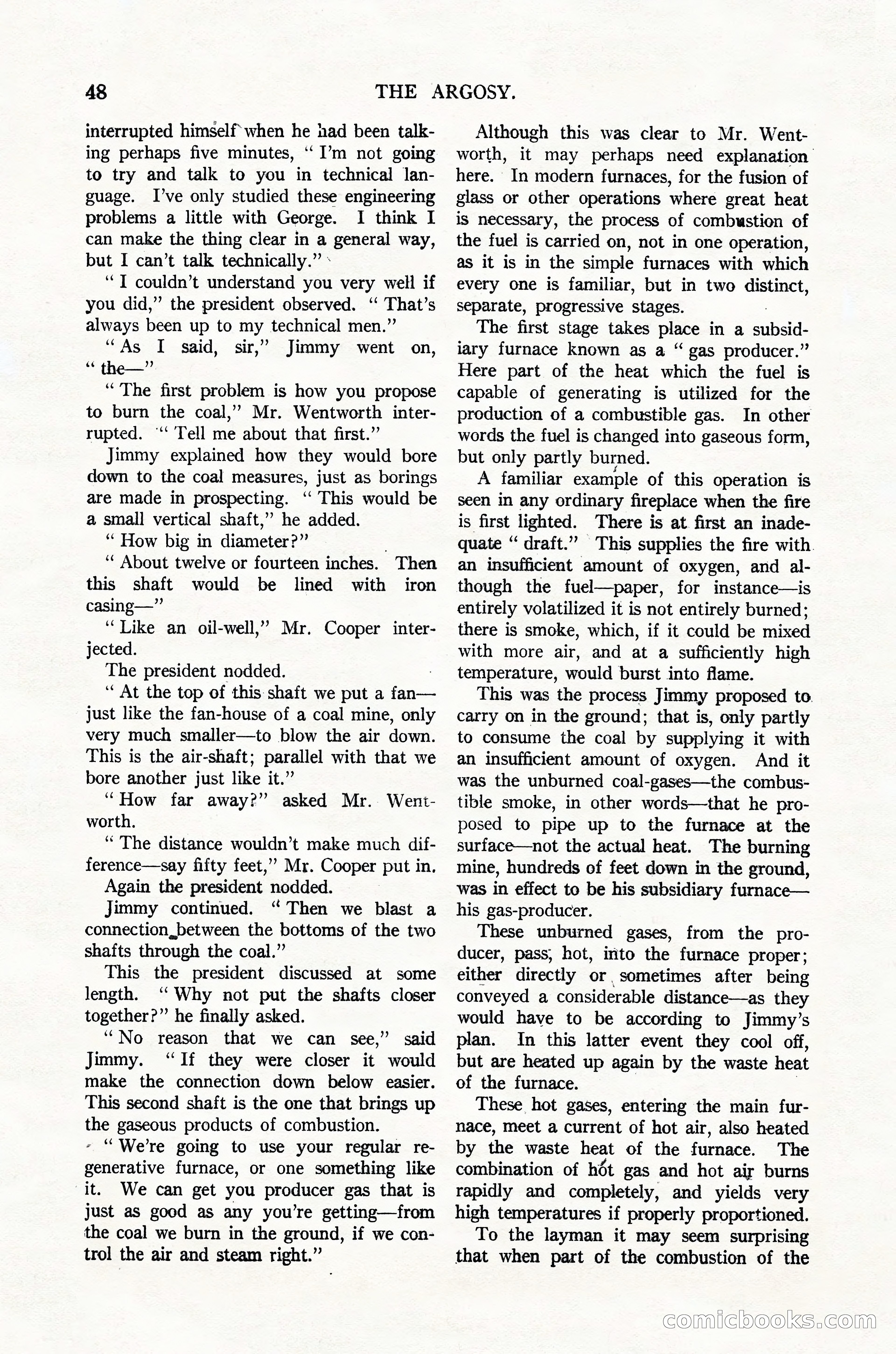
A restored page from Pulp Fiction, 1920. Page through the whole issue in the reader above.
📄 Transcribed text from this page (OCR, searchable)
Machine-transcribed from the original scan — historical spelling and the odd misread are preserved.
48 THE interrupted himself when he had been talk- ing perhaps five minutes, ‘‘ I’m not going to try and talk to you in technical lan- guage. I’ve only studied these engineering problems a little with George. I think I can make the thing clear in a general way, but I can’t talk technically.” * ‘“T couldn’t understand you very well if you did,” the president observed. ‘‘ That’s always been up to my technical men.” ‘““As I said, sir,” Jimmy went on, ce the—=”’ “The first problem is how you propose to burn the coal,’ Mr. Wentworth inter- rupted. “‘ Tell me about that first.” Jimmy explained how they would bore down to the coal measures, just as borings are made in prospecting. ‘‘ This would be a small vertical shaft,” he added. ‘ How big in diameter?” “ About twelve or fourteen inches. Then this shaft would be lined with iron casing—”’ “Like an oil-well,” Mr. jected. The president nodded. : ‘“ At the top of this shaft we put a fan— just like the fan-house of a coal mine, only very much smaller—to blow the air down. This is the air-shaft; parallel with that we bore another just like it.” ‘““How far away?” asked Mr. worth. ‘“ The distance wouldn’t make much dif- ference—say fifty feet,’ Mr. Cooper put in. Again the president nodded. 7 Jimmy continued. “Then we blast a connection, between the bottoms of the two shafts through the coal.” This the president discussed at some length. ‘‘ Why not put the shafts closer together?” he finally asked. ‘“No reason that we can see,” said Jimmy. “If they were closer it would make the connection down below easier. This second shaft is the one that brings up the gaseous products of combustion. - “We're going to use your regular re- generative furnace, or one something like it. We can get you producer gas that is just as good as any you're getting—from the coal we burn in the ground, if we con- trol the air and steam right.” Cooper inter- - Went- ARGOSY. Although this was clear to Mr. Went- worth, it may perhaps need explanation here. In modern furnaces, for the fusion of glass or other operations where great heat is necessary, the process of combustion of the fuel is carried on, not in one operation, as it is in the simple furnaces with which every one is familiar, but in two distinct, separate, progressive stages. The first stage takes place in a aubai lary furnace known as a “ gas producer.” Here part of the heat which the fuel is capable of generating is utilized for the production of a combustible gas. In other words the fuel is changed into gaseous form, but only partly burned. A familiar example of this operation is seen in any ordinary fireplace when the fire is first lighted. There is at first an inade- quate “draft.” This supplies the fire with. an insufficient amount of oxygen, and al- though the fuel—paper, for instance—is entirely volatilized it is not entirely burned; there is smoke, which, if it could be mixed with more air, and at a sufficiently high temperature, would burst into flame. This was the process Jimmy proposed to. carry on in the ground; that is, only partly to consume the coal by supplying it with an insufficient amount of oxygen. And it was the unburned coal-gases—the combus- tible smoke, in other words—that he pro- posed to pipe up to the furnace at the surface—not the actual heat. The burning mine, hundreds of feet down in the ground, was in effect to be his subsidiary furnace— his gas-producer. These unburned gases, from the pro- ducer, pass, hot, into the furnace proper; either directly or, sometimes after being conveyed a considerable distance—as they would have to be according to Jimmy’s plan. In this latter event they cool off, but are heated up again by the waste heat of the furnace. These hot gases, entering the main fur- nace, meet a current of hot air, also heated by the waste heat of the furnace. The combination of hét gas and hot air burns rapidly and completely, and yields very high temperatures if properly proportioned. To the layman it may seem surprising that when part of the combustion of the cComicboooks C©