
Pulp Fiction, 1920 · page 47 of 156
Argosy, Vol. 123, No. 1 — page 47: what you’re looking at
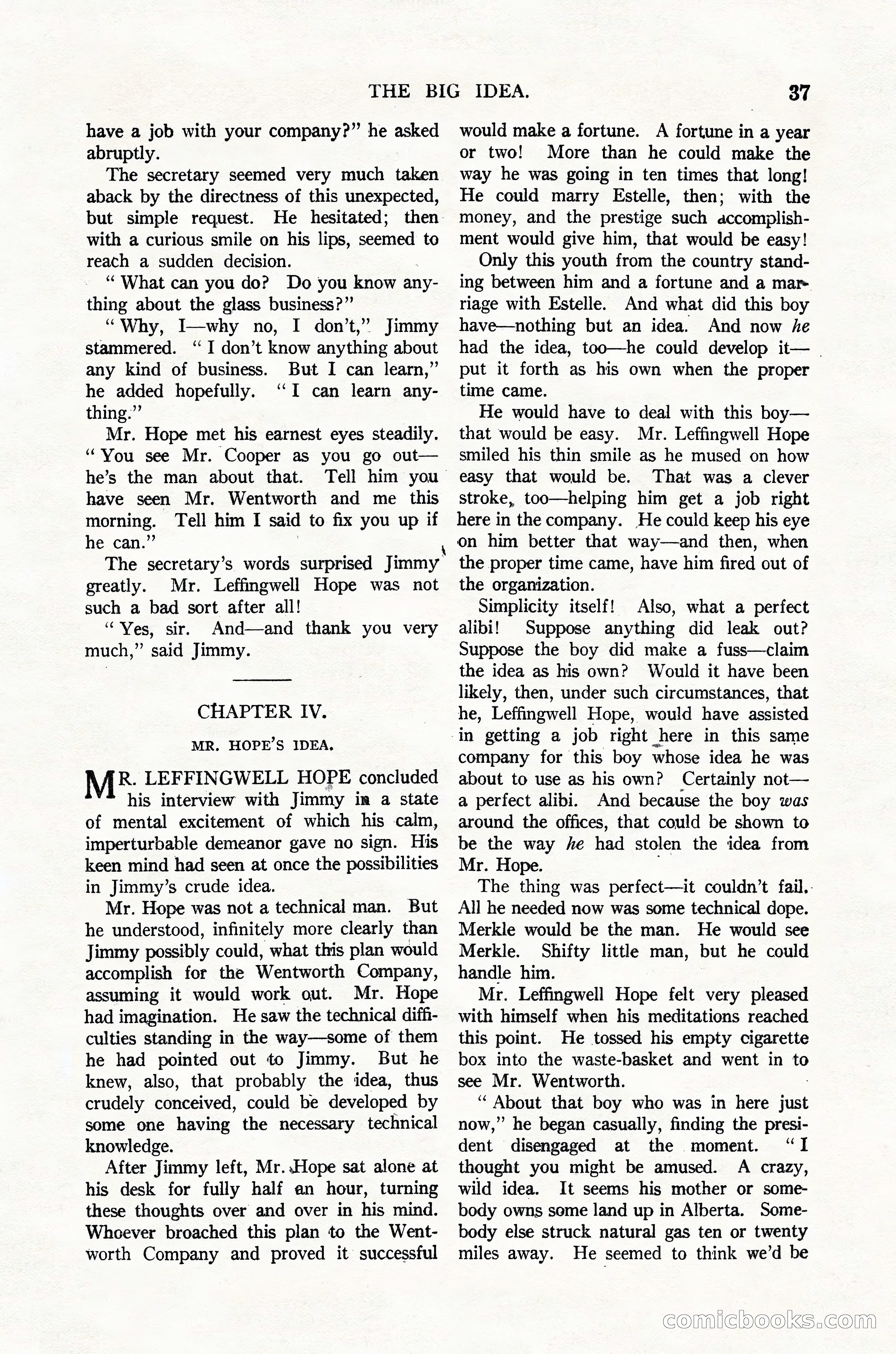
A restored page from Pulp Fiction, 1920. Page through the whole issue in the reader above.
📄 Transcribed text from this page (OCR, searchable)
Machine-transcribed from the original scan — historical spelling and the odd misread are preserved.
THE have a job with your company?” he asked abruptly. The secretary seemed very much taken aback by the directness of this unexpected, but simple request. with a curious smile on his lips, seemed to reach a sudden decision. “What can you do? Do you know any- thing about the glass business?”’ “Why, I—why no, I don't,” Jimmy stammered. ‘I don’t know anything about any kind of business. But I can learn,” he added hopefully. ‘I can learn any- thing.” : Mr. Hope met his earnest eyes steadily. “You see Mr. Cooper as you go out— he’s the man about that. have seen Mr. Wentworth and me this MOFRNg. Tell him I said to fix you up if he can.’ The secretary’s words surprised Jimmy’ greatly. Mr. Leffingwell Hope was not such a bad sort after all! “Yes, sir. And—and thank you very much,” said Jimmy. CHAPTER IV. MR. HOPE’S IDEA. Me LEFFINGWELL HOPE concluded his interview with Jimmy im a state of mental excitement of which his calm, imperturbable demeanor gave no sign. His keen mind had seen at once the possibilities in Jimmy’s crude idea. Mr. Hope was not a technical man. But he understood, infinitely more clearly than Jimmy possibly could, what this plan would accomplish for the Wentworth Company, assuming it would work out. Mr. Hope had imagination. He saw the technical diffi- culties standing in the way—some of them he had pointed out to Jimmy. But he knew, also, that probably the idea, thus crudely conceived, could be developed by some one having the necessary technical knowledge. After Jimmy left, Mr..Hope sat alone at his desk for fully half an hour, turning these thoughts over and over in his mind. Whoever broached this plan to the Went- worth Company and proved it successful BIG IDEA. He hesitated; then. Tell him you 37 would make a fortune. A fortune in a year or two! More than he could make the way he was going in ten times that long! He could marry Estelle, then; with the money, and the prestige such accomplish- ment would give him, that would be easy! Only this youth from the country stand- ing between him and a fortune and a mar riage with Estelle. And what did this boy have—nothing but an idea. And now he had the idea, too—he could develop it— | put it forth as his own when the proper time came. He would have to deal with this boy— that would be easy. Mr. Leffingwell Hope smiled his thin smile as he mused on how easy that would be. That was a clever stroke, too—helping him get a job right here in the company. He could keep his eye on him better that way—and then, when the proper time came, have him fired out of the organization. Simplicity itself! Also, what a perfect alibi! Suppose anything did leak out? Suppose the boy did make a fuss—claim the idea as his own? Would it have been likely, then, under such circumstances, that he, Leffingwell Hope, would have assisted ‘in getting a job right here in this same company for this boy whose idea he was about to use as his own? Certainly not— a perfect alibi. And because the boy was around the offices, that could be shown to be the way he had stolen the idea from Mr. Hope. The thing was perfect—it couldn’t fail. All he needed now was some technical dope. Merkle would be the man. He would see Merkle. Shifty little man, but he could handle him. Mr. Leffingwell Hope felt very pleased with himself when his meditations reached this point. He tossed his empty cigarette box into the waste-basket and went in to see Mr. Wentworth. ‘About that boy who was in here et now,” he began casually, finding the presi- dent disengaged at the moment. “I thought you might be amused. A crazy, wild idea. It seems his mother or some- body owns some land up in Alberta. Some- body else struck natural gas ten or twenty miles away. He seemed to think we’d be COmiclboooks C©