
Pulp Fiction, 1920 · page 32 of 156
Argosy, Vol. 123, No. 1 — page 32: what you’re looking at
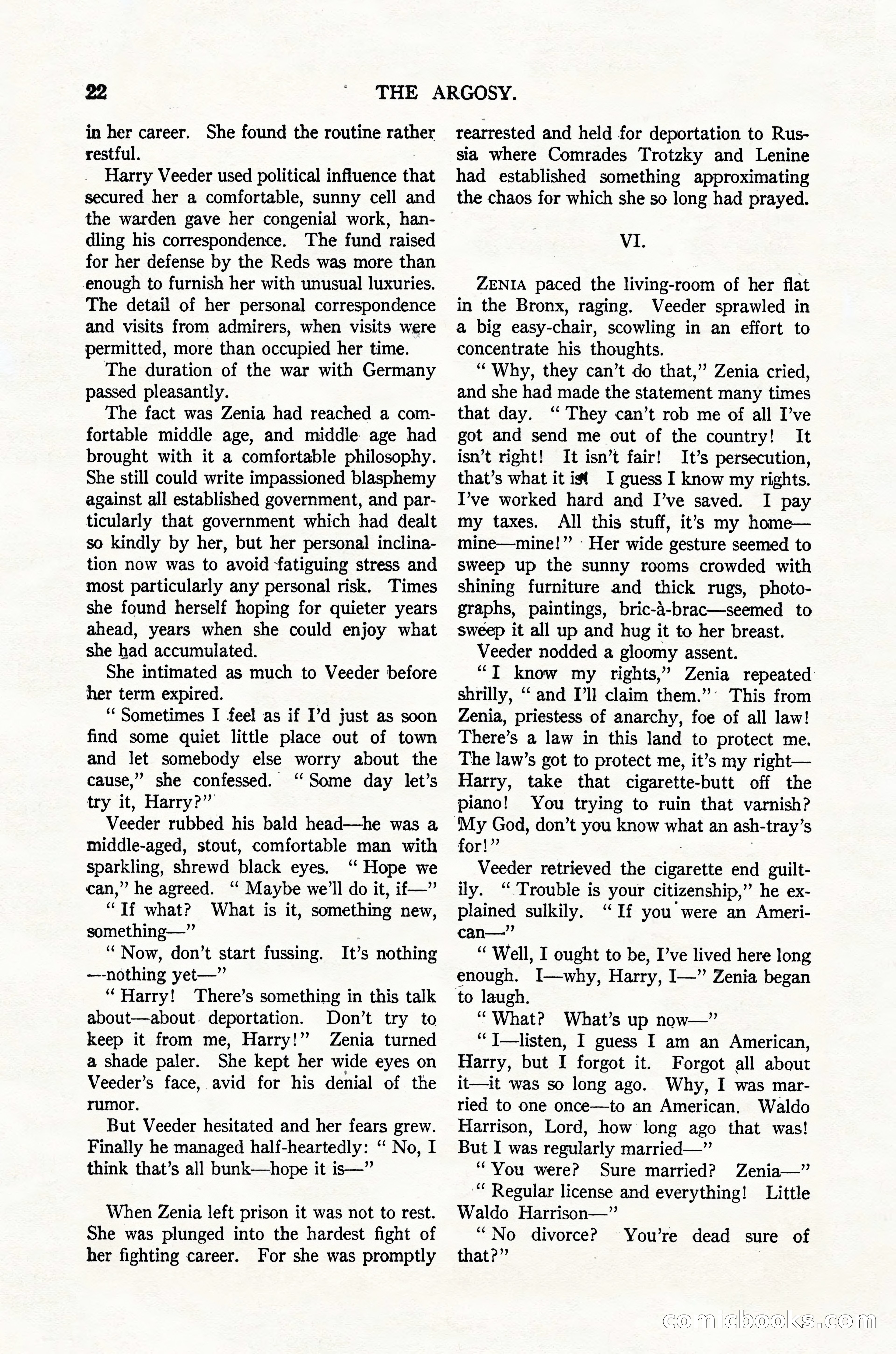
A restored page from Pulp Fiction, 1920. Page through the whole issue in the reader above.
📄 Transcribed text from this page (OCR, searchable)
Machine-transcribed from the original scan — historical spelling and the odd misread are preserved.
22 in her career. She found the routine rather restful. : Harry Veeder used political influence that secured her a comfortable, sunny cell and the warden gave her congenial work, han- dling his correspondence. The fund raised for her defense by the Reds was more than enough to furnish her with unusual luxuries. The detail of her personal correspondence and visits from admirers, when visits were permitted, more than occupied her time. The duration of the war with Germany passed pleasantly. The fact was Zenia had reached a com- fortable middle age, and middle age had brought with it a comfortable philosophy. She still could write impassioned blasphemy against all established government, and par- ticularly that government which had dealt so kindly by her, but her personal inclina- tion now was to avoid fatiguing stress and most particularly any personal risk. Times she found herself hoping for quieter years ahead, years when she could enjoy what she had accumulated. She intimated as much to Veeder before her term expired. ‘‘ Sometimes I feel as if I’d just as soon find some quiet little place out of town and let somebody else worry about the cause,” she confessed. ‘‘ Some day let’s try it, Harry?” Veeder rubbed his bald head—he was a middle-aged, stout, comfortable man with sparkling, shrewd black eyes. ‘‘ Hope we can,” he agreed. “‘ Maybe we'll do it, ifi—” “If what? What is it, something new, something—”’ ‘““Now, don’t start fussing. It’s nothing —-nothing yet—” “Harry! There’s something in this talk about—about. deportation. Don’t try to keep it from me, Harry!” Zenia turned a shade paler. She kept her wide eyes on Veeder’s face, avid for his denial of the rumor. But Veeder hesitated and her fears grew. Finally he managed half-heartedly: ‘‘ No, I think that’s all bunk—hope it is—”’ When Zenia left prison it was not to rest. She was plunged into the hardest fight of her fighting career. For she was promptly THE ARGOSY. rearrested and held for deportation to Rus- sia where Comrades Trotzky and Lenine had established something approximating the chaos for which she so long had prayed. VI. ZENIA paced the living-room of her flat in the Bronx, raging. Veeder sprawled in a big easy-chair, scowling in an effort to concentrate his thoughts. ‘Why, they can’t do that,” Zenia cried, and she had made the statement many times that day. ‘ They can’t rob me of all I’ve got and send me out of the country! It isn’t right! It isn’t fair! It’s persecution, that’s what it i I guess I know my rights. I’ve worked hard and I’ve saved. I pay my taxes. All this stuff, it’s my home— mine—mine!” Her wide gesture seemed to sweep up the sunny rooms crowded with shining furniture and thick rugs, photo- graphs, paintings, bric-a-brac—seemed to sweep it all up and hug it to her breast. Veeder nodded a gloomy assent. “I know my rights,” Zenia repeated shrilly, ‘‘ and I’ll claim them.” This from Zenia, priestess of anarchy, foe of all law! There’s a law in this land to protect me. The law’s got to protect me, it’s my right— Harry, take that cigarette-butt off the piano! You trying to ruin that varnish? ‘My God, don’t you know what an ash-tray’s for!” : Veeder retrieved the cigarette end guilt- ily. “ Trouble is your citizenship,” he ex- plained sulkily. “If you were an Ameri- can—” “Well, I ought to be, I’ve lived here long enough. I—why, Harry, I—” Zenia began to laugh. ‘What? What’s up now—”’ ‘““I—listen, I guess I am an American, Harry, but I forgot it. Forgot all about it—it was so long ago. Why, I was mar- ried to one once—to an American. Waldo Harrison, Lord, how long ago that was! But I was regularly married—” “You were? Sure married? Zenia—” “ Regular license and everything! Little Waldo Harrison—” “No divorce? You’re dead sure of that?” . . DOOK C©