
Pulp Fiction, 1920 · page 142 of 156
Argosy, Vol. 123, No. 1 — page 142: what you’re looking at
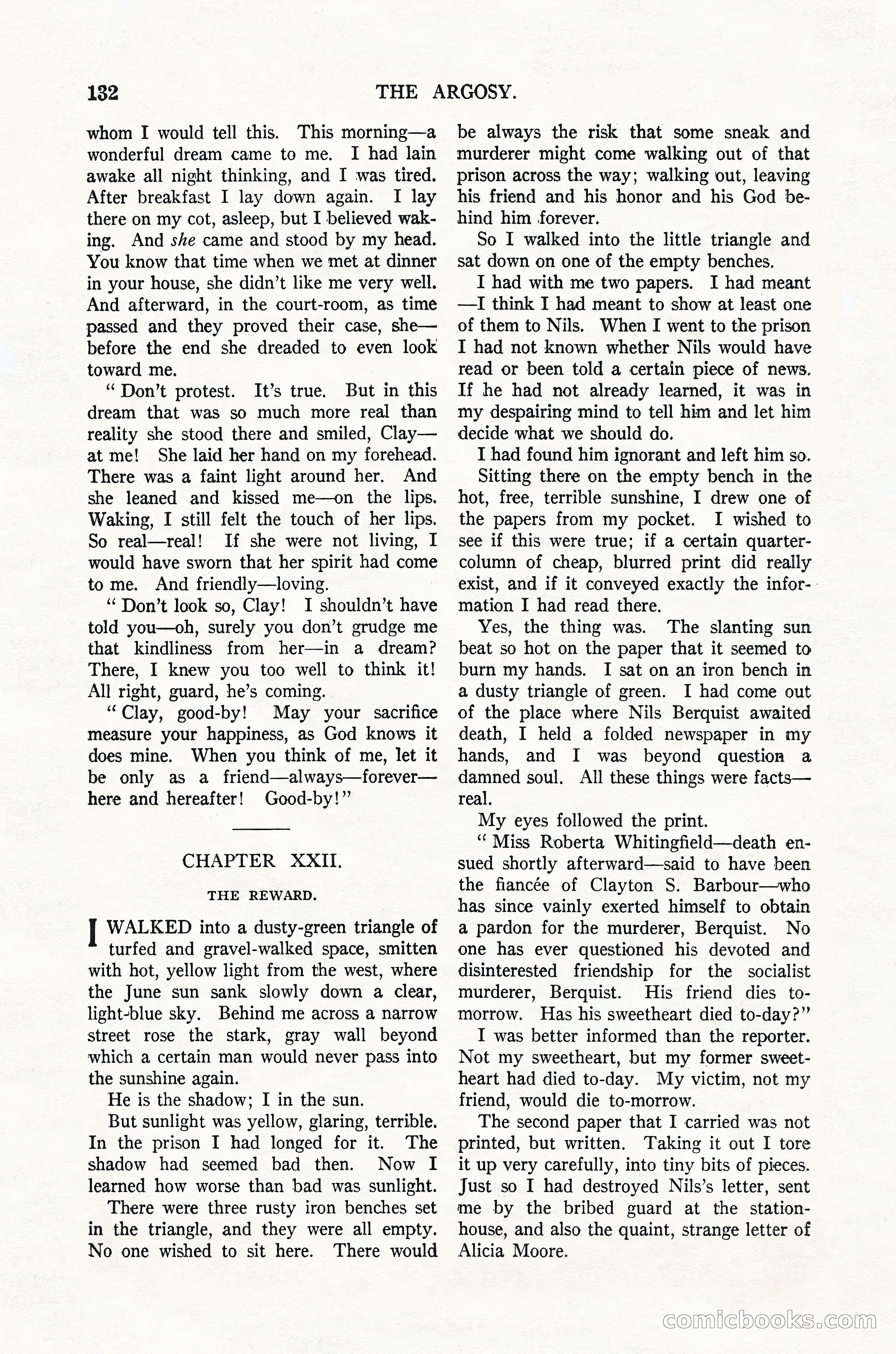
A restored page from Pulp Fiction, 1920. Page through the whole issue in the reader above.
📄 Transcribed text from this page (OCR, searchable)
Machine-transcribed from the original scan — historical spelling and the odd misread are preserved.
132 whom I would tell this. This morning—a wonderful dream came to me. I had lain awake all night thinking, and I was tired. After breakfast I lay down again. I lay there on my cot, asleep, but I believed wak- ing. And she came and stood by my head. You know that time when we met at dinner in your house, she didn’t like me very well. And afterward, in the court-room, as time passed and they proved their case, she— before the end she dreaded to even look toward me. “Don’t protest. It’s true. But in this dream that was so much more real than reality she stood there and smiled, Clay— at me! She laid her hand on my forehead. There was a faint light around her. And she leaned and kissed me—on the lips. Waking, I still felt the touch of her lips. So real—real! If she were not living, I would have sworn that her spirit had come to me. And friendly—loving. “ Don’t look so, Clay! I shouldn’t have told you—oh, surely you don’t grudge me that kindliness from her—in a dream? There, I knew you too well to think it! All right, guard, he’s coming. “Clay, good-by! May your sacrifice measure your happiness, as God knows it does mine. When you think of me, let it be only as a friend—always—forever— here and hereafter! Good-by!”’ CHAPTER XXII, THE REWARD. | WALKED into a dusty-green triangle of turfed and gravel-walked space, smitten with hot, yellow light from the west, where the June sun sank slowly down a clear, light-blue sky. Behind me across a narrow street rose the stark, gray wall beyond which a certain man would never pass into the sunshine again. He is the shadow; I in the sun. But sunlight was yellow, glaring, terrible. In the prison I had longed for it. The shadow had seemed bad then. Now I learned how worse than bad was sunlight. There were three rusty iron benches set in the triangle, and they were all empty. No one wished to sit here. There would THE ARGOSY. be always the risk that some sneak and murderer might come walking out of that prison across the way; walking out, leaving his friend and his honor and his God be- hind him forever. So I walked into the little triangle and sat down on one of the empty benches. I had with me two papers. I had meant —I think I had meant to show at least one of them to Nils. When I went to the prison I had not known whether Nils would have read or been told a certain piece of news. If he had not already learned, it was in my despairing mind to tell him and let him decide what we should do. I had found him ignorant and left him so. Sitting there on the empty bench in the hot, free, terrible sunshine, I drew one of the papers from my pocket. I wished to see if this were true; if a certain quarter- column of cheap, blurred print did really exist, and if it conveyed exactly the infor-- mation I had read there. Yes, the thing was. The slanting sun beat so hot on the paper that it seemed to burn my hands. I sat on an iron bench in a dusty triangle of green. I had come out of the place where Nils Berquist awaited death, I held a folded newspaper in my hands, and I was beyond question a damned soul. All these things were facts— real. My eyes followed the print. ‘“‘Miss Roberta Whitingfield—death en- sued shortly afterward—said to have been the fiancée of Clayton S. Barbour—who has since vainly exerted himself to obtain a pardon for the murderer, Berquist. No one has ever questioned his devoted and disinterested friendship for the socialist murderer, Berquist. His friend dies to- morrow. Has his sweetheart died to-day?” I was better informed than the reporter. Not my sweetheart, but my former sweet- heart had died to-day. My victim, not my friend, would die to-morrow. The second paper that I carried was not printed, but written. Taking it out I tore it up very carefully, into tiny bits of pieces. Just so I had destroyed Nils’s letter, sent me by the bribed guard at the station- house, and also the quaint, strange letter of Alicia Moore. DOOLK C©