
Pulp Fiction, 1920 · page 109 of 156
Argosy, Vol. 123, No. 1 — page 109: what you’re looking at
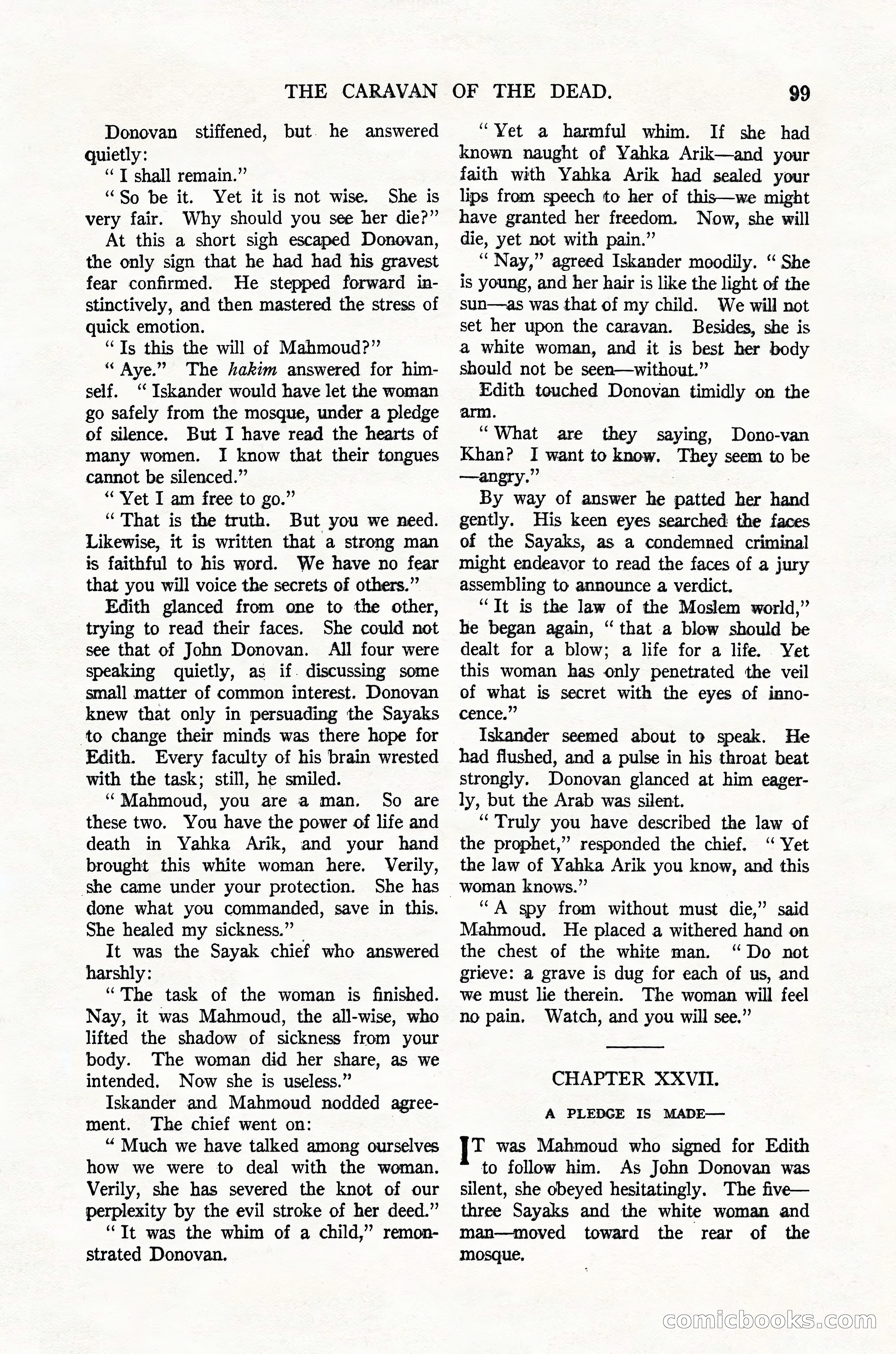
A restored page from Pulp Fiction, 1920. Page through the whole issue in the reader above.
📄 Transcribed text from this page (OCR, searchable)
Machine-transcribed from the original scan — historical spelling and the odd misread are preserved.
THE CARAVAN Donovan stiffened, but. he answered quietly: ‘“ T shall remain.” “So be it. Yet it is not wise. She is very fair. Why should you see her die?”’ At this a short sigh escaped Donovan, the only sign that he had had his gravest fear confirmed. He stepped forward in- stinctively, and then mastered the stress of quick emotion. “Is this the will of Mahmoud?” “Aye.” The hakim answered for him- self. ‘‘ Iskander would have let the woman go safely from the mosque, under a pledge of silence. But I have read the hearts of many women. I know that their tongues cannot be silenced.” “Yet I am free to go.” “That is the truth. But you we need. Likewise, it is written that a strong man is faithful to his word. We have no fear that you will voice the secrets of others.” Edith glanced from one to the other, trying to read their faces. She could not see that of John Donovan. All four were speaking quietly, as if. discussing some small matter of common interest. Donovan knew that only in persuading the Sayaks ‘to change their minds was there hope for Edith. Every faculty of his brain wrested with the task; still, he smiled. ‘‘Mahmoud, you are a man, So are these two. You have the power of life and death in Yahka Arik, and your hand brought this white woman here. Verily, she came under your protection. She has done what you commanded, save in this. She healed my sickness.” It was the Sayak chief who answered harshly: “The task of the woman is finished. Nay, it was Mahmoud, the all-wise, who lifted the shadow of sickness from your body. The woman did her share, as we intended. Now she is useless.” Iskander and Mahmoud nodded agree- ment. The chief went on: 3 “ Much we have talked among ourselves how we were to deal with the woman. Verily, she has severed the knot of our perplexity by the evil stroke of her deed.” “Tt was the whim of a child,” remon- strated Donovan. OF THE DEAD. 99 “Yet a harmful whim. If she had known naught of Yahka Arik—and your faith with Yahka Arik had sealed your lips from speech to her of this—we might have granted her freedom. Now, she will die, yet not with pain.” “Nay,” agreed Iskander moodily. “ She is young, and her hair is like the light of the sun—as was that of my child. We will not set her upon the caravan. Besides, she is a white woman, and it is best her body should not be seen—without.” Edith touched Donovan timidly on the arm. “What are they saying, Dono-van Khan? I want to know. They seem to be By way of answer he patted her hand gently. His keen eyes searched the faces of the Sayaks, as a condemned criminal might endeavor to read the faces of a jury assembling to announce a verdict. “It is the law of the Moslem world,” he began again, “ that a blow should be dealt for a blow; a life for a life. Yet this woman has only penetrated the veil of what is secret with the eyes of inno- cence.” Iskander seemed about to speak. He had flushed, and a pulse in his throat beat strongly. Donovan glanced at him eager- ly, but the Arab was silent. “Truly you have described the law of the prophet,” responded the chief. ‘ Yet the law of Yahka Arik you know, and this woman knows.” ‘A spy from without must die,” said Mahmoud. He placed a withered hand on the chest of the white man. ‘Do not grieve: a grave is dug for each of us, and we must lie therein. The woman will feel no pain. Watch, and you will see.” CHAPTER XXVII. A PLEDGE IS MADE— jt was Mahmoud who signed for Edith to follow him. As John Donovan was silent, she obeyed hesitatingly. The five— three Sayaks and the white woman and man—moved toward the rear of the mosque. CoOmiclboook C@