
Pulp Fiction, 1920 · page 103 of 156
Argosy, Vol. 123, No. 1 — page 103: what you’re looking at
A restored page from Pulp Fiction, 1920. Page through the whole issue in the reader above.
📄 Transcribed text from this page (OCR, searchable)
Machine-transcribed from the original scan — historical spelling and the odd misread are preserved.
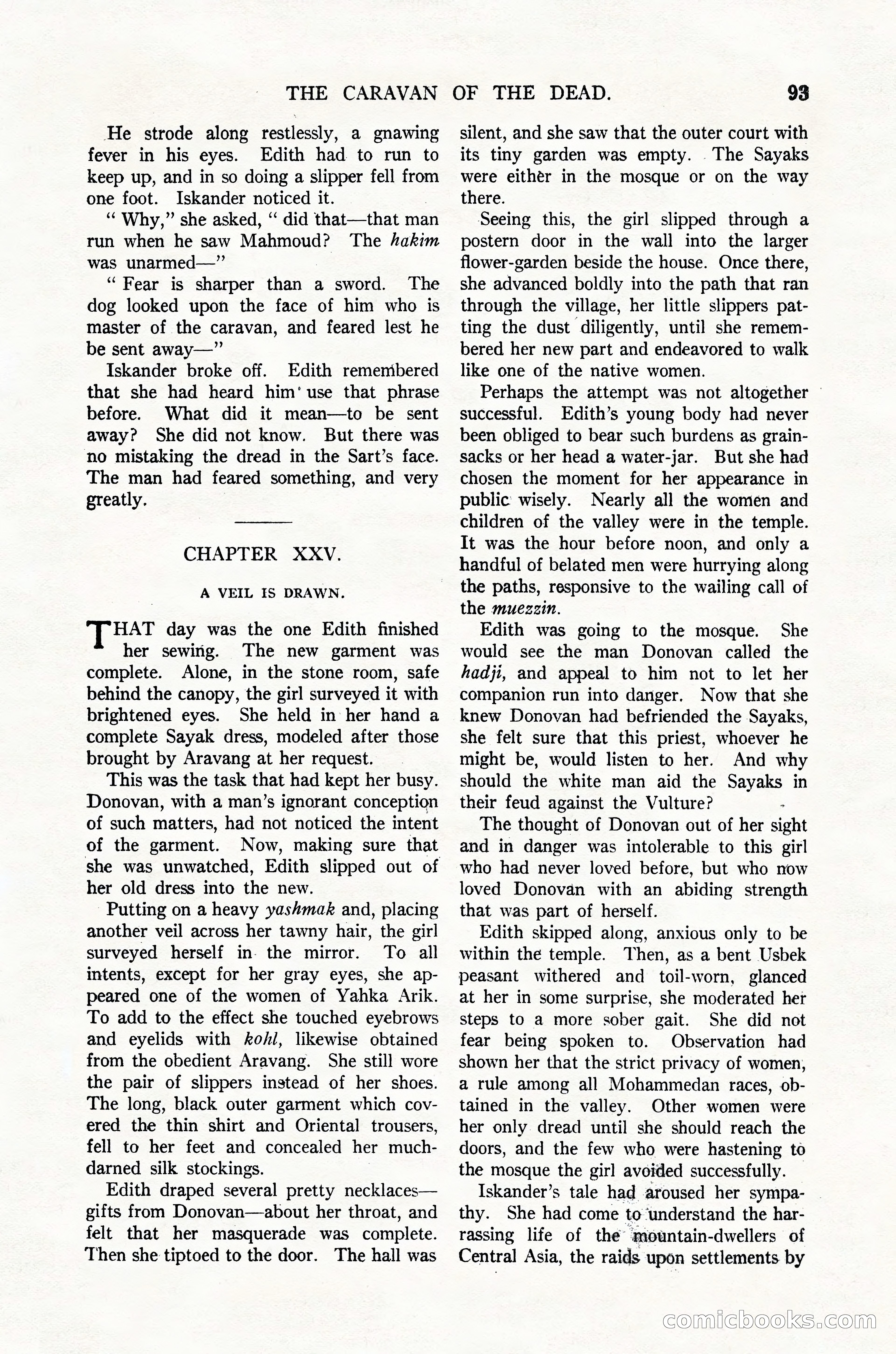
THE CARAVAN He strode along restlessly, a gnawing fever in his eyes. Edith had to run to keep up, and in so doing a slipper fell from one foot. Iskander noticed it. ‘“‘ Why,” she asked, ‘‘ did that—that man run when he Sa Mahmoud? The hakim was unarmed— “Fear is sharper than a sword. The dog looked upon the face of him who is master of the caravan, and feared lest he be sent away—”’ Iskander broke off. Edith remembered that she had heard him‘ use that phrase before. What did it mean—to be sent away? She did not know. But there was no mistaking the dread in the Sart’s face. The man had feared something, and very greatly. CHAPTER XXvV. A VEIL IS DRAWN. "THAT day was the one Edith finished her sewirig. The new garment was complete. Alone, in the stone room, safe behind the canopy, the girl surveyed it with brightened eyes. She held in her hand a complete Sayak dress, modeled after those brought by Aravang at her request. This was the task that had kept her busy. Donovan, with a man’s ignorant conception of such matters, had not noticed the intent of the garment. Now, making sure that she was unwatched, Edith slipped out of her old dress into the new. Putting on a heavy yashmak and, placing another veil across her tawny hair, the girl surveyed herself in. the mirror. To all intents, except for her gray eyes, she ap- peared one of the women of Yahka Arik. To add to the effect she touched eyebrows and eyelids with owl, likewise obtained from the obedient Aravang. She still wore the pair of slippers instead of her shoes. The long, black outer garment which cov- ered the thin shirt and Oriental trousers, fell to her feet and concealed her much- darned silk stockings. Edith draped several pretty necklaces— gifts from Donovan—about her throat, and felt that her masquerade was complete. Then she tiptoed to the door. The hall was OF THE DEAD. 93 silent, and she saw that the outer court with its tiny garden was empty. . The Sayaks were eithér in the mosque or on the way there. Seeing this, the girl slipped through a postern door in the wall into the larger flower-garden beside the house. Once there, she advanced boldly into the path that ran through the village, her little slippers pat- ting the dust diligently, until she remem- bered her new part and endeavored to walk like one of the native women. Perhaps the attempt was not altogether © successful. Edith’s young body had never been obliged to bear such burdens as grain- sacks or her head a water-jar. But she had chosen the moment for her appearance in public wisely. Nearly all the women and children of the valley were in the temple. It was the hour before noon, and only a handful of belated men were hurrying along the paths, responsive to the wailing call of the muezzin. Edith was going to the mosque. She would see the man Donovan called the hadji, and appeal to him not to let her companion run into danger. Now that she knew Donovan had befriended the Sayaks, She felt sure that this priest, whoever he might be, would listen to her. And why should the white man aid the Sayaks in their feud against the Vulture? The thought of Donovan out of her ght and in danger was intolerable to this girl who had never loved before, but who now loved Donovan with an abiding strength that was part of herself. Edith skipped along, anxious only to be within the temple. Then, as a bent Usbek peasant withered and toil-worn, glanced at her in some surprise, she moderated her steps to a more sober gait. She did not fear being spoken to. Observation had shown her that the strict privacy of women, a rule among all Mohammedan races, ob- tained in the valley. Other women were her only dread until she should reach the doors, and the few who were hastening to the mosque the girl avoided successfully. — Iskander’s tale had aroused her sympa- - thy. She had come to. ‘understand the har- rassing life of the ‘mountain- -dwellers of Central Asia, the raids upon settlements by COMICLO© S C©