
Pulp Fiction, 1920 · page 77 of 164
Argosy, Vol. 122, No. 1 — page 77: what you’re looking at
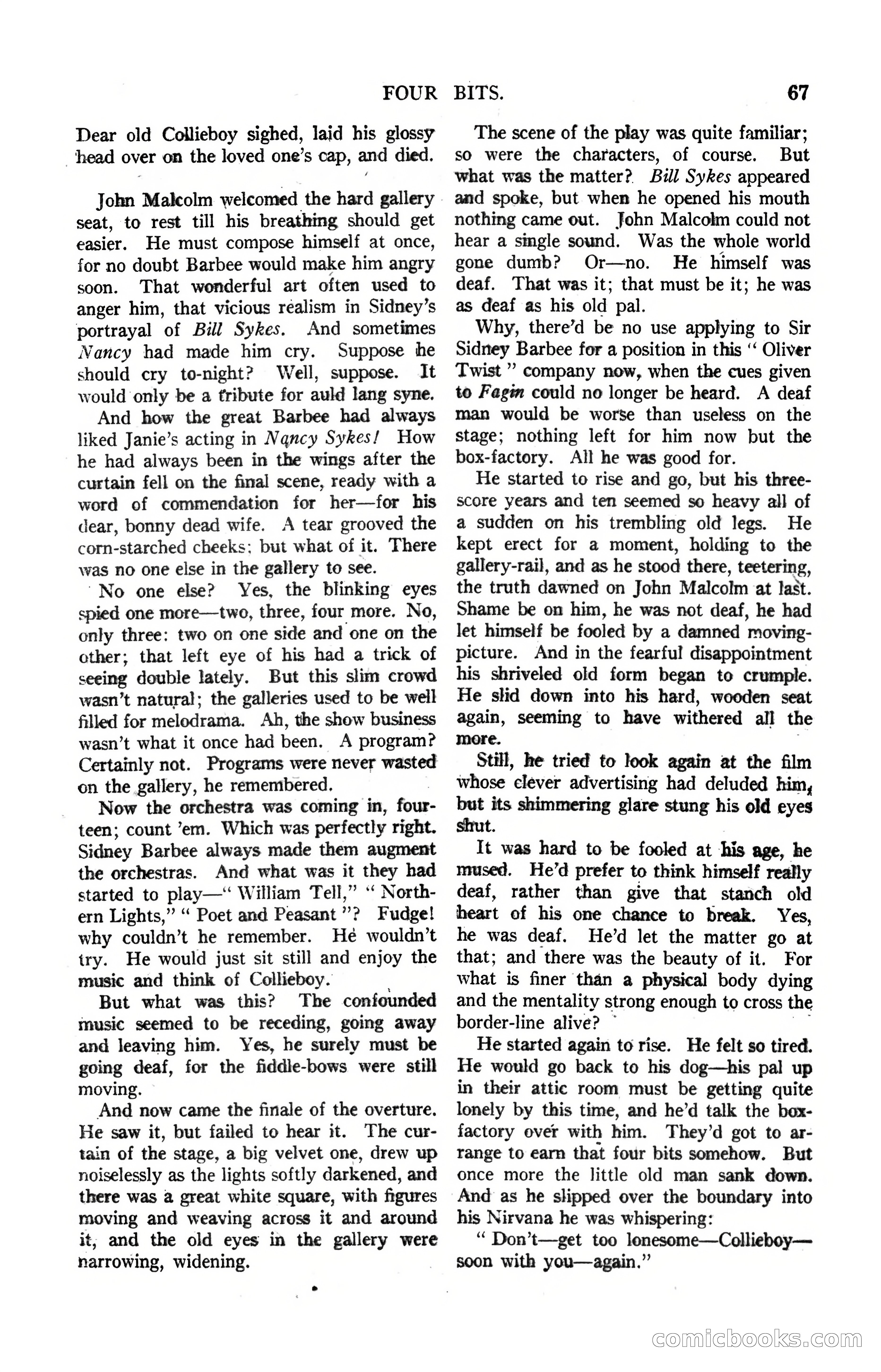
A restored page from Pulp Fiction, 1920. Page through the whole issue in the reader above.
📄 Transcribed text from this page (OCR, searchable)
Machine-transcribed from the original scan — historical spelling and the odd misread are preserved.
FOUR Dear old Collieboy sighed, laid his glossy ‘head over on the loved one’s cap, and died. John Malcolm welcomed the hard gallery seat, to rest till his breathing should get easier. He must compose himself at once, for no doubt Barbee would make him angry soon. ‘That wonderful art often used to anger him, that vicious realism in Sidney’s portrayal of Bill Sykes. And sometimes Nancy had made him cry. Suppose he should cry to-night? Well, suppose. It would only be a tribute for auld lang syne. And how the great Barbee had always liked Janie’s acting in Nqncy Sykes! How he had always been in the wings after the curtain fell on the final scene, ready with a word of commendation for her—for his dear, bonny dead wife. A tear grooved the corn-starched cheeks; but what of it. There was no one else in the gallery to see. ‘No one else? Yes, the blinking eyes spied one more—two, three, four more. No, only three: two on one side and one on the other; that left eye of his had a trick of seeing double lately. But this slim crowd wasn’t natural; the galleries used to be well filled for melodrama. Ah, the show business wasn’t what it once had been. A program? Certainly not. Programs were never wasted on the gallery, he remembered. Now the orchestra was coming in, four- teen; count ’em. Which was perfectly right. Sidney Barbee always made them augment the orchestras. And what was it they had started to play—‘ William Tell,” ‘‘ North- ern Lights,” “ Poet and Peasant’? Fudge! why couldn’t he remember. He wouldn’t try. He would just sit still and enjoy the music and think of Collieboy. But what was this? The confounded music seemed to be receding, going away and leaving him. Yes, he surely must be going deaf, for the fiddie-bows were still moving. And now came the finale of the overture. He saw it, but failed to hear it. The cur- tain of the stage, a big velvet one, drew up noiselessly as the lights softly darkened, and there was a great white square, with figures moving and weaving across it and around it; and the old eyes in the gallery were narrowing, widening. BITS. 67 The scene of the play was quite familiar; so were the characters, of course. But what was the matter? Bill Sykes appeared and spoke, but when he opened his mouth nothing came out. John Malcolm could not hear a smgle sound. Was the whole world gone dumb? Or—no. He himself was deaf. That was it; that must be it; he was as deaf as his old pal. Why, there’d be no use applying to Sir Sidney Barbee for a position in this ‘‘ Oliver Twist ” company now, when the cues given to Fagen could no longer be heard. <A deaf man would be worse than useless on the stage; nothing left for him now but the box-factory. All he was good for. He started to rise and go, but his three- score years and ten seemed so heavy all of a sudden on his trembling old legs. He kept erect for a moment, holding to the gallery-rail, and as he stood there, teetering, the truth dawned on John Malcolm at last. Shame be on him, he was not deaf, he had let himself be fooled by a damned moving- picture. And in the fearful disappointment his shriveled old form began to crumple. He slid down into his hard, wooden seat again, seeming to have withered all the more. Still, he tried to look again at the film whose clever advertising had deluded him, but its shimmering glare stung his old eyes shut. It was hard to be fooled at his age, he mused. He’d prefer to think himself really deaf, rather than give that stanch old heart of his one chance to break. Yes, he was deaf. He’d let the matter go at that; and there was the beauty of it. For what is finer than a physical body dying and the mentality strong enough to cross the border-line alive? © He started again to rise. He felt so tired. He would go back to his dog—his pal up in their attic room must be getting quite lonely by this time, and he’d talk the box- factory over with him. They’d got to ar- range to earn that four bits somehow. But once more the little old man sank down. And as he shipped over the boundary into his Nirvana he was whispering: ‘“ Don’t—get too lonesome—Collieboy— soon with you—again.”’ cComiclbooks.com