
Pulp Fiction, 1920 · page 73 of 164
Argosy, Vol. 122, No. 1 — page 73: what you’re looking at
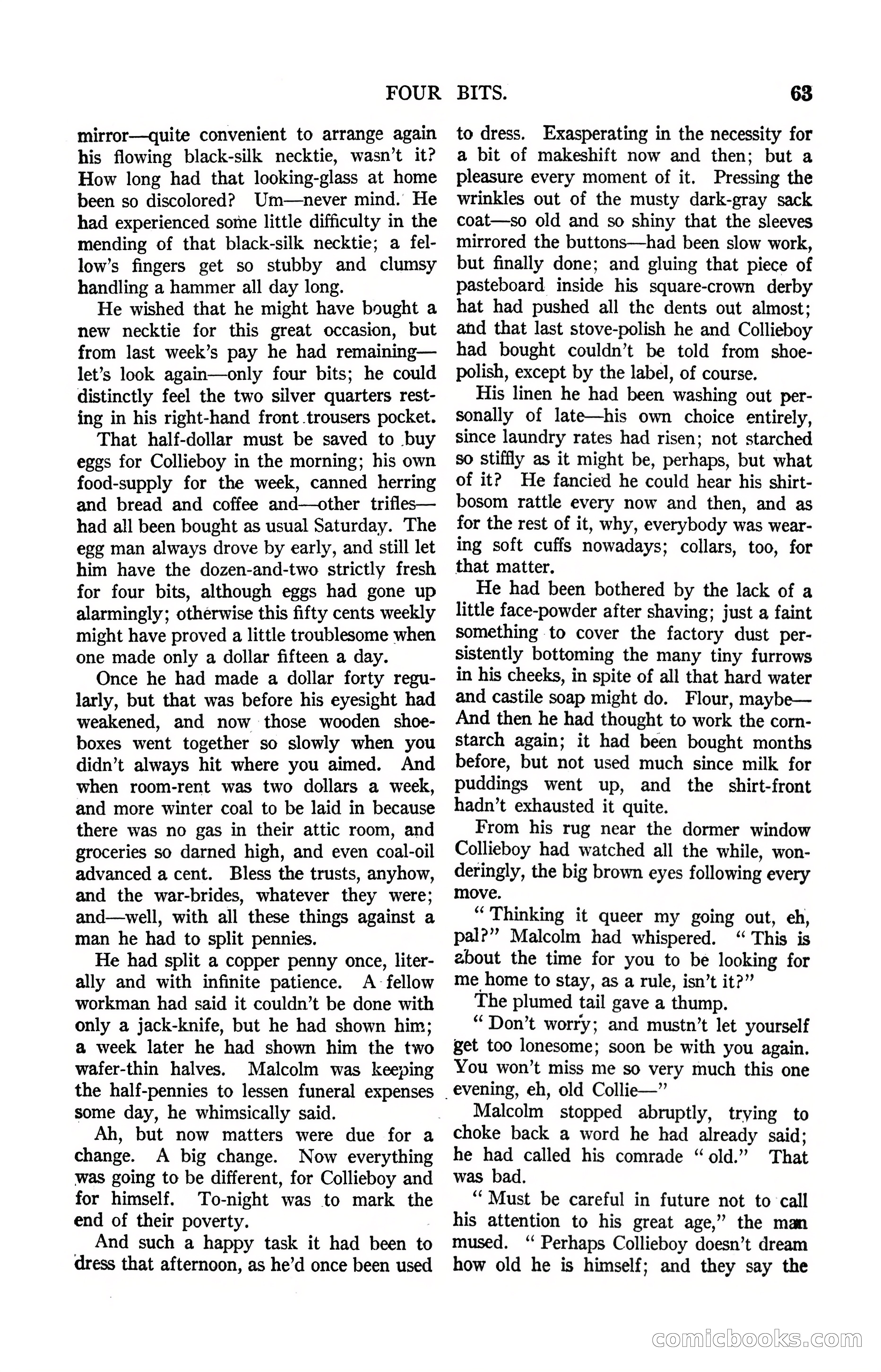
A restored page from Pulp Fiction, 1920. Page through the whole issue in the reader above.
📄 Transcribed text from this page (OCR, searchable)
Machine-transcribed from the original scan — historical spelling and the odd misread are preserved.
FOUR mirror—quite convenient to arrange again his flowing black-silk necktie, wasn’t it? How long had that looking-glass at home been so discolored? Um—never mind. He had experienced some little difficulty in the mending of that black-silk necktie; a fel- low’s fingers get so stubby and clumsy handling a hammer all day long. He wished that he might have bought a new necktie for this great occasion, but from last week’s pay he had remaining— let’s look again—only four bits; he could distinctly feel the two silver quarters rest- ing in his right-hand front trousers pocket. That half-dollar must be saved to buy eggs for Collieboy in the morning; his own food-supply for the week, canned herring and bread and coffee and—other trifles— had all been bought as usual Saturday. The egg man always drove by early, and still let him have the dozen-and-two strictly fresh for four bits, although eggs had gone up alarmingly; otherwise this fifty cents weekly might have proved a little troublesome when one made only a dollar fifteen a day. Once he had made a dollar forty regu- larly, but that was before his eyesight had weakened, and now those wooden shoe- boxes went together so slowly when you didn’t always hit where you aimed. And when room-rent was two dollars a week, and more winter coal to be laid in because there was no gas in their attic room, and groceries so darned high, and even coal-oil advanced a cent. Bless the trusts, anyhow, and the war-brides, whatever they were; and—well, with all these things against a man he had to split pennies. He had split a copper penny once, liter- ally and with infinite patience. A fellow workman had said it couldn’t be done with only a jack-knife, but he had shown him; a week later he had shown him the two wafer-thin halves. Malcolm was keeping the half-pennies to lessen funeral expenses some day, he whimsically said. Ah, but now matters were due for a change. A big change. Now everything was going to be different, for Collieboy and for himself. To-night was to mark the end of their poverty. And such a happy task it had been to dress that afternoon, as he’d once been used BITS. 63 to dress. Exasperating in the necessity for a bit of makeshift now and then; but a pleasure every moment of it. Pressing the wrinkles out of the musty dark-gray sack coat—so old and so shiny that the sleeves mirrored the buttons—had been slow work, but finally done; and gluing that piece of pasteboard inside his square-crown derby hat had pushed all the dents out almost; and that last stove-polish he and Collieboy had bought couldn’t be told from shoe- polish, except by the label, of course. His linen he had been washing out per- sonally of late—his own choice entirely, since laundry rates had risen; not starched so stiffly as it might be, perhaps, but what of it? He fancied he could hear his shirt- bosom rattle every now and then, and as for the rest of it, why, everybody was wear- ing soft cuffs nowadays; collars, too, for that matter. He had been bothered by the lack of a little face-powder after shaving; just a faint something to cover the factory dust per- sistently bottoming the many tiny furrows in his cheeks, in spite of all that hard water and castile soap might do. Flour, maybe— And then he had thought to work the corn- starch again; it had been bought months before, but not used much since milk for puddings went up, and the shirt-front hadn’t exhausted it quite. From his rug near the dormer window Collieboy had watched all the while, won- deringly, the big brown eyes following every move. “Thinking it queer my going out, eh, pale” Malcolm had whispered. “ This is 2bout the time for you to be looking for me home to stay, as a rule, isn’t it?” The plumed tail gave a thump. “Don’t worry; and mustn’t let yourself get too lonesome; soon be with you again. You won’t miss me so very much this one evening, eh, old Collie—” Malcolm stopped abruptly, trying to choke back a word he had already said; he had called his comrade “old.” That was bad. ““Must be careful in future not to call his attention to his great age,” the man mused. ‘ Perhaps Collieboy doesn’t dream how old he is himself; and they say the cComiclbooks.com