
Pulp Fiction, 1920 · page 60 of 164
Argosy, Vol. 122, No. 1 — page 60: what you’re looking at
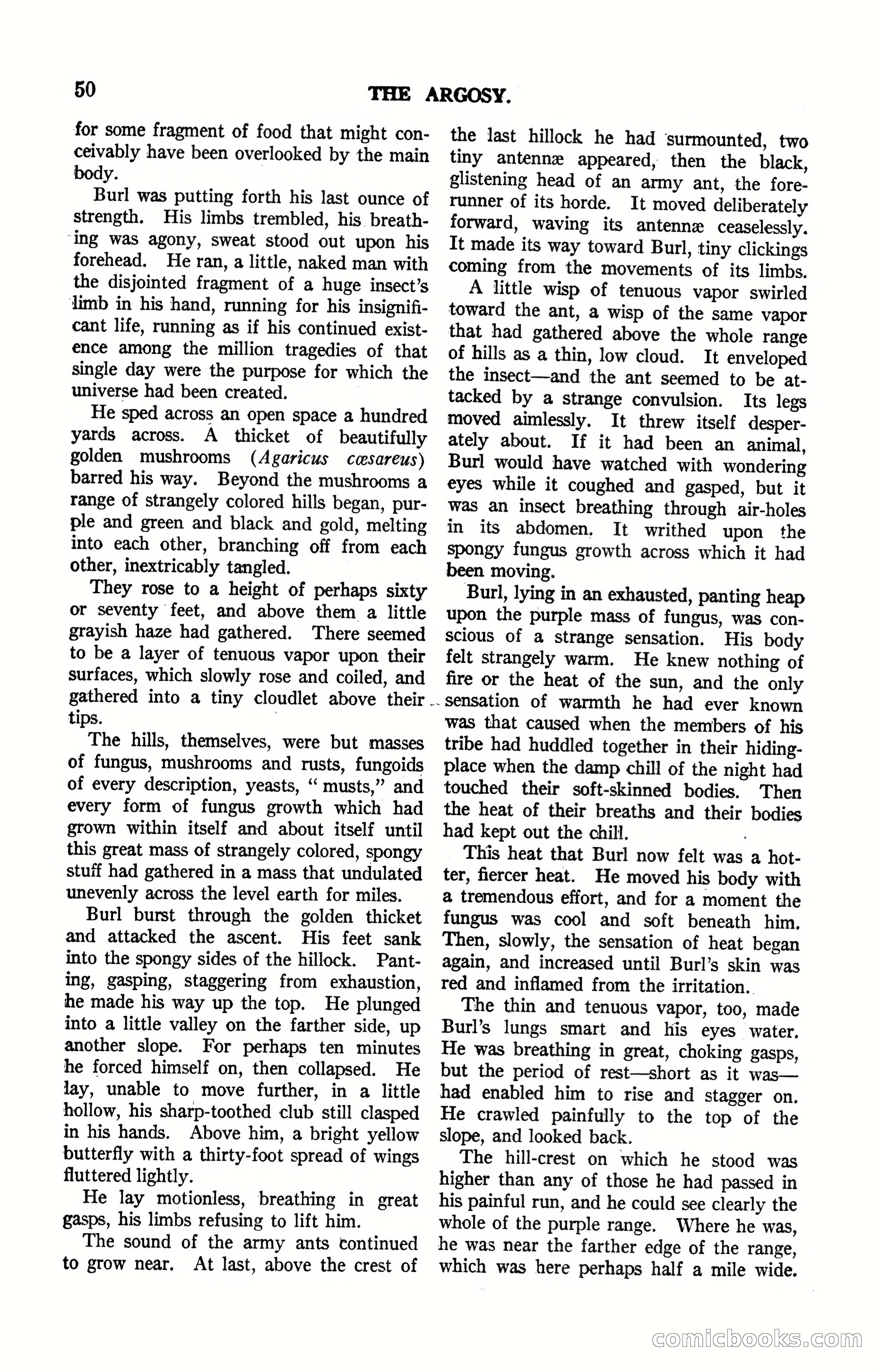
A restored page from Pulp Fiction, 1920. Page through the whole issue in the reader above.
📄 Transcribed text from this page (OCR, searchable)
Machine-transcribed from the original scan — historical spelling and the odd misread are preserved.
50 for some fragment of food that might con- ceivably have been overlooked by the main body. | Burl was putting forth his last ounce of strength. His limbs trembled, his breath- ing was agony, sweat stood out upon his forehead. He ran, a little, naked man with the disjointed fragment of a huge insect’s limb in his hand, running for his insignifi- cant life, running as if his continued exist- ence among the million tragedies of that single day were the purpose for which the universe had been created. He sped across an open space a hundred yards across. A thicket of beautifully golden mushrooms (Agaricus ccsareus) barred his way. Beyond the mushrooms a range of strangely colored hills began, pur- ple and green and black and gold, melting into each other, branching off from each other, inextricably tangled. They rose to a height of perhaps sixty or seventy feet, and above them a little grayish haze had gathered. ‘There seemed to be a layer of tenuous vapor upon their surfaces, which slowly rose and coiled, and gathered into a tiny cloudlet above their tips. | The hills, themselves, were but masses of fungus, mushrooms and rusts, fungoids of every description, yeasts, ‘“ musts,” and every form of fungus growth which had grown within itself and about itself until this great mass of strangely colored, spongy stuif had gathered in a mass that undulated unevenly across the level earth for miles. Burl burst through the golden thicket and attacked the ascent. His feet sank into the spongy sides of the hillock. Pant- ing, gasping, staggering from exhaustion, he made his way up the top. He plunged into a little valley on the farther side, up another slope. For perhaps ten minutes he forced himself on, then collapsed. He lay, unable to move further, in a little hollow, his sharp-toothed club still clasped in his hands. Above him, a bright yellow butterfly with a thirty-foot spread of wings fluttered lightly. He lay motionless, breathing in great gasps, his limbs refusing to lift him. The sound of the army ants continued to grow near. At last, above the crest of -y THE ARGOSY. the last hillock he had surmounted, two tiny antenne appeared, then the black, glistening head of an army ant, the fore- runner of its horde. It moved deliberately forward, waving its antenne ceaselessly. It made its way toward Burl, tiny clickings coming from the movements of its limbs. A little wisp of tenuous vapor swirled toward the ant, a wisp of the same vapor that had gathered above the whole range of hills as a thin, low cloud. It enveloped the insect—and the ant seemed to be at- tacked by a strange convulsion. Its legs moved aimlessly. It threw itself desper- ately about. If it had been an animal, Burl would have watched with wondering eyes while it coughed and gasped, but it was an insect breathing through air-holes in its abdomen. It writhed upon the spongy fungus growth across which it had been moving. Burl, lying in an exhausted, panting heap upon the purple mass of fungus, was con- scious of a strange sensation. His body felt strangely warm. He knew nothing of fire or the heat of the sun, and the only Sensation of warmth he had ever known was that caused when the members of his tribe had huddled together in their hiding- place when the damp chill of the night had touched their soft-skinned bodies. Then the heat of their breaths and their bodies had kept out the chill. This heat that Burl now felt was a hot- ter, fiercer heat. He moved his body with a tremendous effort, and for a moment the fungus was cool and soft beneath him. Then, slowly, the sensation of heat began again, and increased until Burl’s skin was red and inflamed from the irritation. The thin and tenuous vapor, too, made Burl’s lungs smart and his eyes water. He was breathing in great, choking gasps, but the period of rest—short as it was— had enabled him to rise and stagger on. He crawled painfully to the top of the slope, and looked back. The hill-crest on which he stood was higher than any of those he had passed in his painful run, and he could see clearly the whole of the purple range. Where he was, he was near the farther edge of the range, which was here perhaps half a mile wide. cComiclbooks.com