
Pulp Fiction, 1920 · page 52 of 164
Argosy, Vol. 122, No. 1 — page 52: what you’re looking at
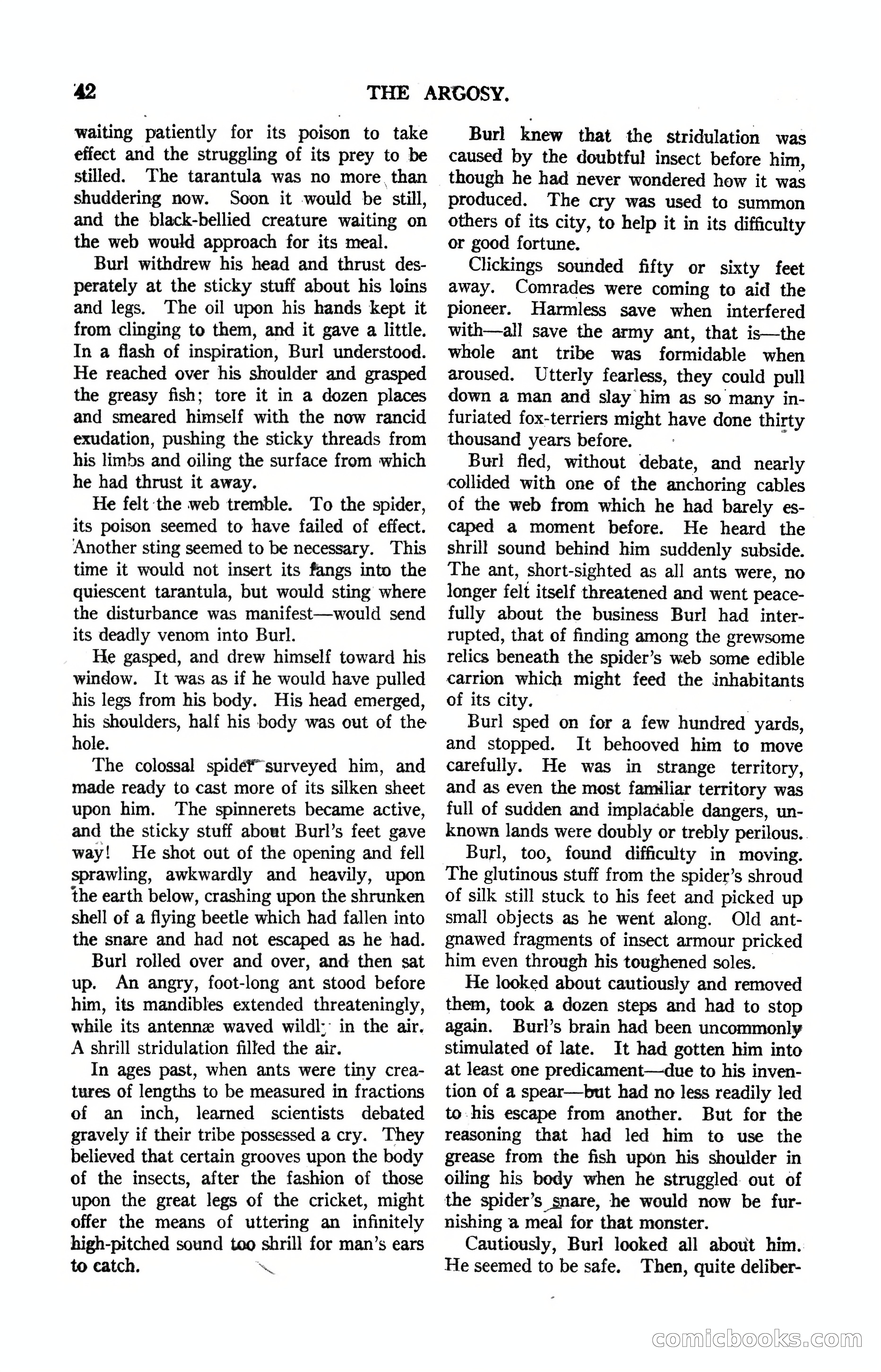
A restored page from Pulp Fiction, 1920. Page through the whole issue in the reader above.
📄 Transcribed text from this page (OCR, searchable)
Machine-transcribed from the original scan — historical spelling and the odd misread are preserved.
42 waiting patiently for its poison to take effect and the struggling of its prey to be stilled. The tarantula was no more, than shuddering now. Soon it would be still, and the black-bellied creature waiting on the web would approach for its meal. Burl withdrew his head and thrust des- perately at the sticky stuff about his loins and legs. The oil upon his hands kept it from clinging to them, and it gave a little. In a flash of inspiration, Burl understood. He reached over his shoulder and grasped the greasy fish; tore it in a dozen places and smeared himself with the now rancid exudation, pushing the sticky threads from his limbs and oiling the surface from which he had thrust it away. He felt the web tremble. To the spider, its poison seemed to have failed of effect. Another sting seemed to be necessary. This time it would not insert its fangs into the quiescent tarantula, but would sting where the disturbance was manifest—would send its deadly venom into Burl. He gasped, and drew himself toward his window. It was as if he would have pulled his legs from his body. His head emerged, his shoulders, half his body was out of the hole. The colossal spidéf™ surveyed him, and made ready to cast more of its silken sheet upon him. The spinnerets became active, and the sticky stuff about Burl’s feet gave way! He shot out of the opening and fell sprawling, awkwardly and heavily, upon the earth below, crashing upon the shrunken shell of a flying beetle which had fallen into the snare and had not escaped as he had. Burl rolled over and over, and then sat up. An angry, foot-long ant stood before him, its mandibles extended threateningly, while its antennz waved wildl:° in the air. A shrill stridulation filled the air. In ages past, when ants were tiny crea- tures of lengths to be measured in fractions of an inch, learned scientists debated gravely if their tribe possessed a cry. They believed that certain grooves upon the body of the insects, after the fashion of those upon the great legs of the cricket, might offer the means of uttering an infinitely high-pitched sound too lena for man’s ears to catch. \ THE ARGOSY. Burl knew that the stridulation was caused by the doubtful insect before him, though he had never wondered how it was produced. The cry was used to summon others of its city, to help it in its difficulty or good fortune. Clickings sounded fifty or sixty feet away. Comrades were coming to aid the pioneer. Harmless save when interfered with—all save the army ant, that is—the whole ant tribe was formidable when aroused. Utterly fearless, they could pull down a man and slay him as so many in- furiated fox-terriers might have done thirty thousand years before. Burl fled, without debate, and nearly collided with one of the anchoring cables of the web from which he had barely es- caped a moment before. He heard the shrill sound behind him suddenly subside. The ant, short-sighted as all ants were, no longer felt itself threatened and went peace- fully about the business Burl had inter- rupted, that of finding among the grewsome relics beneath the spider’s web some edible carrion which might feed the inhabitants of its city. Burl sped on for a few hundred yards, and stopped. It behooved him te move carefully. He was in strange territory, and as even the most familiar territory was full of sudden and implacable dangers, un- known lands were doubly or trebly perilous.. Burl, too, found difficulty in moving. The glutinous stuff from the spider’s shroud of silk still stuck to his feet and picked up small objects as he went along. Old ant- gnawed fragments of insect armour pricked him even through his toughened soles. He looked about cautiously and removed them, took a dozen steps and had to stop again. Burl’s brain had been uncommonly stimulated of late. It had gotten him into at least one predicament—due to his inven- tion of a spear—but had no less readily led to-his escape from another. But for the reasoning that had led him to use the grease from the fish upon his shoulder in oiling his body when he struggled out of the spider’s snare, he would now be fur- nishing a meal for that monster. Cautiously, Burl looked all about him. He seemed to be safe. Then, quite deliber- cCOomiclbooks.com