
Pulp Fiction, 1920 · page 42 of 164
Argosy, Vol. 122, No. 1 — page 42: what you’re looking at
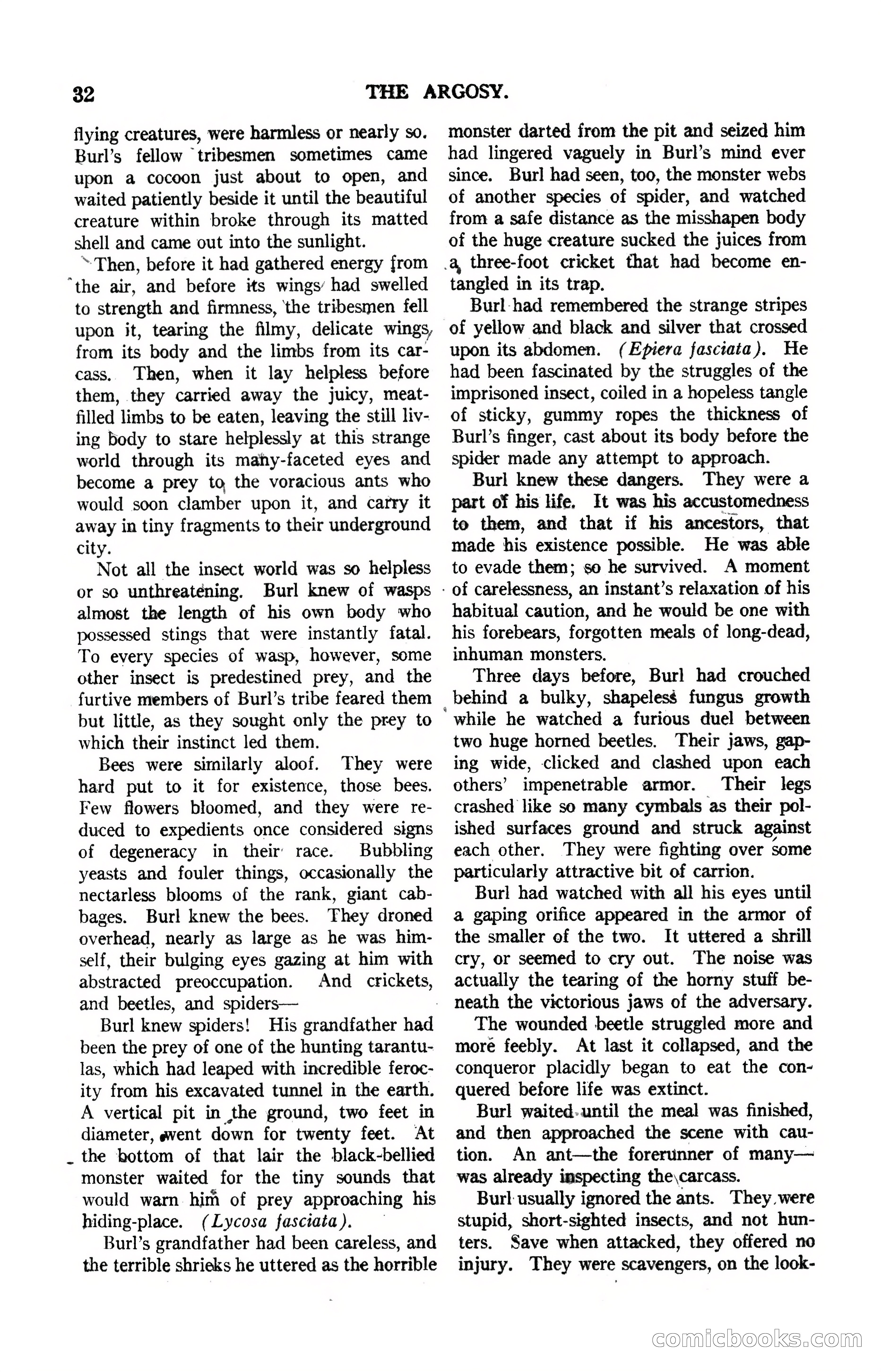
A restored page from Pulp Fiction, 1920. Page through the whole issue in the reader above.
📄 Transcribed text from this page (OCR, searchable)
Machine-transcribed from the original scan — historical spelling and the odd misread are preserved.
32 flying creatures, were harmless or nearly so. Burl’s fellow tribesmen sometimes came upon a cocoon just about to open, and waited patiently beside it until the beautiful creature within broke through its matted shell and came out into the sunlight. “Then, before it had gathered energy from “the air, and before its wings’ had swelled to strength and firmness, ‘the tribesmen fell upon it, tearing the filmy, delicate wings, from its body and the limbs from its car- cass. Then, when it lay helpless before them, they carried away the juicy, meat- filled limbs to be eaten, leaving the still liv- ing body to stare helplessly at this strange world through its mahy-faceted eyes and become a prey to the voracious ants who would soon clamber upon it, and carry it away in tiny fragments to their underground city. Not all the insect world was so helpless or so unthreatening. Burl knew of wasps almost the length of his own body who possessed stings that were instantly fatal. To every species of wasp, however, some other insect is predestined prey, and the furtive members of Burl’s tribe feared them but little, as they sought only the prey to which their instinct led them. Bees were similarly aloof. They were hard put to it for existence, those bees. Few flowers bloomed, and they were re- duced to expedients once considered signs of degeneracy in their’ race. Bubbling yeasts and fouler things, occasionally the nectarless blooms of the rank, giant cab- bages. Burl knew the bees. They droned overhead, nearly as large as he was him- self, their bulging eyes gazing at him with abstracted preoccupation. And crickets, and beetles, and spiders— Burl knew spiders! been the prey of one of the hunting tarantu- las, which had leaped with incredible feroc- ity from his excavated tunnel in the earth. A vertical pit in the ground, two feet in diameter, event down for twenty feet. At _ the bottom of that lair the black-bellied monster waited for the tiny sounds that would warn him of prey approaching his hiding-place. (Lycosa fasciata ). Burl’s grandfather had been careless, and the terrible shrieks he uttered as the horrible His grandfather had THE ARGOSY. monster darted from the pit and seized him had lingered vaguely in Burl’s mind ever since. Burl had seen, too, the monster webs of another species of spider, and watched from a safe distance as the misshapen body of the huge creature sucked the juices from .a, three-foot cricket that had become en- tangled in its trap. Burl-had remembered the strange stripes of yellow and black and silver that crossed upon its abdomen. (Epiera fasciata). He had been fascinated by the struggles of the imprisoned insect, coiled in a hopeless tangle of sticky, gummy ropes the thickness of Burl’s finger, cast about its body before the spider made any attempt to approach. Burl knew these dangers. They were a part of his life. It was his accustomedness to them, and that if his ancestors, that made his existence possible. He was able to evade them; so he survived. A moment - of carelessness, an instant’s relaxation of his habitual caution, and he would be one with his forebears, forgotten meals of long-dead, inhuman monsters. Three days before, Burl had crouched behind a bulky, shapelesé fungus growth ‘while he watched a furious duel between two huge horned beetles. Their jaws, gap- ing wide, clicked and clashed upon each others’ impenetrable armor. Their legs crashed like so many cymbals as their pol- ished surfaces ground and struck against each other. They were fighting over some particularly attractive bit of carrion. Burl had watched with all his eyes until a gaping orifice appeared in the armor of the smaller of the two. It uttered a shrill cry, or seemed to cry out. The noise was actually the tearing of the horny stuff be- neath the victorious jaws of the adversary. The wounded beetle struggled more and more feebly. At last it collapsed, and the conqueror placidly began to eat the con- quered before life was extinct. Burl waited-until the meal was finished, and then approached the scene with cau- tion. An ant—the forerunner of many— was already imspecting the\carcass. Burl usually ignored the ants. They, were stupid, short-sighted insects, and not hun- ters. Save when attacked, they offered no injury. They were scavengers, on the look- cComiclbooks.com