
Pulp Fiction, 1920 · page 40 of 164
Argosy, Vol. 122, No. 1 — page 40: what you’re looking at
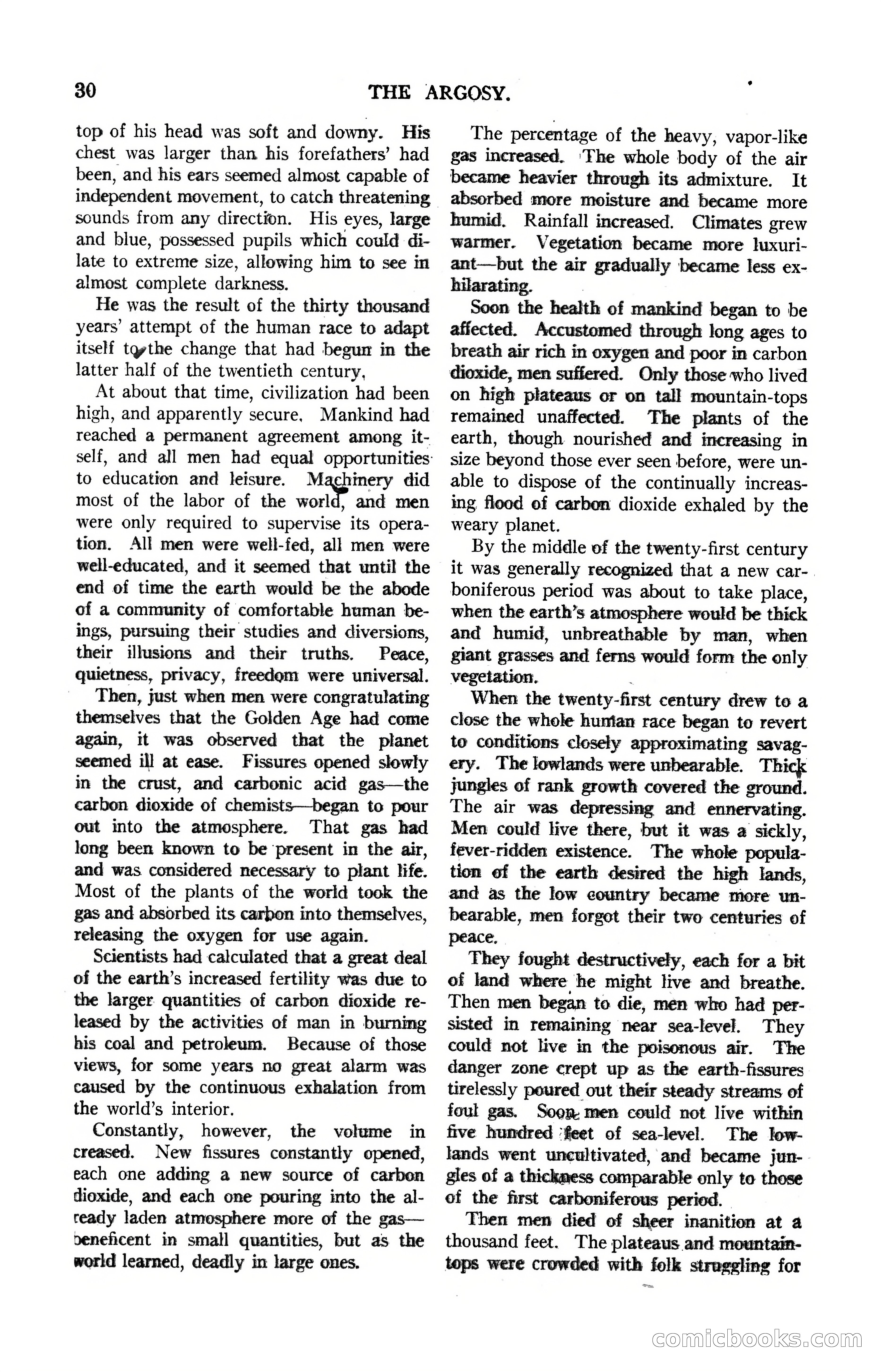
A restored page from Pulp Fiction, 1920. Page through the whole issue in the reader above.
📄 Transcribed text from this page (OCR, searchable)
Machine-transcribed from the original scan — historical spelling and the odd misread are preserved.
30 top of his head was soft and downy. His chest was larger than his forefathers’ had been, and his ears seemed almost capable of independent movement, to catch threatening sounds from any direction. His eyes, large and blue, possessed pupils which could di- late to extreme size, allowing him to see in almost complete darkness. He was the result of the thirty thousand years’ attempt of the human race to adapt itself tgythe change that had begun in the latter half of the twentieth century, At about that time, civilization had been high, and apparently secure, Mankind had reached a permanent agreement among it- self, and all men had equal opportunities: to education and leisure. Machinery did most of the labor of the world and men were only required to supervise its opera- tion. All men were well-fed, all men were well-educated, and it seemed that until the end of time the earth would be the abode of a community of comfortable human be- ings, pursuing their studies and diversions, their illusions and their truths. Peace, quietness, privacy, freedom were universal. Then, just when men were congratulating themselves that the Golden Age had come again, it was observed that the planet seemed ill at ease. Fissures opened slowly im the crust, and carbonic acid gas—the carbon dioxide of chemists—began to pour out into the atmosphere. That gas had long been known to be present in the air, and was considered necessary to plant life. Most of the plants of the world took the gas and absorbed its carbon into themselves, releasing the oxygen for use again. Scientists had calculated that a great deal of the earth’s increased fertility was due to the larger quantities of carbon dioxide re- leased by the activities of man in burning his coal and petroleum. Because of those views, for some years no great alarm was caused by the continuous exhalation from the world’s interior. Constantly, however, the volume in creased. New fissures constantly opened, each one adding a new source of carbon dioxide, and each one pouring into the al- ready laden atmosphere more of the gas— beneficent in small quantities, but as the world learned, deadly in large ones. THE ARGOSY. The percentage of the heavy, vapor-like gas increased. ‘The whole body of the air became heavier through its admixture. It absorbed more moisture and became more humid. Rainfall increased. Climates grew warmer. Vegetation became more luxuri- ant—but the air gradually became less ex- Soon the health of mankind began to be affected. Accustomed through long ages to breath air rich in oxygen and poor in carbon dioxide, men suffered. Only those who lived on high plateaus or on tall mountain-tops remained unaffected. The plants of the earth, though nourished and increasing in size beyond those ever seen before, were un- able to dispose of the continually increas- ing, flood of carbon dioxide exhaled by the weary planet. By the middle of the twenty-first century it was generally recognized that a new car-_ boniferous period was about to take place, when the earth’s atmosphere would be thick and humid, unbreathable by man, when giant grasses and ferns would form the only vegetation. When the twenty-first century drew te a close the whole human race began to revert to conditions closely approximating savag- ery. The lowlands were unbearable. Thick jungles of rank growth covered the ground. The air was depressing and ennervating. Men could live there, but it was a sickly, fever-ridden existence. The whole popula- tion of the earth desired the high lands, and as the low country became more un- bearable, men forget their two centuries of peace. They fought destructively, each for a bit of land where he might live and breathe. Then men began to die, men who had per- sisted in remaining near sea-level. They could not live in the poisonous air. The danger zone crept up as the earth-fissures tirelessly poured out their steady streams of foul gas. Soom men could not live within five hundred ‘feet of sea-level. The low- lands went uncultivated, and became jun- gles of a thickmess comparable only to those of the first carboniferous period. Then men died of sheer inanition at a thousand feet. The plateaus and mountain- tops were crowded with folk stregeling for cComiclbooks.com