
Pulp Fiction, 1920 · page 38 of 164
Argosy, Vol. 122, No. 1 — page 38: what you’re looking at
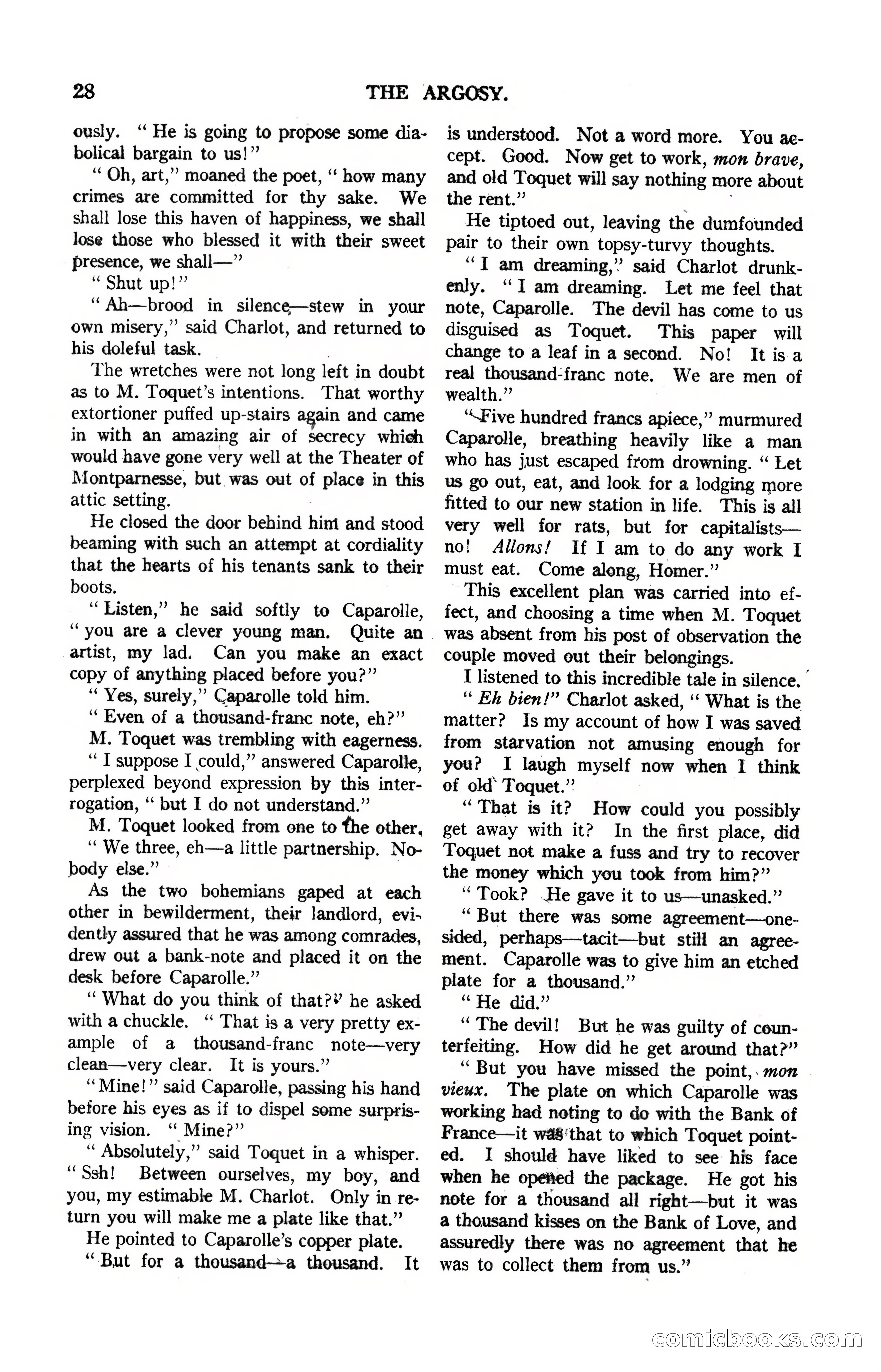
A restored page from Pulp Fiction, 1920. Page through the whole issue in the reader above.
📄 Transcribed text from this page (OCR, searchable)
Machine-transcribed from the original scan — historical spelling and the odd misread are preserved.
28 ously. ‘‘ He is going to propose some dia- bolical bargain to us!” ‘Qh, art,” moaned the poet, “ how many crimes are committed for thy sake. We shall lose this haven of happiness, we shall lose those who blessed it with their sweet presence, we shall—”’ ‘* Shut up!” ‘““Ah—brood in silence—stew in your own misery,” said Charlot, and returned to his doleful task. The wretches were not long left in doubt as to M. Toquet’s intentions. That worthy extortioner puffed up-stairs again and came in with an amazing air of secrecy which would have gone very well at the Theater of Montparnesse, but was out of place in this attic setting. : He closed the door behind himi and stood beaming with such an attempt at cordiality that the hearts of his tenants sank to their boots. “Listen,” he said softly to Caparolle, “you are a clever young man. Quite an. artist, my lad. Can you make an exact copy of anything placed before you?”’ ‘Yes, surely,” Caparolle told him. “Even of a thousand-franc note, eh?” M. Toquet was trembling with eagerness. ‘“ I suppose I could,” answered Caparolle, perplexed beyond expression by this inter- rogation, “ but I do not understand.” M. Toquet looked from one to the other, “We three, eh—a little partnership. No- body else.” As the two bohemians gaped at each other in bewilderment, their landlord, evi- dently assured that he was among comrades, drew out a bank-note and placed it on the desk before Caparolle.”’ ‘What do you think of that?” he asked with a chuckle. ‘‘ That is a very pretty ex- ample of a thousand-franc note—very clean—very clear. It is yours.” ‘‘Mine!” said Caparolle, passing his hand before his eyes as if to dispel some surpris- ing vision. “ Mine?” ‘‘ Absolutely,” said Toquet in a whisper. “Ssh! Between ourselves, my boy, and you, my estimable M. Charlot. Only in re- turn you will make me a plate like that.” He pointed to Caparolle’s copper plate. ‘But for a thousand—a thousand. It THE ARGOSY. is understood. Not aword more. You ac- cept. Good. Now get to work, mon brave, and old Toquet will say nothing more about the rent.” He tiptoed out, leaving the dumfounded pair to their own topsy-turvy thoughts. “I am dreaming,” said Charlot drunk- enly. ‘I am dreaming. Let me feel that note, Caparolle. The devil has come to us disguised as Toquet. This paper will change to a leaf in a second. No! Itisa real thousand-franc note. We are men of wealth.” : ‘Five hundred francs apiece,” murmured Caparolle, breathing heavily like a man who has just escaped from drowning. “ Let us go out, eat, and look for a lodging more fitted to our new station in life. This is all very well for rats, but for capitalists— no! Allons! If I am to do any work I must eat. Come along, Homer.’ This excellent plan was carried into ef- fect, and choosing a time when M. Toquet was absent from his post of observation the couple moved out their belongings. I listened to this incredible tale in silence. “ Eh bien!’ Charlot asked, ‘‘ What is the matter? Is my account of how I was saved from starvation not amusing enough for you? I laugh myself now when I think of old’ Toquet.” ‘That is it? How could you possibly get away with it? In the first place, did Toquet not make a fuss and try to recover the money which you took from him?” ‘Took? He gave it to us—unasked.” “But there was some agreement—one- sided, perhaps—tacit—but still an agree- ment. Caparolle was to give him an etched plate for a thousand.” ‘He did.” “The devil! But he was guilty of coun- terfeitmg. How did he get around that?” ‘But you have missed the point,. mon vieux, The plate on which Caparolle was working had neting to do with the Bank of France—it wa8'that to which Toquet point- ed. I should have liked to see his face when he opefted the package. He got his note for a thousand all right—but it was a thousand kisses on the Bank of Love, and assuredly there was no agreement that he was to collect them from us.” cComiclbooks.com