
Pulp Fiction, 1920 · page 28 of 164
Argosy, Vol. 122, No. 1 — page 28: what you’re looking at
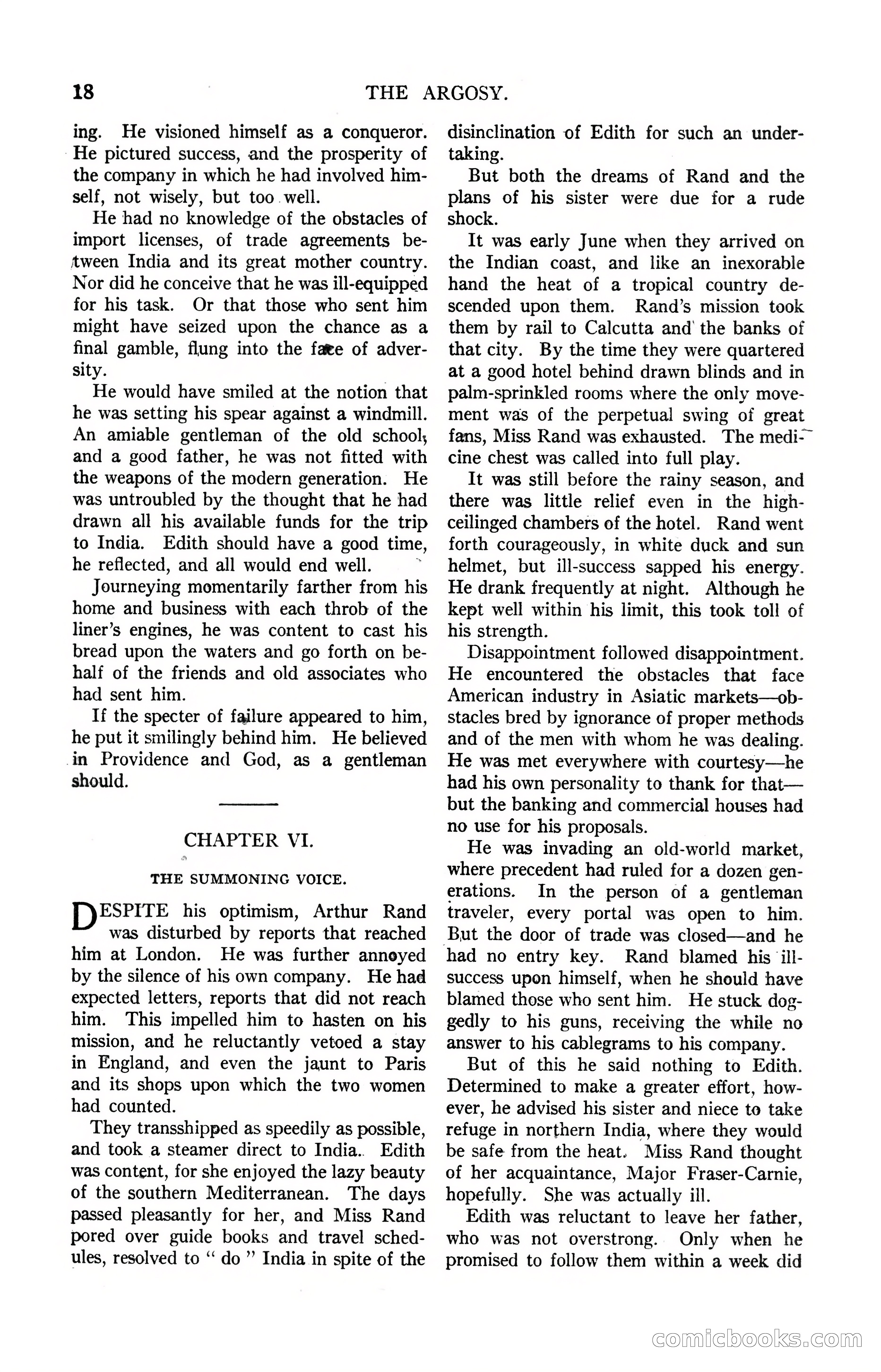
A restored page from Pulp Fiction, 1920. Page through the whole issue in the reader above.
📄 Transcribed text from this page (OCR, searchable)
Machine-transcribed from the original scan — historical spelling and the odd misread are preserved.
18 ing. He visioned himself as a conqueror. He pictured success, and the prosperity of the company in which he had involved him- self, not wisely, but too well. He had no knowledge of the obstacles of import licenses, of trade agreements be- tween India and its great mother country. Nor did he conceive that he was ill-equipped for his task. Or that those who sent him might have seized upon the chance as a final gamble, flung into the fate of adver- sity. He would have smiled at the notion that he was setting his spear against a windmill. An amiable gentleman of the old school, and a good father, he was not fitted with the weapons of the modern generation. He was untroubled by the thought that he had drawn all his available funds for the trip to India. Edith should have a good time, he reflected, and all would end well. Journeying momentarily farther from his home and business with each throb of the liner’s engines, he was content to cast his bread upon the waters and go forth on be- half of the friends and old associates who had sent him. If the specter of failure appeared to him, he put it smilingly behind him. He believed in Providence and God, as a gentleman should. CHAPTER VI. THE SUMMONING VOICE. DESPITE his optimism, Arthur Rand was disturbed by reports that reached him at London. He was further annoyed by the silence of his own company. He had expected letters, reports that did not reach him. This impelled him to hasten on his mission, and he reluctantly vetoed a stay in England, and even the jaunt to Paris and its shops upon which the two women had counted. They transshipped as speedily as possible, and took a steamer direct to India.. Edith was content, for she enjoyed the lazy beauty of the southern Mediterranean. The days passed pleasantly for her, and Miss Rand pored over guide books and travel sched- ules, resolved to “‘ do ” India in spite of the THE ARGOSY. disinclination of Edith for such an under- taking. But both the dreams of Rand and the plans of his sister were due for a rude shock. It was early June when they arrived on the Indian coast, and like an inexorable hand the heat of a tropical country de- scended upon them. Rand’s mission took them by rail to Calcutta and' the banks of that city. By the time they were quartered at a good hotel behind drawn blinds and in palm-sprinkled rooms where the only move- ment was of the perpetual swing of great fans, Miss Rand was exhausted. The medi-— cine chest was called into full play. It was still before the rainy season, and there was little relief even in the high- ceilinged chambers of the hotel. Rand went forth courageously, in white duck and sun helmet, but ill-success sapped his energy. He drank frequently at night. Although he kept well within his limit, this took toll of his strength. Disappointment followed disappointment. He encountered the obstacles that face American industry in Asiatic markets—ob- stacles bred by ignorance of proper methods and of the men with whom he was dealing. He was met everywhere with courtesy—he had his own personality to thank for that— but the banking and commercial houses had no use for his proposals. He was invading an old-world market, where precedent had ruled for a dozen gen- erations. In the person of a gentleman traveler, every portal was open to him. But the door of trade was closed—and he had no entry key. Rand blamed his ‘ill- success upon himself, when he should have blamed those who sent him. He stuck dog- gedly to his guns, receiving the while no answer to his cablegrams to his company. But of this he said nothing to Edith. Determined to make a greater effort, how- ever, he advised his sister and niece to take refuge in northern India, where they would be safe from the heat. Miss Rand thought of her acquaintance, Major Fraser-Carnie, hopefully. She was actually ill. Edith was reluctant to leave her father, who was not overstrong. Only when he promised to follow them within a week did cComiclbooks.com