
Pulp Fiction, 1920 · page 26 of 164
Argosy, Vol. 122, No. 1 — page 26: what you’re looking at
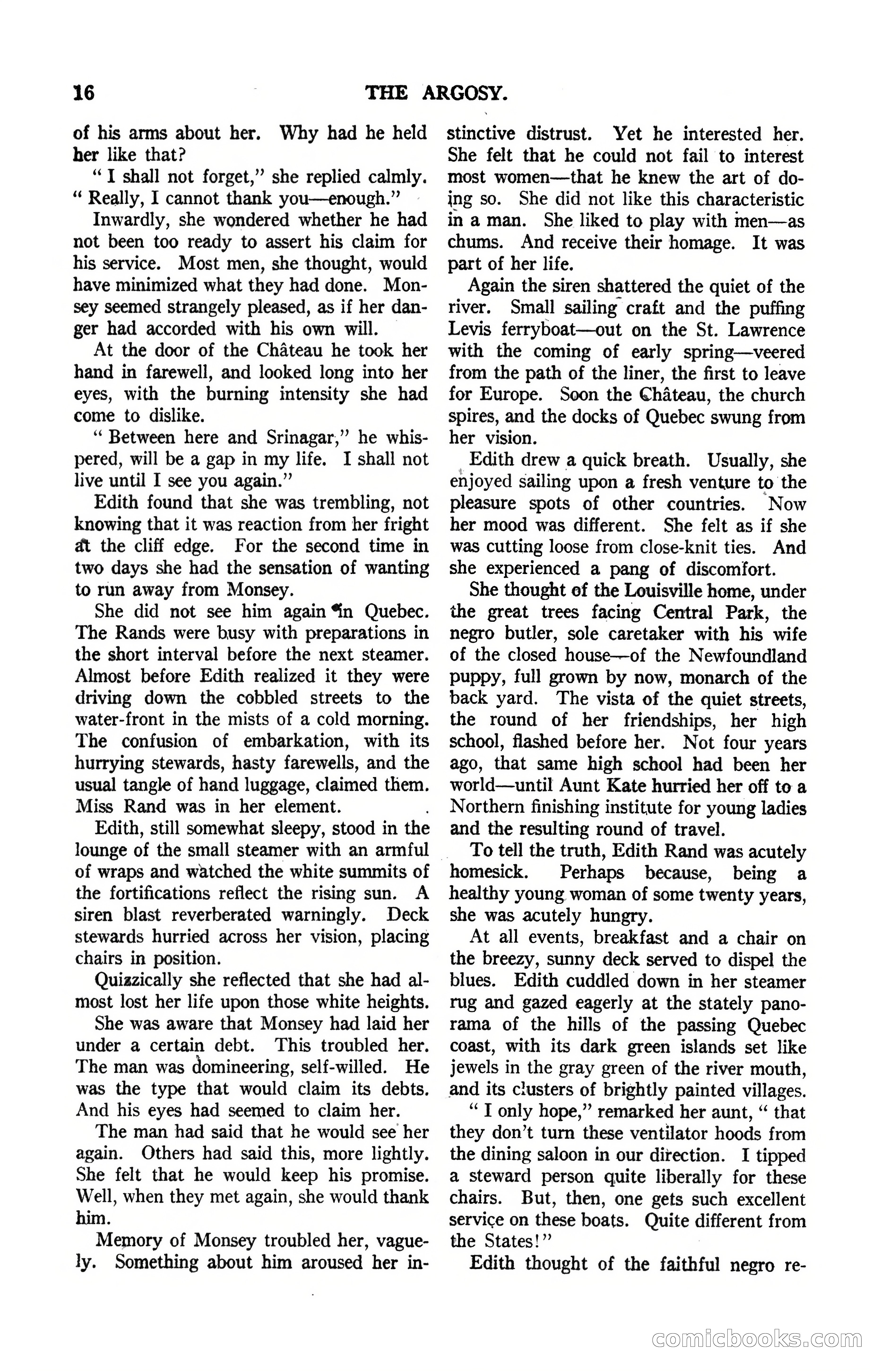
A restored page from Pulp Fiction, 1920. Page through the whole issue in the reader above.
📄 Transcribed text from this page (OCR, searchable)
Machine-transcribed from the original scan — historical spelling and the odd misread are preserved.
16 of his arms about her. her like that? “I shall not forget,” she replied calmly. “* Really, I cannot thank you—enough.”’ Inwardly, she wondered whether he had not been too ready to assert his claim for his service. Most men, she thought, would have minimized what they had done. Mon- sey seemed strangely pleased, as if her dan- ger had accorded with his own will. — At the door of the Chateau he took her hand in farewell, and looked long into her eyes, with the burning intensity she had come to dislike. ‘‘ Between here and Srinagar,” he whis- pered, will be a gap in my life. I shall not live until I see you again.” Edith found that she was trembling, not knowing that it was reaction from her fright at the cliff edge. For the second time in two days she had the sensation of wanting to run away from Monsey. She did not see him again “in Quebec. The Rands were busy with preparations in the short interval before the next steamer. Almost before Edith realized it they were driving down the cobbled streets to the water-front in the mists of a cold morning. The confusion of embarkation, with its hurrying stewards, hasty farewells, and the usual tangle of hand luggage, claimed them. Miss Rand was in her element. : Edith, still somewhat sleepy, stood in the Why had he held lounge of the small steamer with an armful | of wraps and watched the white summits of the fortifications reflect the rising sun. A siren blast reverberated warningly. Deck stewards hurried across her vision, placing chairs in position. Quizzically she reflected that she had al- most lost her life upon those white heights. She was aware that Monsey had laid her under a certain debt. This troubled her. The man was domineering, self-willed. He was the type that would claim its debts. And his eyes had seemed to claim her. The man had said that he would see her again. Others had said this, more lightly. She felt that he would keep his promise. Well, when they met again, she would thank him. Memory of Monsey troubled her, vague- ly. Something about him aroused her in- THE ARGOSY. stinctive distrust. Yet he interested her. She felt that he could not fail to interest most women—that he knew the art of do- ing so. She did not like this characteristic in aman. She liked to play with men—as chums. And receive their homage. It was part of her life. Again the siren shattered the quiet of the river. Small sailing craft and the puffing Levis ferryboat—out on the St. Lawrence with the coming of early spring—veered from the path of the liner, the first to leave for Europe. Soon the Chateau, the church spires, and the docks of Quebec swung from her vision. Edith drew a quick breath. Usually, she enjoyed sailing upon a fresh venture to the pleasure spots of other countries. Now her mood was different. She felt as if she was cutting loose from close-knit ties. And she experienced a pang of discomfort. She thought of the Louisville home, under the great trees facing Central Park, the negro butler, sole caretaker with his wife of the closed house—of the Newfoundland puppy, full grown by now, monarch of the back yard. The vista of the quiet streets, the round of her friendships, her high school, flashed before her. Not four years ago, that same high school had been her world—until Aunt Kate hurried her off to a Northern finishing institute for young ladies and the resulting round of travel. To tell the truth, Edith Rand was acutely homesick. Perhaps because, being a healthy young woman of some twenty years, she was acutely hungry. At all events, breakfast and a chair on the breezy, sunny deck served to dispel the blues. Edith cuddled down in her steamer rug and gazed eagerly at the stately pano- rama of the hills of the passing Quebec coast, with its dark green islands set like jewels in the gray green of the river mouth, and its clusters of brightly painted villages. ‘“T only hope,” remarked her aunt, “ that they don’t turn these ventilator hoods from the dining saloon in our direction. I tipped a steward person quite liberally for these chairs. But, then, one gets such excellent service on these boats. Quite different from the States!” Edith thought of the faithful negro re- cComiclbooks.com