
Pulp Fiction, 1920 · page 136 of 164
Argosy, Vol. 122, No. 1 — page 136: what you’re looking at
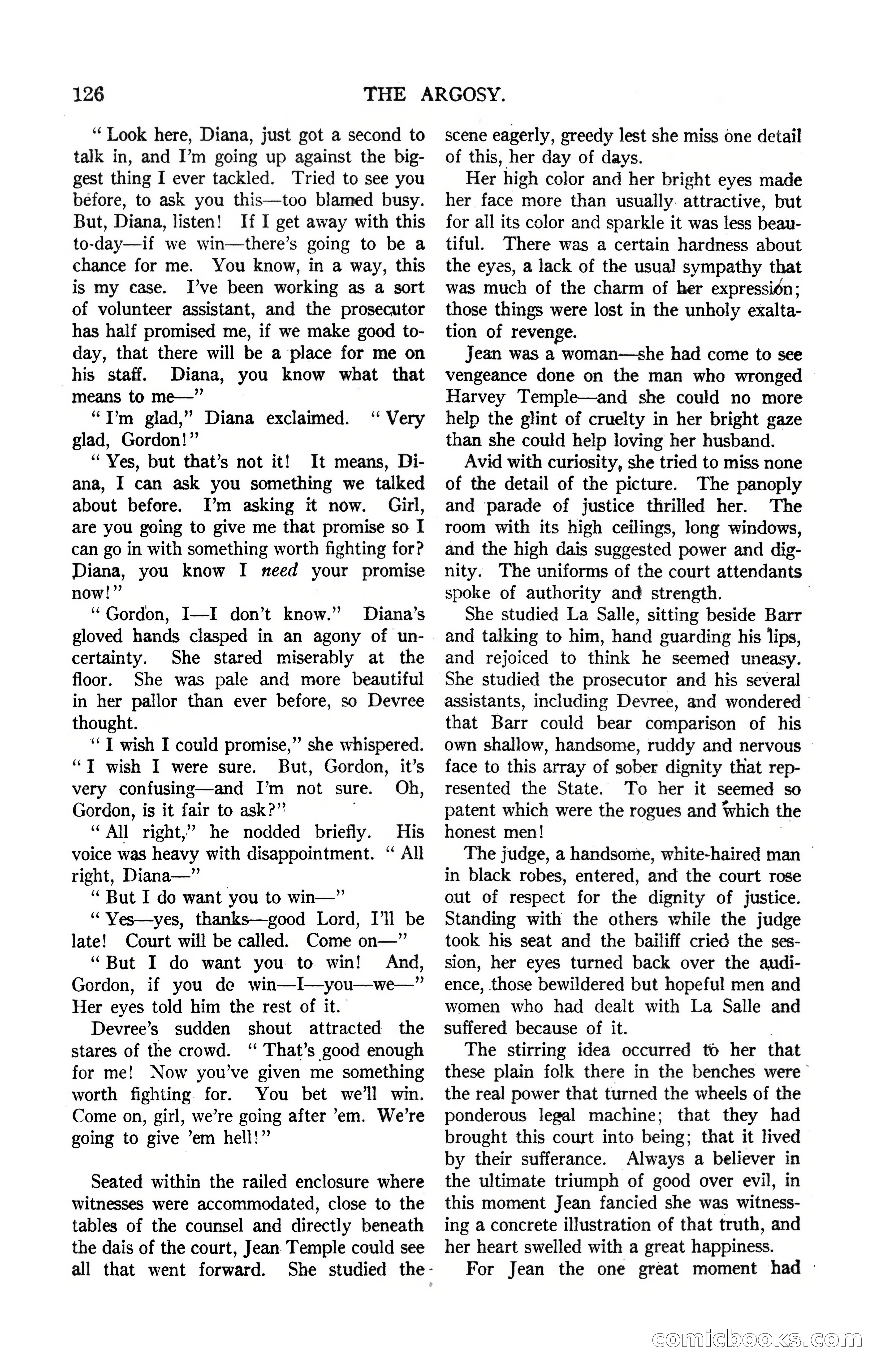
A restored page from Pulp Fiction, 1920. Page through the whole issue in the reader above.
📄 Transcribed text from this page (OCR, searchable)
Machine-transcribed from the original scan — historical spelling and the odd misread are preserved.
126 “Look here, Diana, just got a second to talk in, and I’m going up against the big- gest thing I ever tackled. Tried to see you before, to ask you this—too blamed busy. But, Diana, listen! If I get away with this to-day—if we win—there’s going to be a chance for me. You know, in a way, this is my case. I’ve been working as a sort of volunteer assistant, and the prosecutor has half promised me, if we make good to- day, that there will be a ‘place for me on his staff. Diana, you know what that means to me—’’ | “Tm glad,” Diana exclaimed. glad, Gordon!”’ “Yes, but that’s not it! It means, Di- ana, I can ask you something we talked about before. I’m asking it now. Girl, are you going to give me that promise so I can go in with something worth fighting for? Diana, you know I need your promise now!” “Gordon, I—I don’t know.” &e Very Diana’s gloved hands clasped in an agony of un- | certainty. She stared miserably at the floor. She was pale and more beautiful in her pallor than ever before, so Devree thought. “T wish I could promise,” she whispered. “TI wish I were sure. But, Gordon, it’s very confusing—and I’m not sure. Oh, Gordon, is it fair to ask?” “All right,’’ he nodded briefly. His voice was heavy with disappointment. “ All right, Diana—”’ “ But I do want you to win—” ‘““Ves—yes, thanks—good Lord, I'll be late! Court will be called. Come on—” “But I do want you to win! And, Gordon, if you de win—I—you—we—”’ Her eyes told him the rest of it. Devree’s sudden shout attracted the stares of the crowd. ‘“ That’s good enough for me! Now you’ve given me something worth fighting. for. You bet we'll win. Come on, girl, we’re going after em. We're going to give ’em hell!” Seated within the railed enclosure where witnesses were accommodated, close to the tables of the counsel and directly beneath the dais of the court, Jean Temple could see all that went forward. She studied the- THE ARGOSY. scene eagerly, greedy lest she miss one detail of this, her day of days. Her high color and her bright eyes made her face more than usually. attractive, but for all its color and sparkle it was less beau- tiful. There was a certain hardness about the eyes, a lack of the usual sympathy that was much of the charm of her expressién; those things were lost in the unholy exalta- tion of revenge. Jean was a woman—she had come to see vengeance done on the man who wronged Harvey Temple—and she could no more help the glint of cruelty in her bright gaze than she could help loving her husband. Avid with curiosity, she tried to miss none of the detail of the picture. The panoply and parade of justice thrilled her. The room with its high ceilings, long windows, and the high dais suggested power and dig- nity. The uniforms of the court attendants spoke of authority and strength. | She studied La Salle, sitting beside Barr and talking to him, hand guarding his lips, and rejoiced to think he seemed uneasy. She studied the prosecutor and his several assistants, including Devree, and wondered that Barr could bear comparison of his own shallow, handsome, ruddy and nervous — face to this array of sober dignity that rep- resented the State. To her it seemed so patent which were the rogues and Which the honest men! | | The judge, a handsome, white-haired man — in black robes, entered, and the court rose out of respect for the dignity of justice. Standing with the others while the judge took his seat and the bailiff cried the ses- sion, her eyes turned back over the audi- ence, those bewildered but hopeful men and women who had dealt with La Salle and suffered because of it. | The stirring idea occurred to her that these plain folk there in the benches were the real power that turned the wheels of the ponderous legal machine; that they had brought this court into being; that it lived by their sufferance. Always a believer in the ultimate triumph of good over evil, in this moment Jean fancied she was witness- ing a concrete illustration of that truth, and her heart swelled with a great happiness. For Jean the one great moment had — cComiclbooks.com