
Pulp Fiction, 1920 · page 12 of 164
Argosy, Vol. 122, No. 1 — page 12: what you’re looking at
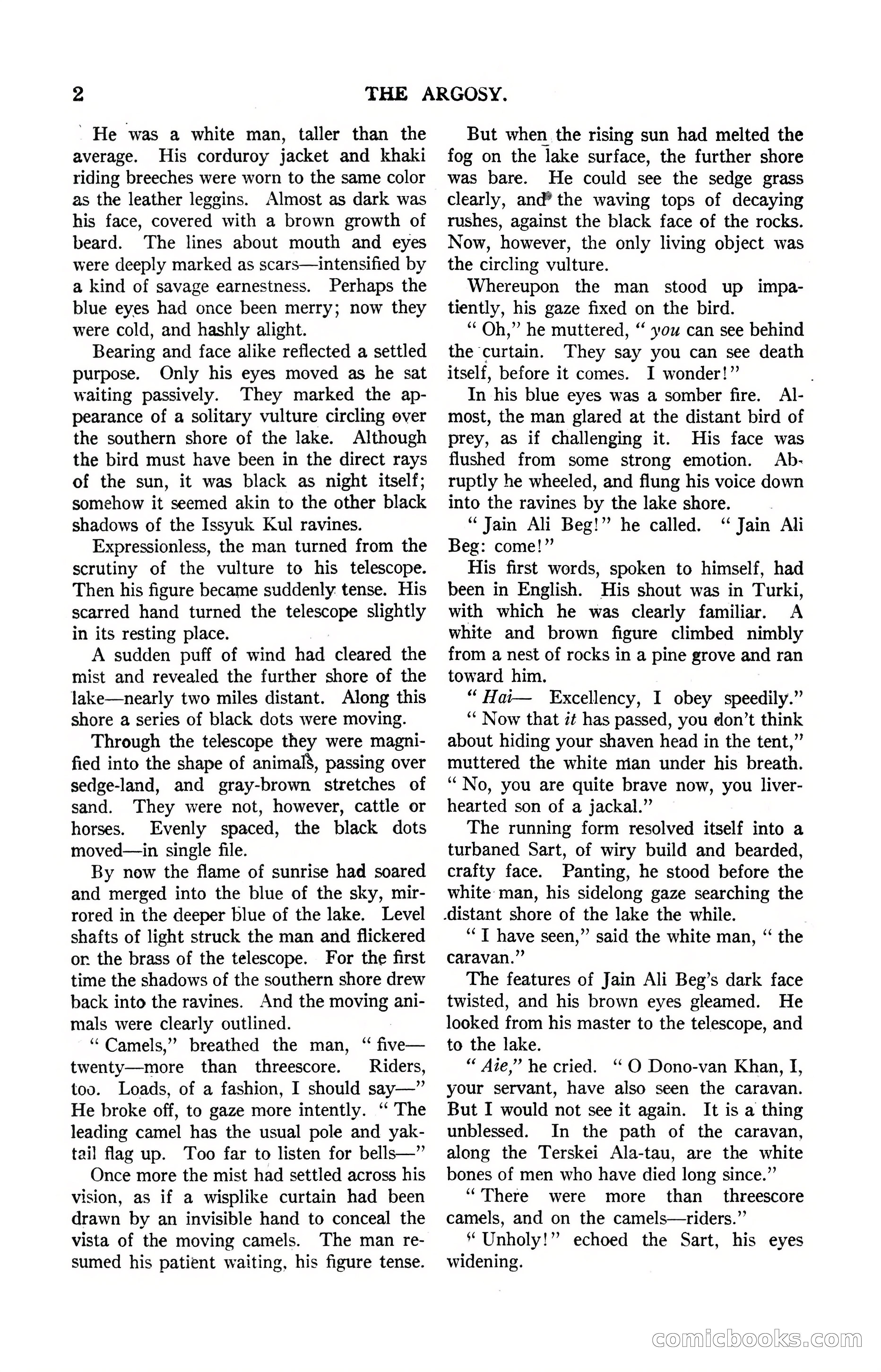
A restored page from Pulp Fiction, 1920. Page through the whole issue in the reader above.
📄 Transcribed text from this page (OCR, searchable)
Machine-transcribed from the original scan — historical spelling and the odd misread are preserved.
2 THE ARGOSY. ' He was a white man, taller than the average. His corduroy jacket and khaki riding breeches were worn to the same color as the leather leggins. Almost as dark was his face, covered with a brown growth of beard. The lines about mouth and eyes were deeply marked as scars—intensified by a kind of savage earnestness. Perhaps the blue eyes had once been merry; now they were cold, and hashly alight. Bearing and face alike reflected a settled purpose. Only his eyes moved as he sat waiting passively. They marked the ap- pearance of a solitary vulture circling over the southern shore of the lake. Although the bird must have been in the direct rays of the sun, it was black as night itself; somehow it seemed akin to the other black shadows of the Issyuk Kul ravines. Expressionless, the man turned from the scrutiny of the vulture to his telescope. Then his figure became suddenly tense. His scarred hand turned the leet slightly in its resting place. A sudden puff of wind had cleared the mist and revealed the further shore of the lake—nearly two miles distant. Along this shore a series of black dots were moving. Through the telescope they were magni- fied into the shape of animals, passing over sedge-land, and gray-brown stretches of sand. They were not, however, cattle or horses. Evenly spaced, the black dots moved—in single file. By now the flame of sunrise had soared and merged into the blue of the sky, mir- rored in the deeper blue of the lake. Level shafts of light struck the man and flickered or the brass of the telescope. For the first time the shadows of the southern shore drew back into the ravines. And the moving ani- mals were clearly outlined. “Camels,” breathed the man, “ five— twenty—more than threescore. Riders, too. Loads, of a fashion, I should say—” He broke off, to gaze more intently. ‘‘ The leading camel has the usual pole and yak- tail flag up. Too far to listen for bells—” Once more the mist had settled across his vision, as if a wisplike curtain had been drawn by an invisible hand to conceal the vista of the moving camels. The man re- sumed his patient waiting, his figure tense. But when the rising sun had melted the fog on the lake surface, the further shore was bare. He could see the sedge grass clearly, and® the waving tops of decaying rushes, against the black face of the rocks. Now, however, the only living object was the circling vulture. Whereupon the man stood up impa- tiently, his gaze fixed on the bird. “Oh,” he muttered, “‘ you can see behind the curtain. They say you can see death itself, before it comes. I wonder!” , In his blue eyes was a somber fire. Al- most, the man glared at the distant bird of prey, as if challenging it. His face was flushed from some strong emotion. Ab- ruptly he wheeled, and flung his voice down into the ravines by the lake shore. “Jain Ali Beg!” he called. ‘ Jain Ali Beg: come!” His first words, spoken to himself, had been in English. His shout was in Turki, with which he was clearly familiar. <A white and brown figure climbed nimbly from a nest of rocks in a pine grove and ran toward him, “ Hai— Excellency, I obey speedily.” ‘* Now that zt has passed, you don’t think about hiding your shaven head in the tent,” muttered the white nian under his breath. ‘No, you are quite brave now, you liver- hearted son of a jackal.” The running form resolved itself into a turbaned Sart, of wiry build and bearded, crafty face. Panting, he stood before the white man, his sidelong gaze searching the distant shore of the lake the while. ‘‘T have seen,” caravan.” The features of Jain Ali Beg’s dark face twisted, and his brown eyes gleamed. He looked from his master to the telescope, and to the lake. “Ate,” he cried. ‘‘O Dono-van Khan, I, your servant, have also seen the caravan. But I would not see it again. It is a thing unblessed. In the path of the caravan, along the Terskei Ala-tau, are the white bones of men who have died long since.” “There were more than _ threescore camels, and on the camels—riders.”’ * Unholy!” echoed the Sart, his eyes widening. said the white man, ‘‘ the cComiclbooks.com