
Pulp Fiction, 1920 · page 108 of 164
Argosy, Vol. 122, No. 1 — page 108: what you’re looking at
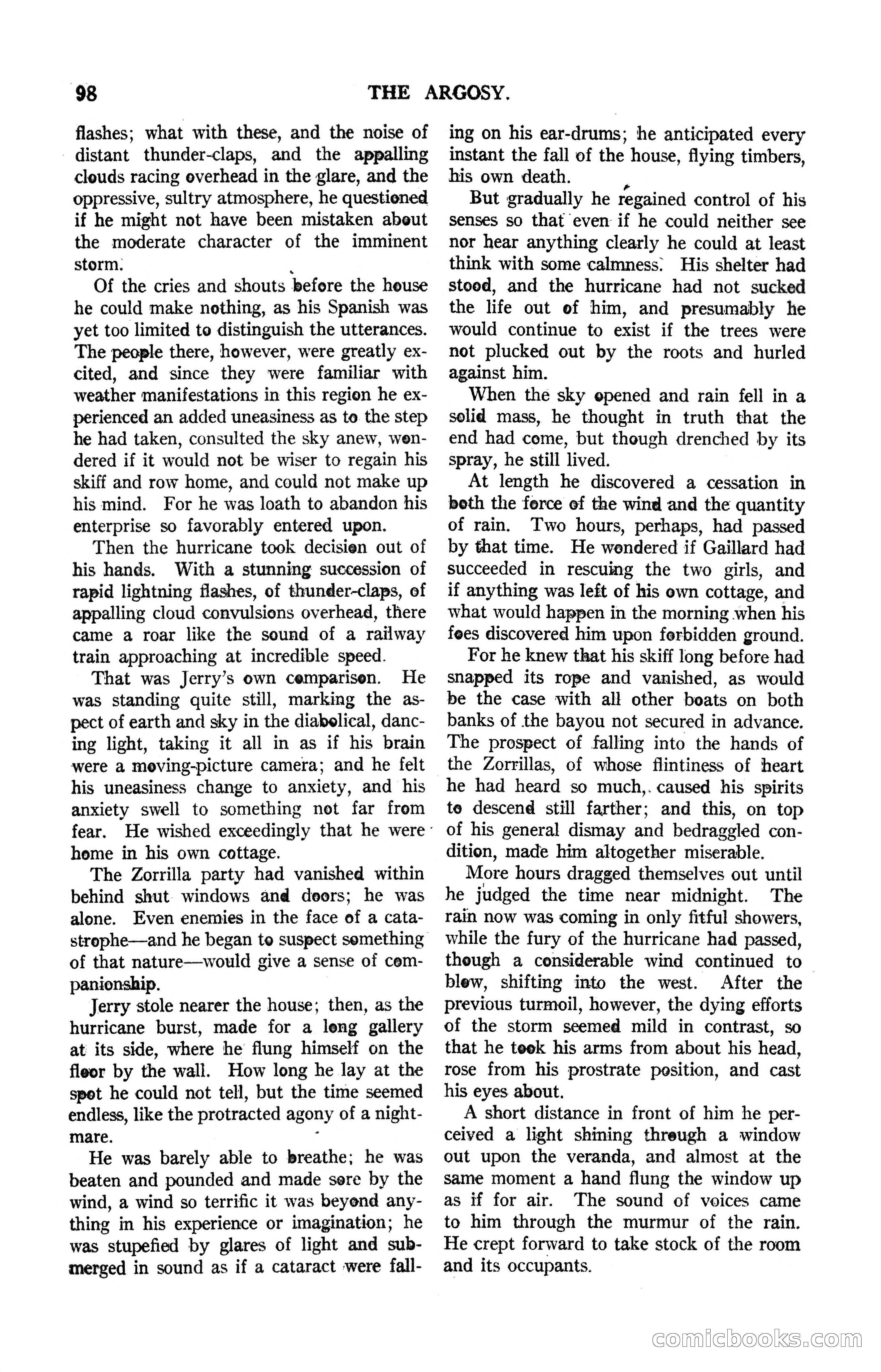
A restored page from Pulp Fiction, 1920. Page through the whole issue in the reader above.
📄 Transcribed text from this page (OCR, searchable)
Machine-transcribed from the original scan — historical spelling and the odd misread are preserved.
98 flashes; what with these, and the noise of distant thunder-claps, and the appalling cleuds racing everhead in the glare, and the oppressive, sultry atmosphere, he questioned if he might not have been mistaken abeut the moderate character of the imminent storm. . Of the cries and shouts before the house he could make nothing, as his Spanish was yet too limited to distinguish the utterances. The people there, however, were greatly ex- cited, and since they were familiar with weather manifestations in this region he ex- perienced an added uneasiness as to the step he had taken, consulted the sky anew, wen- dered if it would not be wiser to regain his skiff and row home, and could not make up his mind. For he was loath to abandon his enterprise so favorably entered upon. Then the hurricane took decisien out of his hands. With a stunning succession of rapid lightning flashes, of thunder-claps, of appalling cloud convulsions overhead, there came a roar like the sound of a railway train approaching at incredible speed. That was Jerry’s own cemparisen. He was standing quite still, marking the as- pect of earth and sky in the diabolical, danc- ing light, taking it all in as if his brain were a meving-picture camera; and he felt his uneasiness change to anxiety, and his anxiety swell to something not far from fear. home in his own cottage. The Zorrilla party had vanished within behind shut windows and deers; he was alone. Even enemies in the face of a cata- strophe—and he began to suspect something of that nature—would give a sense of cem- panionship. Jerry stole nearer the house; then, as the hurricane burst, made for a leng gallery at its side, where he flung himself on the fleor by the wall. How long he lay at the spet he could not tell, but the time seemed endless, like the protracted agony of a night- mare. ° He was barely able to breathe; he was beaten and pounded and made sore by the wind, a wind so terrific it was beyend any- thing in his experience or imagination; he was stupefied by glares of light and sub- merged in sound as if a cataract were fall- He wished exceedingly that he were - THE ARGOSY. ing on his ear-drums; he anticipated every instant the fall of the house, flying timbers, his own death. P But gradually he regained control of his senses so that even if he could neither see nor hear anything clearly he could at least think with some calmness. His shelter had stoed, and the hurricane had not sucked the life out of him, and presumably he would continue to exist if the trees were not plucked out by the roots and hurled against him. When the sky opened and rain fell in a solid mass, he thought in truth that the end had come, but though drenched by its spray, he still lived. At length he discovered a cessation in both the ferce of the wind and the quantity of rain. Two hours, perhaps, had passed by that time. He wendered if Gaillard had succeeded in rescuing the two girls, and if anything was left of his own cottage, and what would happen in the morning when his fees discovered him upon ferbidden ground. For he knew that his skiff long before had snapped its rope and vanished, as would be the case with all other boats on both banks of the bayou not secured in advance. The prospect of falling into the hands of the Zorrillas, of whose flintiness of heart he had heard so much,. caused his spirits te descend still farther; and this, on top of his general dismay and bedraggled con- dition, made him altogether miserable. More hours dragged themselves out until he judged the time near midnight. The rain now was coming in only fitful showers, while the fury of the hurricane had passed, theugh a considerable wind continued to blew, shifting into the west. After the previous turmoil, however, the dying efforts of the storm seemed mild in contrast, so that he teek his arms from about his head, rose from his prostrate position, and cast his eyes about. A short distance in front of him he per- ceived a light shining threugh a window out upon the veranda, and almost at the same moment a hand flung the window up as if for air. The sound of voices came to him through the murmur of the rain. He crept forward to take stock of the room and its occupants. cCOomiclbooks.com