
Pulp Fiction, 1920 · page 104 of 164
Argosy, Vol. 122, No. 1 — page 104: what you’re looking at
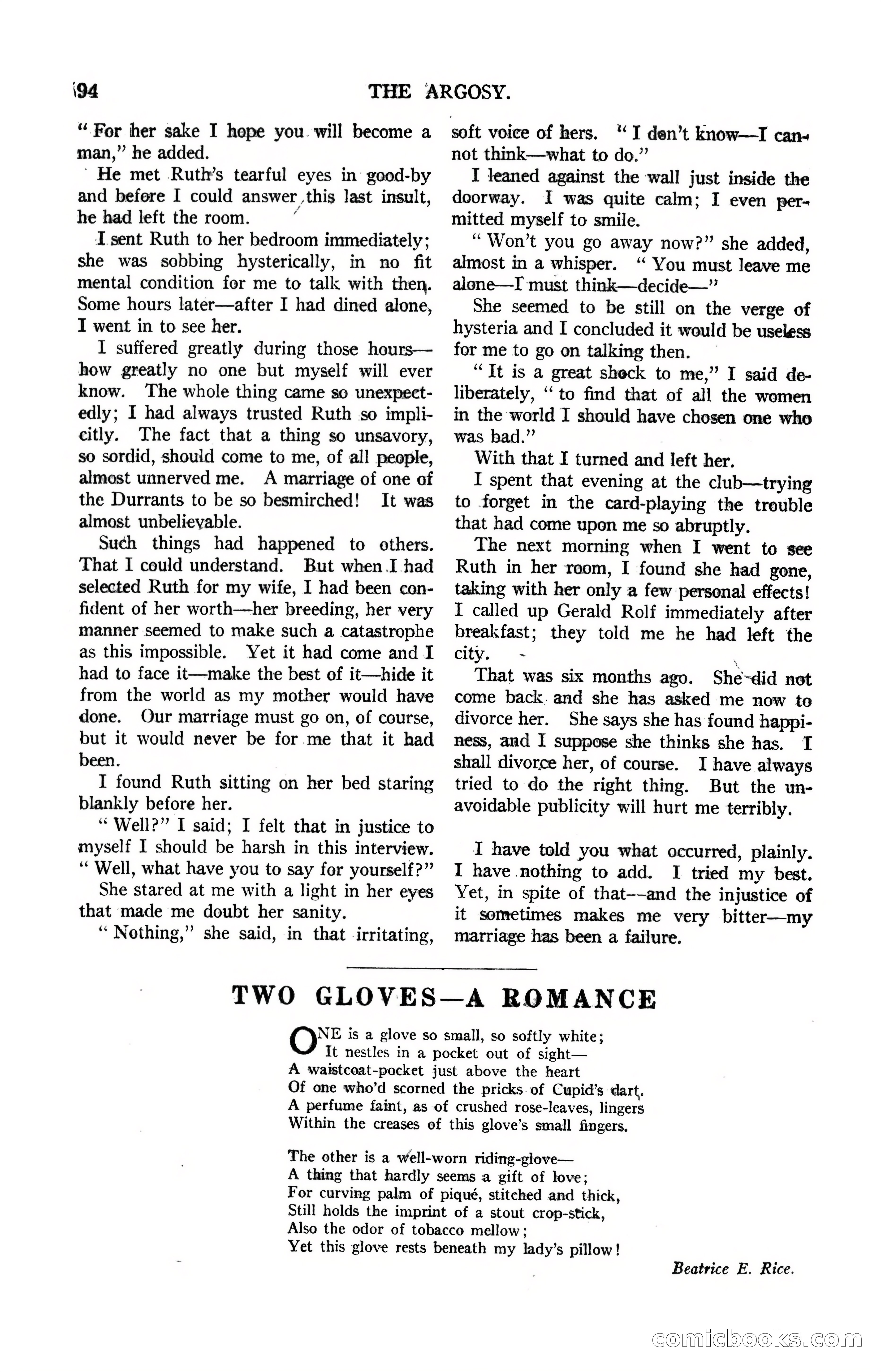
A restored page from Pulp Fiction, 1920. Page through the whole issue in the reader above.
📄 Transcribed text from this page (OCR, searchable)
Machine-transcribed from the original scan — historical spelling and the odd misread are preserved.
“For her sake I hope you will become a man,” he added. ' He met Ruth’s tearful eyes in good-by and before I could answer ,this last insult, he had left the room. I sent Ruth to her bedroom immediately ; she was sobbing hysterically, in no fit mental condition for me to talk with then. Some hours later—after I had dined alone, I went in to see her. I suffered greatly during those hours— how greatly no one but myself will ever know. The whole thing came so unexpect- edly; I had always trusted Ruth so impli- citly. The fact that a thing so unsavory, so sordid, should come to me, of all people, almost unnerved me. A marriage of one of the Durrants to be so besmirched! It was almost unbelievable. Such things had happened to others. That I could understand. But when.I had selected Ruth for my wife, I had been con- fident of her worth—her breeding, her very manner seemed to make such a catastrophe as this impossible. Yet it had come and I had to face it—make the best of it—hide it from the world as my mother would have done. Our marriage must go on, of course, but it would never be for me that it had been. I found Ruth sitting on her bed staring blankly before her. “Well?” I said; I felt that in justice to myself I should be harsh in this interview. ‘Well, what have you to say for yourself?” She stared at me with a light in her eyes that made me doubt her sanity. “ Nothing,” she said, in that irritating, soft voice of hers. THE ARGOSY. “T den’t know—I can. not think—what to do.” I Jeaned against the wall just inside the doorway. I was quite calm; I even per- mitted myself to smile. ‘ Won’t you go away now?” she added, almost in a whisper. ‘ You must leave me alone—I must think—decide—” She seemed to be still on the verge of hysteria and I concluded it would be useless for me to go on talking then. — “It is a great shock to me,” I said de- liberately, “to find that of all the women in the world I should have chosen one who was bad.” . With that I turned and left her. I spent that evening at the club—trying to forget in the card-playing the trouble that had come upon me so abruptly. The next morning when I went to see Ruth in her room, I found she had gone, taking with her only a few personal effects! I called up Gerald Rolf immediately after breakfast; they told me he had left the city. - ; That was six months ago. She~did not come back. and she has asked me now to divorce her. She says she has found happi- ness, and I suppose she thinks she has. I shall divorce her, of course. I have always tried to do the right thing. But the un- avoidable publicity will hurt me terribly. I have told you what occurred, plainly. I have nothing to add. I tried my best. Yet, in spite of that-—-and the injustice of it sometimes makes me very bitter—my marriage has been a failure. TWO GLOVES—A ROMANCE O* E is a glove so small, so softly white; It nestles in a pocket out of sight— A waistcoat-pocket just above the heart Of one who'd scorned the pricks. of Cupid’s dart. A perfume faint, as of crushed rose-leaves, lingers Within the creases of this glove’s small fingers, The other is a well-worn riding-glove— A thing that hardly seems a gift of love; For curving palm of piqué, stitched and thick, Still holds the imprint of a stout crop-stick, Also the odor of tobacco mellow; Yet this glove rests beneath my lady’s pillow! Beatrice E. Rice. cComiclbooks.com