
Pulp Fiction, 1920 · page 92 of 180
Argosy, Vol. 118, No. 4 — page 92: what you’re looking at
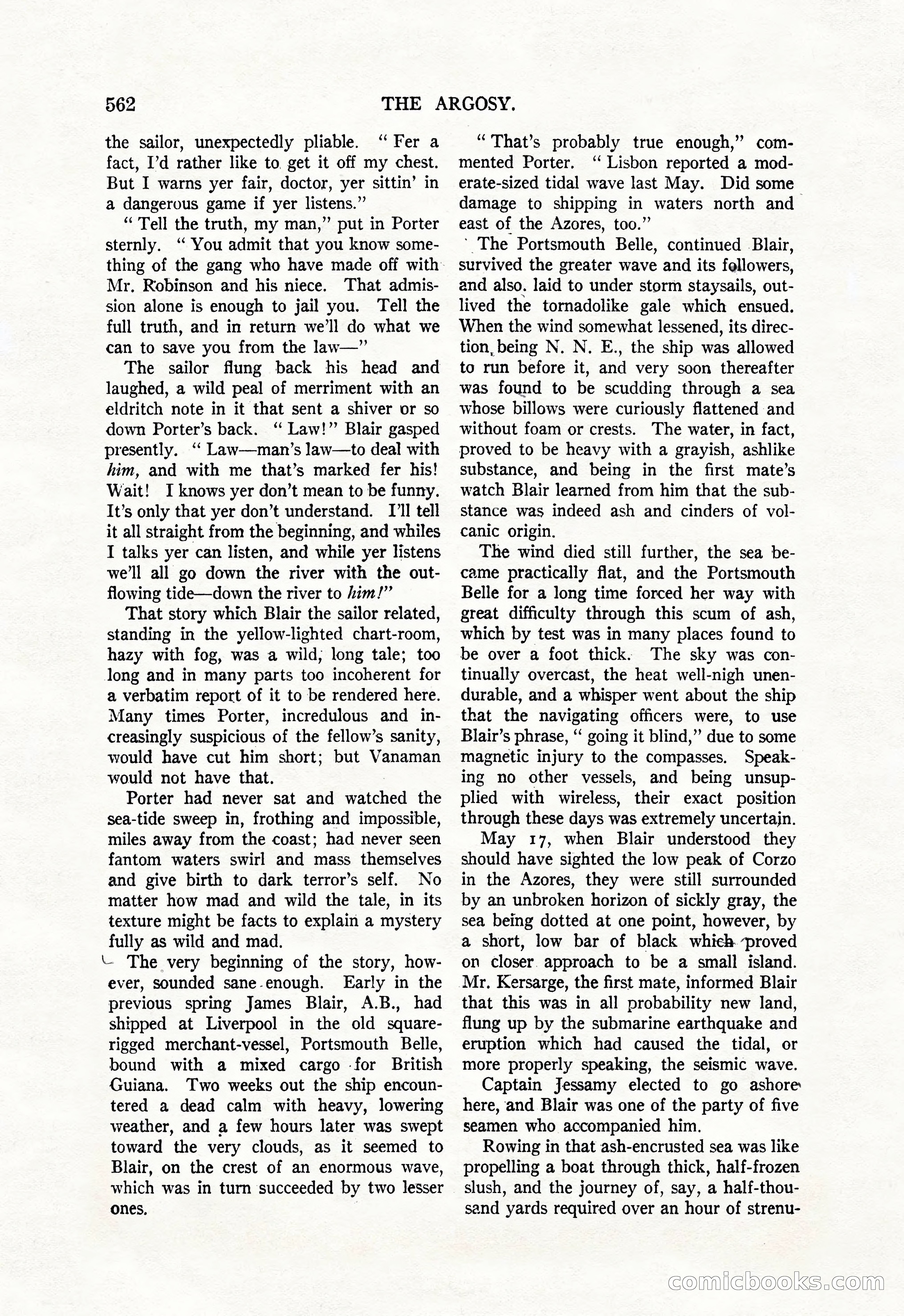
A restored page from Pulp Fiction, 1920. Page through the whole issue in the reader above.
📄 Transcribed text from this page (OCR, searchable)
Machine-transcribed from the original scan — historical spelling and the odd misread are preserved.
562 the sailor, unexpectedly pliable. “Fer a fact, I’d rather like to get it off my chest. But I warns yer fair, doctor, yer sittin’ in a dangerous game if yer listens.” “ Tell the truth, my man,” put in Porter sternly. ‘“ You admit that you know some- thing of the gang who have made off with: Mr. Robinson and his niece. That admis- sion alone is enough to jail you. Tell the full truth, and in return we’ll do what we can to save you from the law—”’ The sailor flung back his head and laughed, a wild peal of merriment with an eldritch note in it that sent a shiver or so down Porter’s back. ‘“ Law!” Blair gasped presently. ‘‘ Law—man’s lJaw—to deal with him, and with me that’s marked fer his! Wait! I knows yer don’t mean to be funny. It’s only that yer don’t understand. I'll tell it all straight from the beginning, and whiles I talks yer can listen, and while yer listens we'll all go down the river with the out- flowing tide—down the river to him!” That story which Blair the sailor related, standing in the yellow-lighted chart-room, hazy with fog, was a wild; long tale; too long and in many parts too incoherent for a verbatim report of it to be rendered here. Many times Porter, incredulous and in- creasingly suspicious of the fellow’s sanity, would have cut him short; but Vanaman would not have that. Porter had never sat and watched the sea-tide sweep in, frothing and impossible, miles away from the coast; had never seen fantom waters swirl and mass themselves and give birth to dark terror’s self. No matter how mad and wild the tale, in its texture might be facts to explain a mystery fully as wild and mad. \_ The very beginning of the story, how- ever, sounded sane-enough. Early in the previous spring James Blair, A.B., had shipped at Liverpool in the old square- rigged merchant-vessel, Portsmouth Belle, bound with a mixed cargo -for British Guiana. Two weeks out the ship encoun- tered a dead calm with heavy, lowering weather, and a few hours later was swept toward the very clouds, as it seemed to Blair, on the crest of an enormous wave, which was in turn succeeded by two lesser ones. THE ARGOSY. ‘“That’s probably true enough,” com- mented Porter. ‘“‘ Lisbon reported a mod- erate-sized tidal wave last May. Did some damage to shipping in waters north and east of the Azores, too.” ’ The Portsmouth Belle, continued Blair, survived the greater wave and its followers, and also. laid to under storm staysails, out- lived the tornadolike gale which ensued. When the wind somewhat lessened, its direc- tion, being N. N. E., the ship was allowed to run before it, and very soon thereafter was found to be scudding through a sea whose billows were curiously flattened and without foam or crests. The water, in fact, proved to be heavy with a grayish, ashlike substance, and being in the first mate’s watch Blair learned from him that the sub- stance was indeed ash and cinders of vol- canic origin. The wind died still further, the sea be- came practically flat, and the Portsmouth Belle for a long time forced her way with great difficulty through this scum of ash, which by test was in many places found to be over a foot thick. The sky was con- tinually overcast, the heat well-nigh unen- durable, and a whisper went about the ship that the navigating officers were, to use Blair’s phrase, ‘‘ going it blind,” due to some magnetic injury to the compasses. Speak- ing no other vessels, and being unsup- plied with wireless, their exact position through these days was extremely uncertajn. May 17, when Blair understood they should have sighted the low peak of Corzo in the Azores, they were still surrounded by an unbroken horizon of sickly gray, the sea being dotted at one point, however, by a short, low bar of black which -proved on closer. approach to be a small island. Mr. Kersarge, the first mate, informed Blair that this was in all probability new land, flung up by the submarine earthquake and eruption which had caused the tidal, or more properly speaking, the seismic wave. Captain Jessamy elected to go ashore here, and Blair was one of the party of five seamen who accompanied him. Rowing in that ash-encrusted sea was like propelling a boat through thick, half-frozen slush, and the journey of, say, a half-thou- sand yards required over an hour of strenu- cComicoool.