
Pulp Fiction, 1920 · page 78 of 180
Argosy, Vol. 118, No. 4 — page 78: what you’re looking at
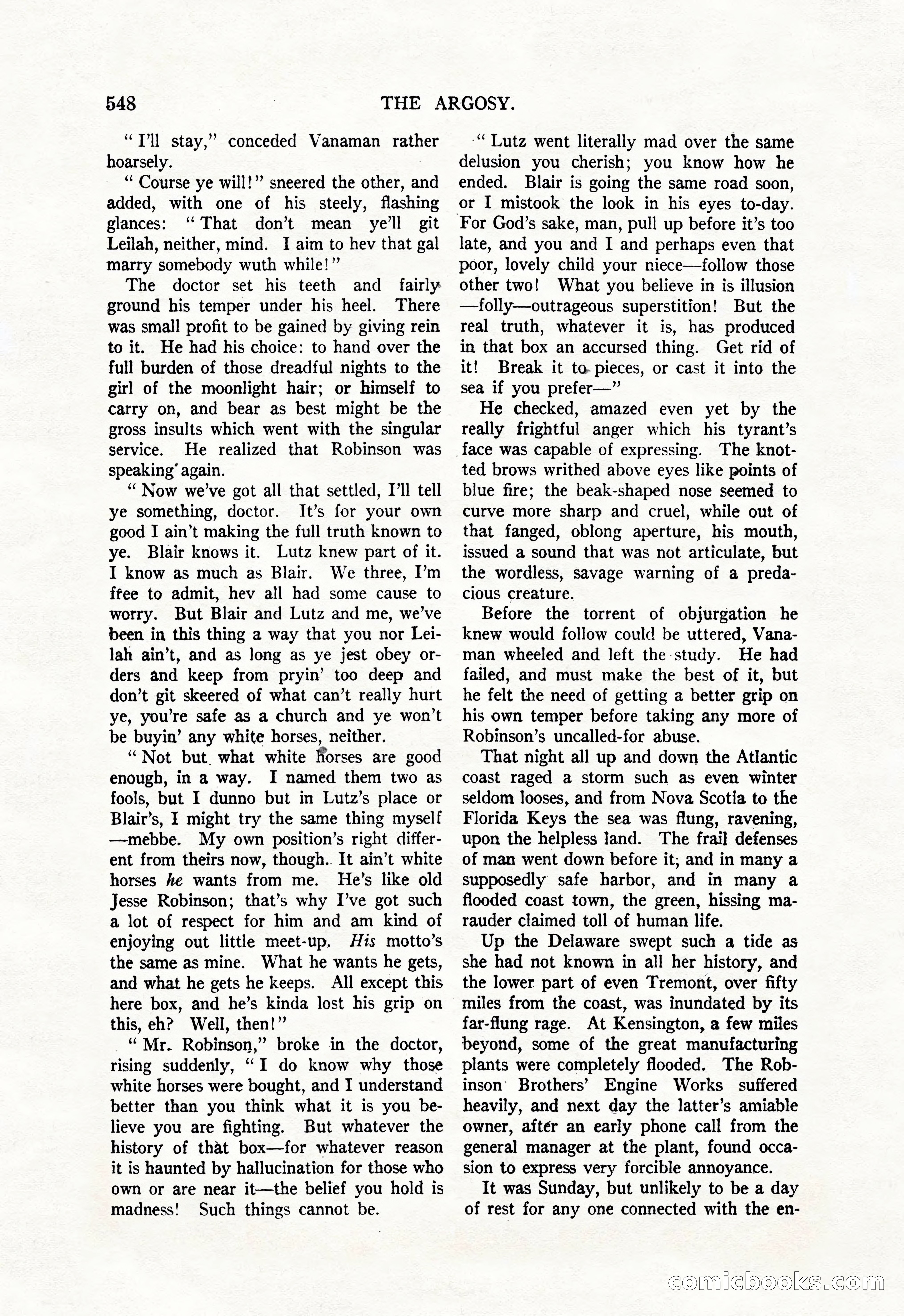
A restored page from Pulp Fiction, 1920. Page through the whole issue in the reader above.
📄 Transcribed text from this page (OCR, searchable)
Machine-transcribed from the original scan — historical spelling and the odd misread are preserved.
548 “Tl stay,” conceded Vanaman rather hoarsely. ‘“‘ Course ye will!” sneered the other, and added, with one of his steely, flashing glances: ‘‘ That don’t mean ye'll git Leilah, neither, mind. I aim to hev that gal marry somebody wuth while!”’ The doctor set his teeth and fairly ground his temper under his heel. There was small profit to be gained by giving rein to it. He had his choice: to hand over the full burden of those dreadful nights to the girl of the moonlight hair; or himself to carry on, and bear as best might be the gross insults which went with the singular service. He realized that Robinson was speaking’ again. “Now we've got all that settled, I’ll tell ye something, doctor. It’s for your own good I ain’t making the full truth known to ye. Blair knows it. Lutz knew part of it. I know as much as Blair. We three, I’m ffee to admit, hev all had some cause to worry. But Blair and Lutz and me, we’ve been in this thing a way that you nor Lei- lah ain’t, and as long as ye jest obey or- ders and keep from pryin’ too deep and don’t git skeered of what can’t really hurt ye, you’re safe as a church and ye won't be buyin’ any white horses, neither. “Not but. what white Horses are good enough, in a way. I named them two as fools, but I dunno but in Lutz’s place or Blair’s, I might try the same thing myself —mebbe. My own position’s right differ- ent from theirs now, though.. It ain’t white horses he wants from me. He’s like old Jesse Robinson; that’s why I’ve got such a lot of respect for him and am kind of enjoying out little meet-up. His motto’s the same as mine. What he wants he gets, and what he gets he keeps. All except this here box, and he’s kinda lost his grip on this, eh? Well, then!” “Mr. Robinson,” broke in the doctor, rising suddenly, “I do know why those white horses were bought, and I understand better than you think what it is you be- lieve you are fighting. But whatever the history of that box—for whatever reason it is haunted by hallucination for those who own or are near it—the belief you hold is madness! Such things cannot be. THE ARGOSY. “Lutz went literally mad over the same delusion you cherish; you know how he ended. Blair is going the same road soon, or I mistook the look in his eyes to-day. For God’s sake, man, pull up before it’s too late, and you and I and perhaps even that poor, lovely child your niece—follow those other two! What you believe in is illusion —folly—outrageous superstition! But the real truth, whatever it is, has produced in that box an accursed thing. Get rid of it! Break it to pieces, or cast it into the sea if you prefer—” He checked, amazed even yet by the really frightful anger which his tyrant’s face was capable of expressing. The knot- ted brows writhed above eyes like points of blue fire; the beak-shaped nose seemed to curve more sharp and cruel, while out of that fanged, oblong aperture, his mouth, issued a sound that was not articulate, but the wordless, savage warning of a preda- cious creature. Before the torrent of objurgation he knew would follow could be uttered, Vana- man wheeled and left the study. He had failed, and must make the best of it, but he felt the need of getting a better grip on his own temper before taking any more of Robinson’s uncalled-for abuse. That night all up and down the Atlantic coast raged a storm such as even winter seldom looses, and from Nova Scotia to the Florida Keys the sea was flung, ravening, upon the helpless land. The frail defenses of man went down before it; and in many a supposedly safe harbor, and in many a flooded coast town, the green, hissing ma- rauder claimed toll of human life. Up the Delaware swept such a tide as she had not known in all her history, and the lower part of even Tremont, over fifty ~miles from the coast, was inundated by its far-flung rage. At Kensington, a few miles beyond, some of the great manufacturing plants were completely flooded. The Rob- inson’ Brothers’ Engine Works suffered heavily, and next day the latter’s amiable owner, after an early phone call from the general manager at the plant, found occa- sion to express very forcible annoyance. It was Sunday, but unlikely to be a day of rest for any one connected with the en- im (S| Q) DOOLK