
Pulp Fiction, 1920 · page 69 of 180
Argosy, Vol. 118, No. 4 — page 69: what you’re looking at
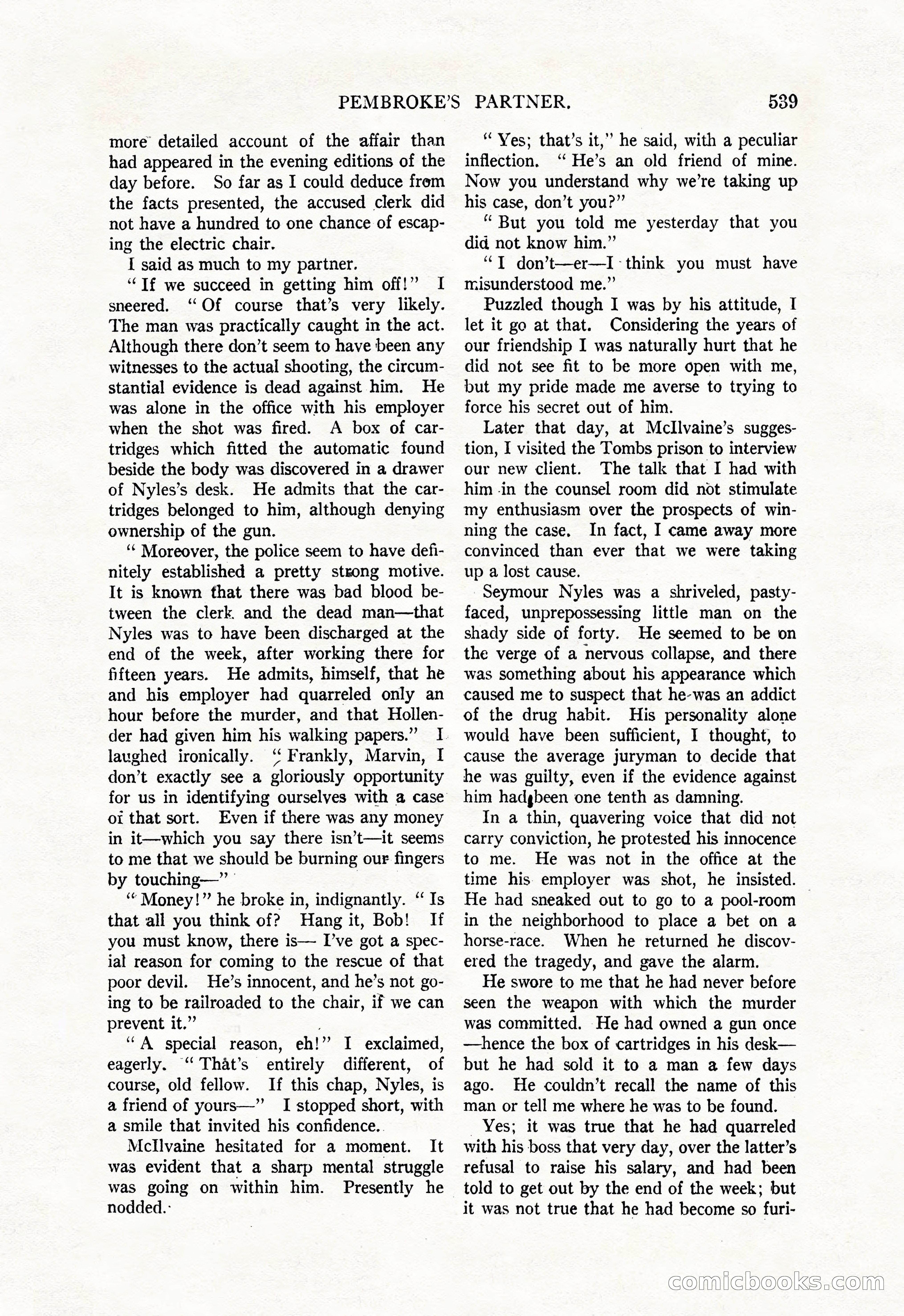
A restored page from Pulp Fiction, 1920. Page through the whole issue in the reader above.
📄 Transcribed text from this page (OCR, searchable)
Machine-transcribed from the original scan — historical spelling and the odd misread are preserved.
PEMBROKE’S PARTNER. more’ detailed account of the affair than had appeared in the evening editions of the day before. So far as I could deduce from the facts presented, the accused clerk did not have a hundred to one chance of escap- ing the electric chair. [ said as much to my partner. ‘Tf we succeed in getting him off!” I sneered. “Of course that’s very likely. The man was practically caught in the act. Although there don’t seem to have been any witnesses to the actual shooting, the circum- stantial evidence is dead against him. He was alone in the office with his employer when the shot was fired. A box of car- tridges which fitted the automatic found beside the body was discovered in a drawer of Nyles’s desk. He admits that the car- tridges belonged to him, although denying ownership of the gun. ‘¢ Moreover, the police seem to have defi- nitely established a pretty strong motive. It is known that there was bad blood be- tween the clerk. and the dead man—that Nyles was to have been discharged at the end of the week, after working there for fifteen years. He admits, himself, that he and his employer had quarreled only an hour before the murder, and that Hollen- der had given him his walking papers.” I. laughed ironically. ‘ Frankly, Marvin, I don’t exactly see a gloriously opportunity for us in identifying ourselves with a case ot that sort. Even if there was any money in it—which you say there isn’t—it seems to me that we should be burning our fingers by touching—” | ‘“* Money!” he broke in, indignantly. ‘ Is that all you think of? Hang it, Bob! If you must know, there is— I’ve got a spec- ial reason for coming to the rescue of that poor devil. He’s innocent, and he’s not go- ing to be railroaded to the chair, if we can prevent it.” ; ‘“A special reason, eh!” I exclaimed, eagerly. ‘“‘ That’s entirely different, of course, old fellow. If this chap, Nyles, is a friend of yours—’’ I stopped short, with a smile that invited his confidence. . McIlvaine hesitated for a moment. It was evident that a sharp mental struggle was going on within him. Presently he nodded.: y 539 Yes; that’s it,” he said, with a peculiar inflection. ‘‘ He’s an old friend of mine. Now you understand why we’re taking up his case, don’t you?”’ “ But you told me yesterday that you did not know him.” ‘Tl don’t—er—I think you must have misunderstood me.”’ Puzzled though I was by his attitude, I let it go at that. Considering the years of our friendship I was naturally hurt that he did not see fit to be more open with me, but my pride made me averse to trying to force his secret out of him. Later that day, at Mcllvaine’s sugges- tion, I visited the Tombs prison to interview our new client. The talk that I had with him -in the counsel room did not stimulate my enthusiasm over the prospects of win- ning the case. In fact, I came away more convinced than ever that we were taking up a lost cause. Seymour Nyles was a shriveled, pasty- faced, unprepossessing little man on the shady side of forty. He seemed to be on the verge of a nervous collapse, and there was something about his appearance which caused me to suspect that he-was an addict of the drug habit. His personality alone would have been sufficient, I thought, to cause the average juryman to decide that he was guilty, even if the evidence against him hadgbeen one tenth as damning. In a thin, quavering voice that did not carry conviction, he protested his innocence to me. He was not in the office at the time his. employer was shot, he insisted. — He had sneaked out to go to a pool-room in the neighborhood to place a bet on a horse-race. When he returned he discov- ered the tragedy, and gave the alarm. He swore to me that he had never before Seen the weapon with which the murder was committed. He had owned a gun once —hence the box of cartridges in his desk— but he had sold it to a man a few days ago. He couldn’t recall the name of this man or tell me where he was to be found. _ Yes; it was true that he had quarreled with his boss that very day, over the latter’s refusal to raise his salary, and had been told to get out by the end of the week; but it was not true that he had become so furi- mn (SO) NOOK