
Pulp Fiction, 1920 · page 64 of 180
Argosy, Vol. 118, No. 4 — page 64: what you’re looking at
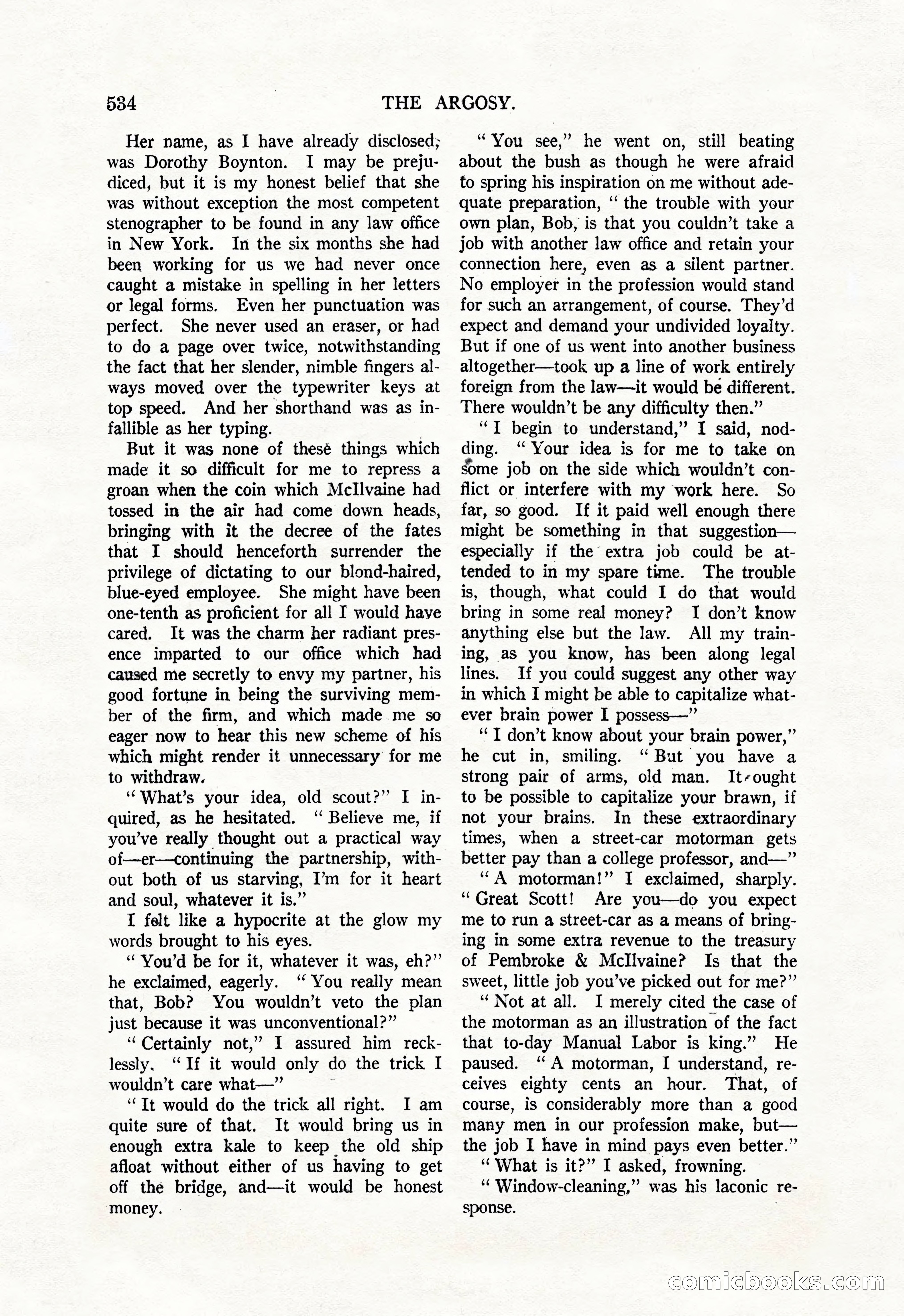
A restored page from Pulp Fiction, 1920. Page through the whole issue in the reader above.
📄 Transcribed text from this page (OCR, searchable)
Machine-transcribed from the original scan — historical spelling and the odd misread are preserved.
534 Her name, as I have already disclosed; was Dorothy Boynton. I may be preju- diced, but it is my honest belief that she was without exception the most competent stenographer to be found in any law office in New York. In the six months she had been working for us we had never once caught a mistake in spelling in her letters or legal forms. Even her punctuation was perfect. She never used an eraser, or had to do a page over twice, notwithstanding the fact that her slender, nimble fingers al- ways moved over the typewriter keys at top speed. And her shorthand was as in- fallible as her typing. ? But it was none of thesé things which made it so difficult for me to repress a groan when the coin which Mcllvaine had tossed in the air had come down heads, bringing with it the decree of the fates that I should henceforth surrender the privilege of dictating to our blond-haired, blue-eyed employee. She might have been one-tenth as proficient for all I would have cared. It was the charm her radiant pres- ence imparted to our office which had caused me secretly to envy my partner, his good fortune in being the surviving mem- ber of the firm, and which made me so eager now to hear this new scheme of his which might render it unnecessary for me to withdraw. ‘““What’s your idea, old scout?” I in- quired, as he hesitated. ‘“‘ Believe me, if you've really thought out a practical way of—er—continuing the partnership, with- out both of us starving, I’m for it heart and soul, whatever it is.” I felt like a hypocrite at the glow my words brought to his eyes. ‘“‘You’d be for it, whatever it was, eh?”’ he exclaimed, eagerly. ‘‘ You really mean that, Bob? You wouldn’t veto the plan just because it was unconventional?”’ “Certainly not,’ I assured him reck- lessly. “If it would only do the trick I wouldn’t care what—”’ E ‘Tt would do the trick all right. I am quite sure of that. It would bring us in enough extra kale to keep the old ship afloat without either of us having to get off the bridge, and—it would be honest ‘money. THE ARGOSY. “You see,” he went on, still beating about the bush as though he were afraid to spring his inspiration on me without ade- quate preparation, “‘ the trouble with your own plan, Bob, is that you couldn’t take a job with another law office and retain your connection here, even as a silent partner. No employer in the profession would stand for such an arrangement, of course. They’d expect and demand your undivided loyalty. But if one of us went into another business altogether—took up a line of work entirely foreign from the law—it would be different. There wouldn’t be any difficulty then.” “I begin to understand,” I said, nod- ding. ‘“ Your idea is for me to take on some job on the side which wouldn’t con- flict or interfere with my work here. So far, so good. If it paid well enough there might be something in that suggestion— especially if the extra job could be at- tended to in my spare time. The trouble is, though, what could I do that would bring in some real money? I don’t know anything else but the law. All my train- ing, as you know, has been along legal lines. If you could suggest any other way in which I might be able to capitalize what- ever brain power I possess—”’ ‘I don’t know about your brain power,” he cut in, smiling. “ But you have a strong pair of arms, old man. It-ought to be possible to capitalize your brawn, if not your brains. In these extraordinary times, when a street-car motorman gets better pay than a college professor, and—”’ ‘“A motorman!” I exclaimed, sharply. “Great Scott! Are you—do you expect me to run a street-car as a means of bring- ing in some extra revenue to the treasury of Pembroke & Mcllvaine? Is that the sweet, little job you’ve picked out for me?” “Not at all. I merely cited the case of the motorman as an illustration of the fact that to-day Manual Labor is king.” He paused. ‘A motorman, I understand, re- ceives eighty cents an hour. That, of course, is considerably more than a good many men in our profession make, but— the job I have in mind pays even better.” ‘“‘ What is it?” I asked, frowning. © ‘“‘ Window-cleaning,”’ was his laconic re- sponse. (C(O) mM NOOK