
Pulp Fiction, 1920 · page 55 of 180
Argosy, Vol. 118, No. 4 — page 55: what you’re looking at
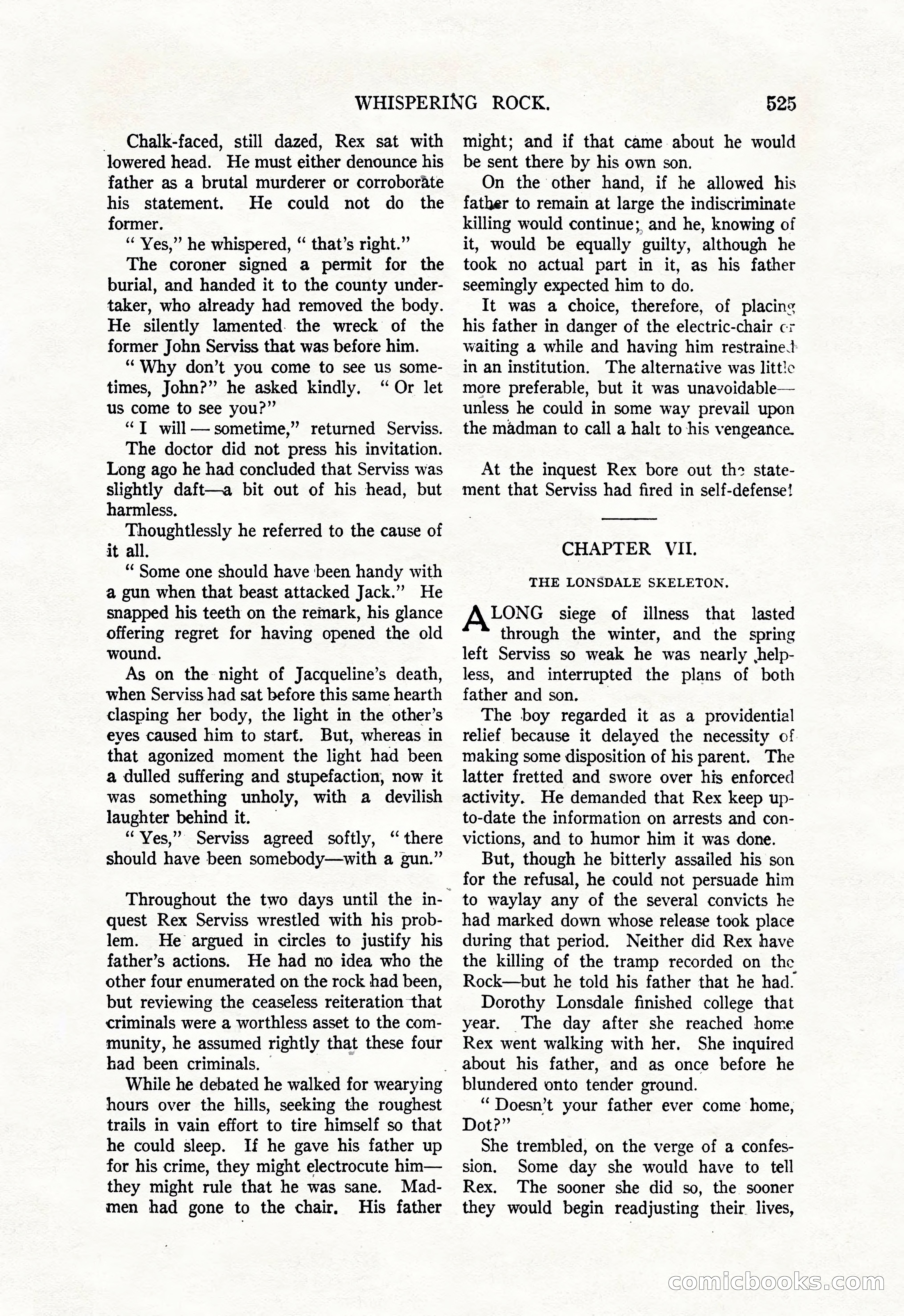
A restored page from Pulp Fiction, 1920. Page through the whole issue in the reader above.
📄 Transcribed text from this page (OCR, searchable)
Machine-transcribed from the original scan — historical spelling and the odd misread are preserved.
WHISPERING ROCK. _ Chalk-faced, still dazed, Rex sat with lowered head. He must either denounce his father as a brutal murderer or corroborate his statement. He could not do the former. “Yes,” he whispered, “ that’s right.” The coroner signed a permit for the burial, and handed it to the county under- taker, who already had removed the body. He silently lamented. the wreck of the former John Serviss that was before him. “Why don’t you come to see us some- times, John?” he asked kindly, “Or let us come to see you?” “IT will — sometime,” returned Serviss. The doctor did not press his invitation. Long ago he had concluded that Serviss was slightly daft—a bit out of his head, but harmless. Thoughtlessly he referred to the cause of it all. 3 ‘‘ Some one should have been handy with a gun when that beast attacked Jack.” He snapped his teeth on the remark, his glance offering regret for having opened the old wound. As on the night of Jacqueline’s death, when Serviss had sat before this same hearth clasping her body, the light in the other’s eves caused him to start. But, whereas in that agonized moment the light had been a dulled suffering and stupefaction, now it was something unholy, with a devilish laughter behind it. — “Yes,” Serviss agreed softly, ‘“ there should have been somebody—with a gun.” Throughout the two days until the in-— quest Rex Serviss wrestled with his prob- lem. He argued in circles to justify his father’s actions. He had no idea who the other four enumerated on the rock had been, but reviewing the ceaseless reiteration that criminals were a worthless asset to the com- munity, he assumed rightly that these four had been criminals. © While he debated he walked for wearying hours over the hills, seeking the roughest trails in vain effort to tire himself so that he could sleep. If he gave his father up for his crime, they might electrocute him— they might rule that he was sane. Mad- men had gone to the chair, His father 525 might; and if that came about he would be sent there by his own son. On the other hand, if he allowed his father to remain at large the indiscriminate killing would continue; and he, knowing of it, would be equally guilty, although he took no actual part in it, as his father seemingly expected him to do. It was a choice, therefore, of placing his father in danger of the electric-chair cr waiting a while and having him restraine.t in an institution. The alternative was litt!c more preferable, but it was unavoidable— unless he could in some way prevail upon the madman to call a halt to ‘his vengeance. At the inquest Rex bore out th2 state- ment that Serviss had fired in self-defense! CHAPTER VII. THE LONSDALE SKELETON, ALONG siege of illness that lasted through the winter, and the spring left Serviss so weak he was nearly help- less, and interrupted the plans of both father and son. The boy regarded it as a providential relief because it delayed the necessity of making some disposition of his parent. The latter fretted and swore over his enforced activity. He demanded that Rex keep up- to-date the information on arrests and con- victions, and to humor him it was done. But, though he bitterly assailed his son for the refusal, he could not persuade him to waylay any of the several convicts he had marked down whose release took place during that period. Neither did Rex have the killing of the tramp recorded on the Rock—but he told his father that he had. Dorothy Lonsdale finished college that year. The day after she reached home Rex went walking with her. She inquired _ about his father, and as once before he blundered onto tender ground. ““Doesn’t your father ever come home, Dot?” She trembled, on the verge of a confes- sion. Some day she would have to tell Rex. The sooner she did so, the sooner they would begin readjusting their lives, im (S| QO) NOOK