
Pulp Fiction, 1920 · page 48 of 180
Argosy, Vol. 118, No. 4 — page 48: what you’re looking at
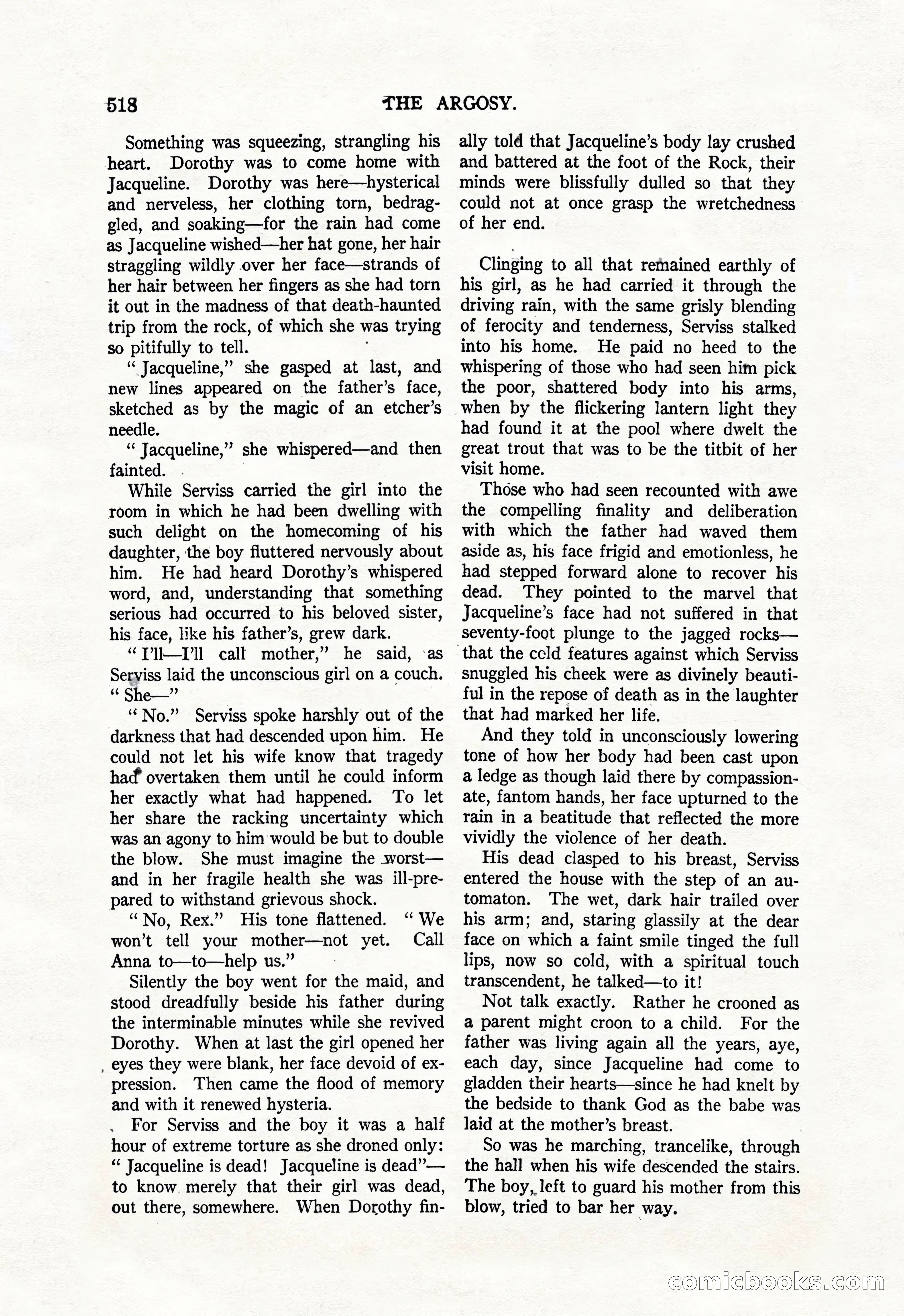
A restored page from Pulp Fiction, 1920. Page through the whole issue in the reader above.
📄 Transcribed text from this page (OCR, searchable)
Machine-transcribed from the original scan — historical spelling and the odd misread are preserved.
518 Something was squeezing, strangling his heart. Dorothy was to come home with Jacqueline. Dorothy was here—hysterical and nerveless, her clothing torn, bedrag- gled, and soaking—for the rain had come as Jacqueline wished—her hat gone, her hair straggling wildly over her face—strands of her hair between her fingers as she had torn it out in the madness of that death-haunted trip from the rock, of which she was trying so pitifully to tell. ‘“ Jacqueline,” she gasped at last, and new lines appeared on the father’s face, sketched as by the magic of an etcher’s needle. ‘‘ Jacqueline,” she whispered—and then fainted. | | While Serviss carried the girl into the room in which he had been dwelling with such delight on the homecoming of his daughter, the boy fluttered nervously about him. He had heard Dorothy’s whispered word, and, understanding that something serious had occurred to his beloved sister, his face, like his father’s, grew dark. “TI—T’ll_ calt mother,” he said, ‘as Serviss laid the unconscious girl on a couch. 6¢ She—”’ “No.” Serviss spoke harshly out of the darkness that had descended upon him. He could not let his wife know that tragedy had’ overtaken them until he could inform her exactly what had happened. To let her share the racking uncertainty which was an agony to him would be but to double the blow. She must imagine the worst— and in her fragile health she was ill-pre- pared to withstand grievous shock. “No, Rex.” His tone flattened. won’t tell your mother—not yet. Anna to—to—help us.” Silently the boy went for the maid, and stood dreadfully beside his father during the interminable minutes while she revived Dorothy. When at last the girl opened her , eyes they were blank, her face devoid of ex- pression. Then came the flood of memory and with it renewed hysteria. For Serviss and the boy it was a half hour of extreme torture as she droned only: “ Jacqueline is dead! Jacqueline is dead” — to know merely that their girl was dead, out there, somewhere. When Dorothy fin- <4 We Call THE ARGOSY. ally told that Jacqueline’s body lay crushed and battered at the foot of the Rock, their minds were blissfully dulled so that they could not at once grasp the wretchedness of her end. Clinging to all that remained earthly of his girl, as he had carried it through the driving rain, with the same grisly blending of ferocity and tenderness, Serviss stalked into his home. He paid no heed to the whispering of those who had seen him pick the poor, shattered body into his arms, when by the flickering lantern light they had found it at the pool where dwelt the great trout that was to be the titbit of her visit home. Those who had seen recounted with awe the compelling finality and deliberation with which the father had waved them aside as, his face frigid and emotionless, he had stepped forward alone to recover his dead. They pointed to the marvel that Jacqueline’s face had not suffered in that seventy-foot plunge to the jagged rocks— that the ccld features against which Serviss snuggled his cheek were as divinely beauti- ful in the repose of death as in the laughter that had marked her life. And they told in unconsciously lowering tone of how her body had been cast upon a ledge as though laid there by compassion- ate, fantom hands, her face upturned to the rain in a beatitude that reflected the more vividly the violence of her death. His dead clasped to his breast, Serviss entered the house with the step of an au- tomaton. The wet, dark hair trailed over his arm; and, staring glassily at the dear face on which a faint smile tinged the full lips, now so cold, with a spiritual touch transcendent, he talked—to it! Not talk exactly. Rather he crooned as a parent might croon to a child. For the father was living again all the years, aye, each day, since Jacqueline had come to gladden their hearts—since he had knelt by the bedside to thank God as the babe was laid at the mother’s breast. So was he marching, trancelike, through the hall when his wife descended the stairs. The boy, left to guard his mother from this blow, tried to bar her way. NOO (S| QO) mM S (Co)