
Pulp Fiction, 1920 · page 27 of 180
Argosy, Vol. 118, No. 4 — page 27: what you’re looking at
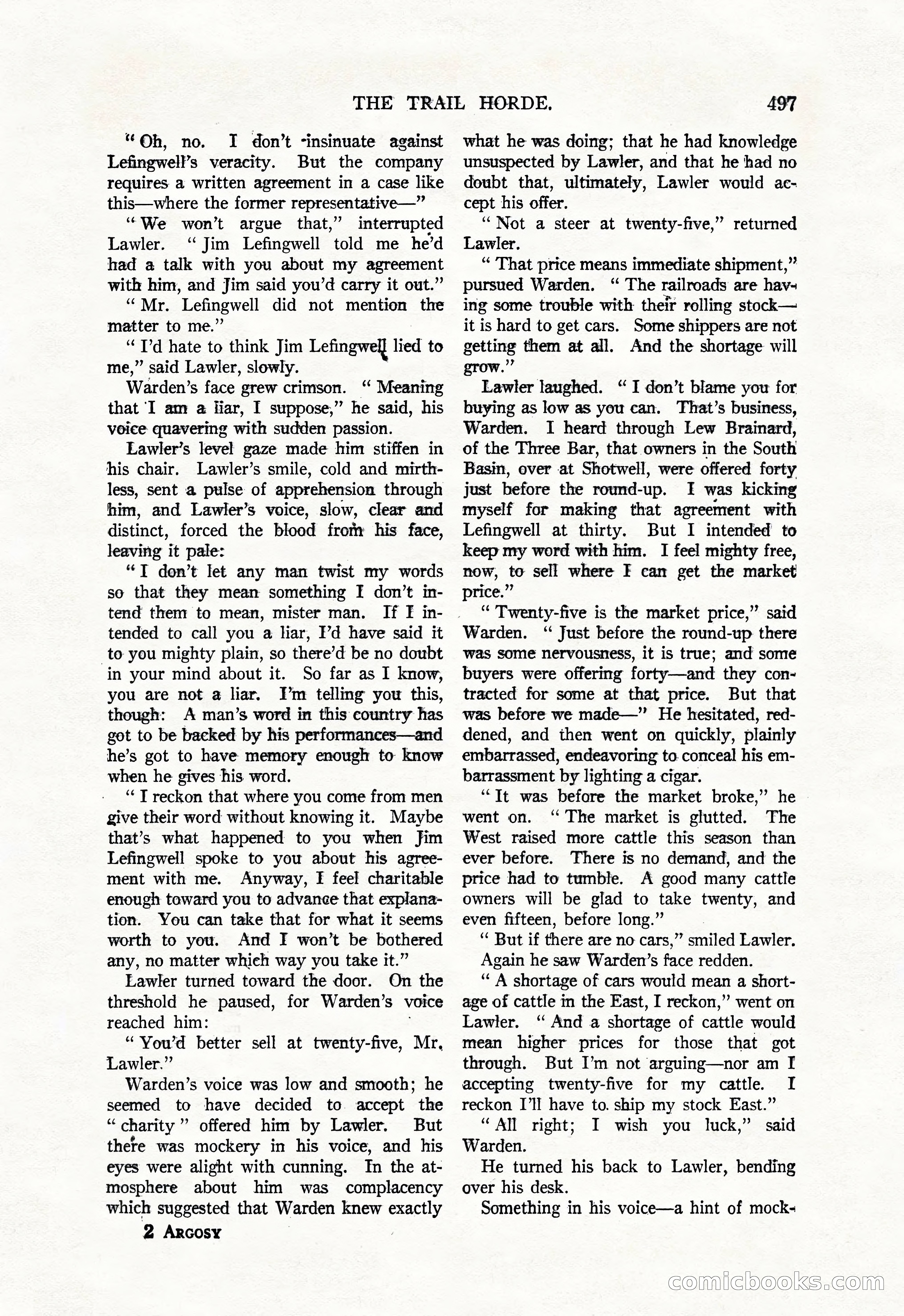
A restored page from Pulp Fiction, 1920. Page through the whole issue in the reader above.
📄 Transcribed text from this page (OCR, searchable)
Machine-transcribed from the original scan — historical spelling and the odd misread are preserved.
THE TRAIL HORDE. “Oh, no. I don’t -insinuate against LefingwelPs veracity. But the company requires a written agreement in a case like this—where the former representative—” ‘““We won’t argue that,’ interrupted Lawler. ‘Jim Lefingwell told me he’d had a talk with you about my agreement with him, and Jim said you’d carry it out.” “Mr. Seene well did not mention the matter to me.’ “Td hate to think Jim Lefingwell lied to me,” said Lawler, slowly. Warden’ s face grew crimson. ‘ Meaning that I am a liar, I suppose,’ he said, his voice quavermg with sudden passion. Lawler’s level gaze made him stiffen in his chair. Lawler’s smile, cold and mirth- less, sent a pulse of apprehension through him, and Lawler’s voice, slow, clear and distinct, forced the blood fromm his face, leaving it pale: “T don’t let any man twist my words so that they mean something I don’t in- tend them to mean, mister man. If I in- tended to call you a Har, Pd have said it to you mighty plain, so there’d be no doubt in your mind about it. So far as I know, you are not a liar. Im telling yow this, though: A man’s word in this country has got to be backed by his performances—and he’s got to have memory enough to know when he gives ‘his word. ‘“‘T reckon that where you come from men give their word without knowing it. Maybe that’s what happened to you when Jim Lefingwell spoke to you about his agree- ment with me. Anyway, I feel charitable enough taward you to advance that explana- tion. You can take that for what it seems worth to you. And I won’t be bothered any, no matter which way you take it.” Lawler turned toward the door. On the threshold he paused, for Warden’s voice reached him: “You'd better sell at twenty-five, Mr. Lawler.” Warden’s voice was low and smooth; he seemed to have decided to. accept the “ charity ” offered him by Lawler. But there was mockery in his voice, and his eyes were alight with cunning. In the at- mosphere about him was complacency which suggested that Warden knew pore 2 Arcosy | Warden. 497 what he was doing; that he had knowledge unsuspected by Lawler, and that he had no doubt that, ultimately, Lawler would ac- cept his offer. ‘““Not a steer at twenty-five,” returned Lawler. “ ‘That price means immediate shipment,” pursued Warden. “ The railroads are hav- ing some trouble with their rolling stock— it is hard to get cars. Some shippers are not getting them at all. And the shortage will Lawler laughed. “I don’t blame you for buying as low as you can. That’s business, Warden. I heard through Lew Brainard, of the Three Bar, that owners in the South Basin, over at Shotwell, were offered forty just before the romd-up. I was kicking myself for making that agreement with Lefingwell at thirty. But I intended to keep my word with him. I feel mighty free, now, to sell where EF can get the market price.” ‘Twenty-five is the market price,” said ‘“‘ Just before the round-up there was some nervousness, it is true; and some buyers were offering forty—and they con- tracted for some at that price. But that was before we made—” He hesitated, red- dened, and then went on quickly, plainly embarrassed, endeavoring to.conceal his em- barrassment by lighting a cigar. ‘“It was before the market broke,” he went on. ‘‘ The market is glutted. The West raised more cattle this season than ever before. There is no demand, and the price had to tumble. A good many cattle owners will be glad to take twenty, and even fifteen, before long.” : ‘ But if there are no cars,” smiled Lawler. Again he saw Warden’s face redden. ‘‘ A shortage of cars would mean a short- age of cattle m the East, I reckon,” went on Lawler. ‘‘ And a shortage of cattle would mean higher prices for those that got through. But I’m not arguing—nor am I accepting twenty-five for my cattle. I reckon Ill have to. ship my stock East.” “All right; I wish you luck,’ said Warden. He turned his back to Lawler, bending over his desk. Something in his voice—a hint of mock- nn (S| QO) NOOK