
Pulp Fiction, 1920 · page 25 of 180
Argosy, Vol. 118, No. 4 — page 25: what you’re looking at
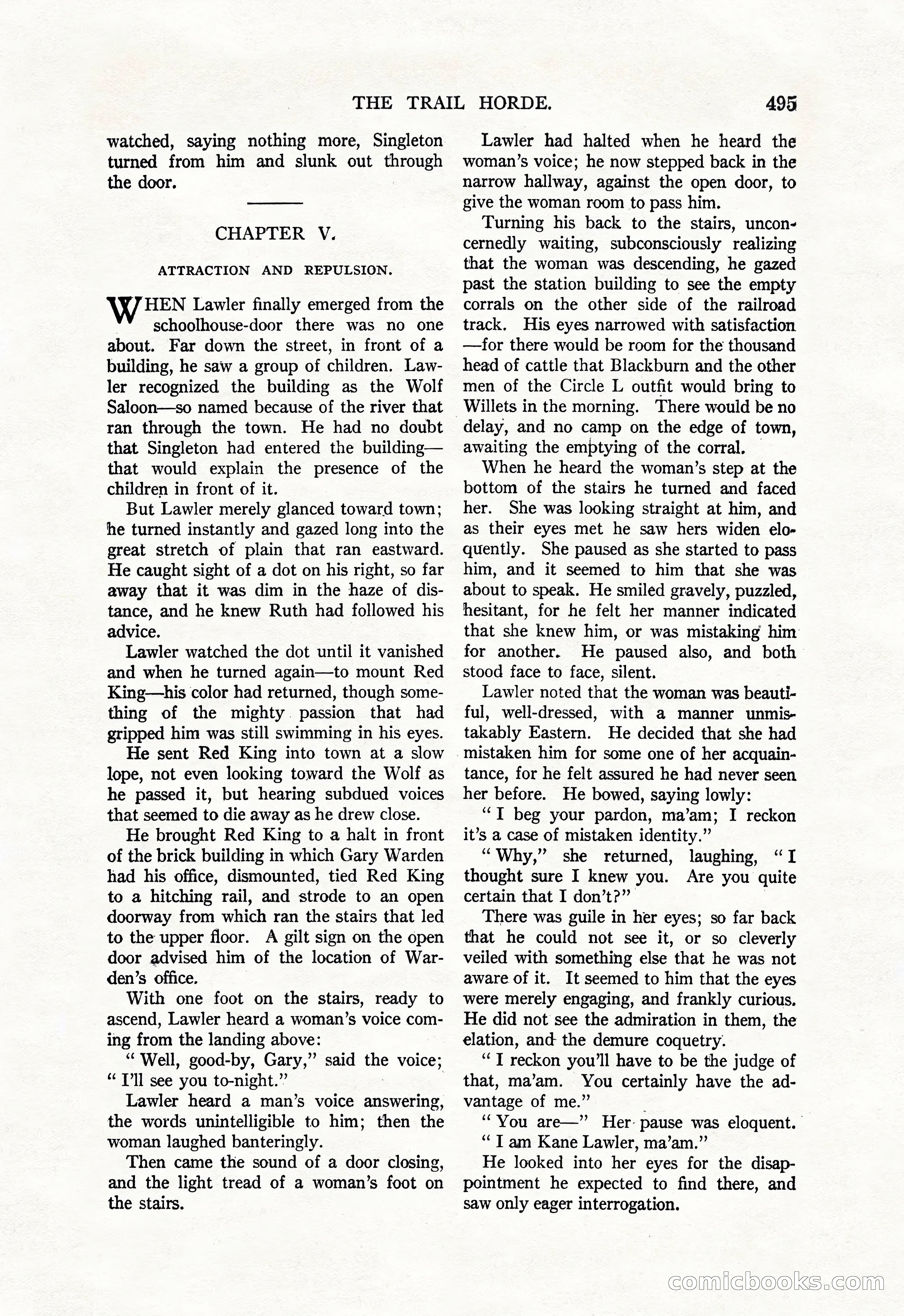
A restored page from Pulp Fiction, 1920. Page through the whole issue in the reader above.
📄 Transcribed text from this page (OCR, searchable)
Machine-transcribed from the original scan — historical spelling and the odd misread are preserved.
THE TRAIL HORDE. watched, saying nothing more, Singleton turned from him and slunk out through the door. CHAPTER V. ATTRACTION W HEN Lawler finally emerged from the | schoolhouse-door there was no one about. Far down the street, in front of a building, he saw a group of children. Law- ler recognized the building as the Wolf Saloon—so named because of the river that ran through the town. He had no doubt that Singleton had entered the building— that would explain the presence of the children in front of it. But Lawler merely glanced toward town; he turned instantly and gazed long into the great stretch of plain that ran eastward. He caught sight of a dot on his right, so far away that it was dim in the haze of dis- tance, and he knew Ruth had followed his advice. Lawler watched the dot until it vanished and when he turned again—to mount Red King—his color had returned, though some- thing of the mighty. passion that had gripped him was still swimming in his eyes. He sent Red King into town at a slow lope, not even looking toward the Wolf as he passed it, but hearing subdued voices that seemed to die away as he drew close. He brought Red King to a halt in front of the brick building in which Gary Warden had his office, dismounted, tied Red King to a hitching rail, and strode to an open doorway from which ran the stairs that led to the upper floor. A gilt sign on the open door advised him of the location of War- den’s office. With one foot on the stairs, ready to ascend, Lawler heard a woman’s voice com- ing from the landing above: “Well, good-by, “Gary” said me voice; * T’ll see you to-night.”’ Lawler heard a man’s voice answering, the words unintelligible to him; then the woman laughed banteringly. Then came the sound of a door closing, and the light tread of a woman’s foot on the stairs. AND REPULSION. 495 Lawler had halted when he heard the woman’s voice; he now stepped back in the narrow hallway, against the open door, to give the woman room to pass him. Turning his back to the stairs, uncon- cernedly waiting, subconsciously realizing that the woman was descending, he gazed past the station building to see the empty corrals on the other side of the railroad track. His eyes narrowed with satisfaction —for there would be room for the thousand head of cattle that Blackburn and the other men of the Circle L outfit would bring to -Willets in the morning. There would be no delay, and no camp on the edge of town, awaiting the emptying of the corral. When he heard the woman’s step at the bottom of the stairs he turned and faced her. She was looking straight at him, and as their eyes met he saw hers widen elo- quently. She paused as she started to pass him, and it seemed to him that she was about to speak. He smiled gravely, puzzled, hesitant, for he felt her manner indicated that she knew him, or was mistaking him for another. He paused also, and both stood face to face, silent. Lawler noted that the woman was beauti- ful, well-dressed, with a manner unmis- takably Eastern. He decided that she had mistaken him for some one of her acquain- tance, for he felt assured he had never seen her before. He bowed, saying lowly: ‘“‘T beg your pardon, ma’am; I reckon it’s a case of mistaken identity.” “Why,” she returned, laughing, “I thought sure I knew you. Are you quite certain that I don’t?” There was guile in her eyes; so far back that he could not see it, or so cleverly veiled with something else that he was not aware of it. It seemed to him that the eyes were merely engaging, and frankly curious. He did not see the admiration in them, the elation, and the demure coquetry. ‘“T reckon you'll have to be the judge of that, ma’am. You certainly have the ad- vantage of me.” ‘You are—”’ Her- pause was eloquent. ‘““T am Kane Lawler, ma’am.” He looked into her eyes for the disap- pointment he expected to find there, and saw only eager interrogation. mM (Cl QO) NOOK