
Pulp Fiction, 1920 · page 167 of 180
Argosy, Vol. 118, No. 4 — page 167: what you’re looking at
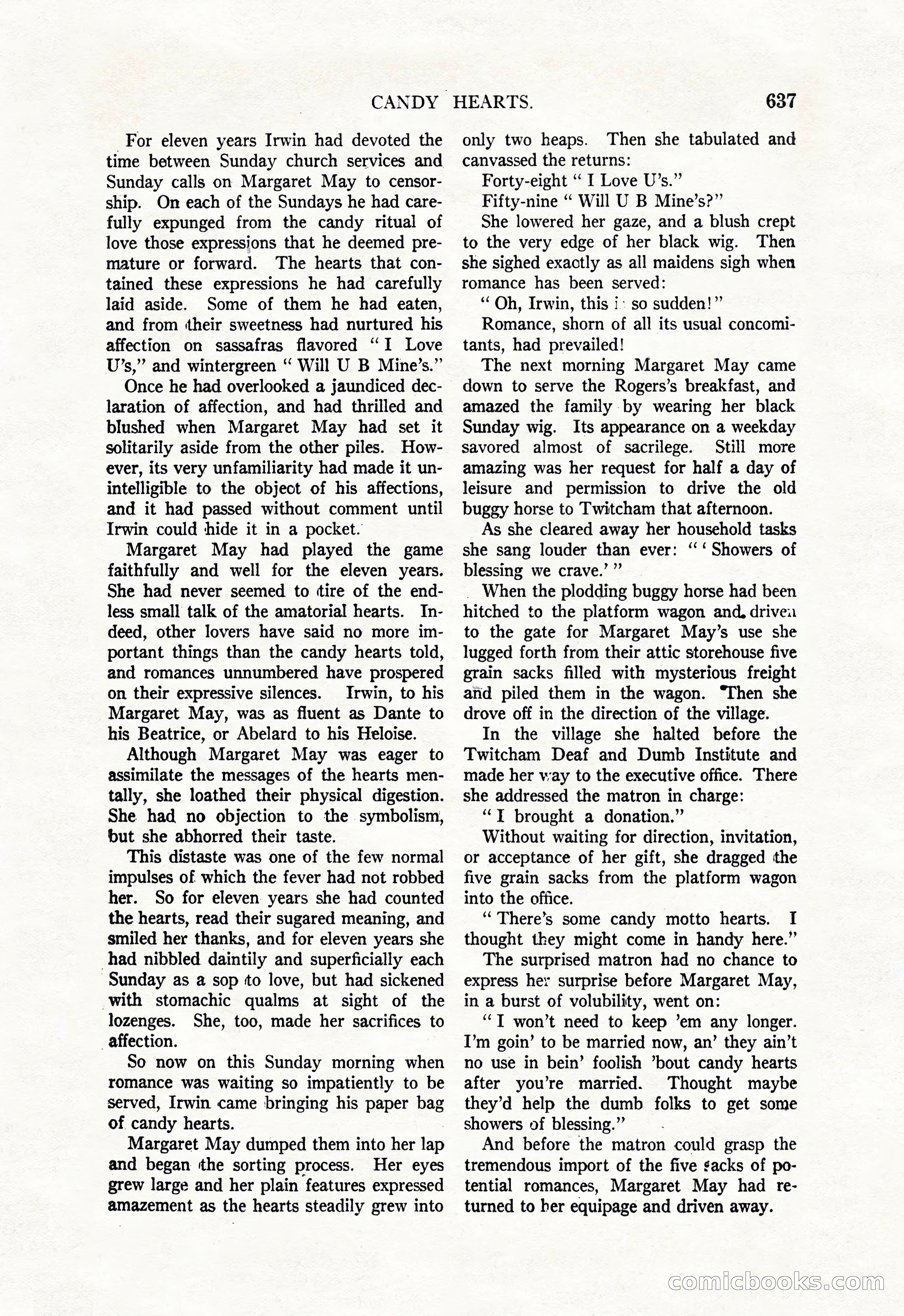
A restored page from Pulp Fiction, 1920. Page through the whole issue in the reader above.
📄 Transcribed text from this page (OCR, searchable)
Machine-transcribed from the original scan — historical spelling and the odd misread are preserved.
CANDY HEARTS. For eleven years Irwin had devoted the time between Sunday church services and Sunday calls on Margaret May to censor- ship. On each of the Sundays he had care- fully expunged from the candy ritual of love those expressions that he deemed pre- mature or forward. The hearts that con- tained these expressions he had carefully laid aside. Some of them he had eaten, and from their sweetness had nurtured his affection on sassafras flavored “I Love U’s,” and wintergreen ‘“‘ Will U B Mine’s.” Once he had overlooked a jaundiced dec- laration of affection, and had thrilled and blushed when Margaret May had set it solitarily aside from the other piles. How- ever, its very unfamiliarity had made it un- intelligible to the object of his affections, and it had passed without comment until Irwin could hide it in a pocket. Margaret May had played the game faithfully and well for the eleven years. She had never seemed to tire of the end- less small talk of the amatorial hearts. In- deed, other lovers have said no more im- portant things than the candy hearts told, and romances unnumbered have prospered on their expressive silences. Irwin, to his Margaret May, was as fluent as Dante to his Beatrice, or Abelard to his Heloise. Although Margaret May was eager to assimilate the messages of the hearts men- tally, she loathed their physical digestion. She had no objection to the symbolism, but she abhorred their taste. This distaste was one of the few normal impulses of which the fever had not robbed her. So for eleven years she had counted the hearts, read their sugared meaning, and smiled her thanks, and for eleven years she had nibbled daintily and superficially each Sunday as a sop to love, but had sickened with stomachic qualms at sight of the lozenges. She, too, made her sacrifices to _affection. So now on this Sunday morning when romance was waiting so impatiently to be served, Irwin came bringing his paper bag of candy hearts. . Margaret May dumped them into her lap and began tthe sorting process. Her eyes grew large and her plain features expressed amazement as the hearts steadily grew into 637 only two heaps. Then she tabulated and canvassed the returns: Forty-eight “‘ I Love U’s.” Fifty-nine “ Will U B Mine’s?” She lowered her gaze, and a blush crept to the very edge of her black wig. Then she sighed exactly as all maidens sigh when romance has been served: ‘“‘ Oh, Irwin, this i: so sudden!’ Romance, shorn of all its usual concomi- tants, had prevailed! The next morning Margaret May came down to serve the Rogers’s breakfast, and amazed the family by wearing her black Sunday wig. Its appearance on a weekday savored almost of sacrilege. Still more amazing was her request for half a day of leisure and permission to drive the old buggy horse to Twitcham that afternoon. As she cleared away her household tasks she sang louder than ever: “‘ Showers of blessing we crave.’ ”’ _ When the plodding buggy horse had been hitched to the platform wagon and, driven to the gate for Margaret May’s use she lugged forth from their attic storehouse five grain sacks filled with mysterious freight and piled them in the wagon. “Then she drove off in the direction of the village. In the village she halted before the Twitcham Deaf and Dumb Institute and made her way to the executive office. There she addressed the matron in charge: “TY brought a donation.” Without waiting for direction, invitation, or acceptance of her gift, she dragged the five grain sacks from the platform wagon into the office. ‘““ There’s some candy motto hearts. I thought they might come in handy here.” The surprised matron had no chance to express her surprise before Margaret May, in a burst of volubility, went on: ‘““T won’t need to keep ’em any longer. I’m goin’ to be married now, an’ they ain’t no use in bein’ foolish *bout candy hearts after you’re married. Thought maybe they’d help the dumb folks to get some showers of blessing.” —- And before the matron could grasp the tremendous import of the five ¢acks of po- tential romances, Margaret May had re- turned to her equipage and driven away. nn (oO) NOOLK