
Pulp Fiction, 1920 · page 163 of 180
Argosy, Vol. 118, No. 4 — page 163: what you’re looking at
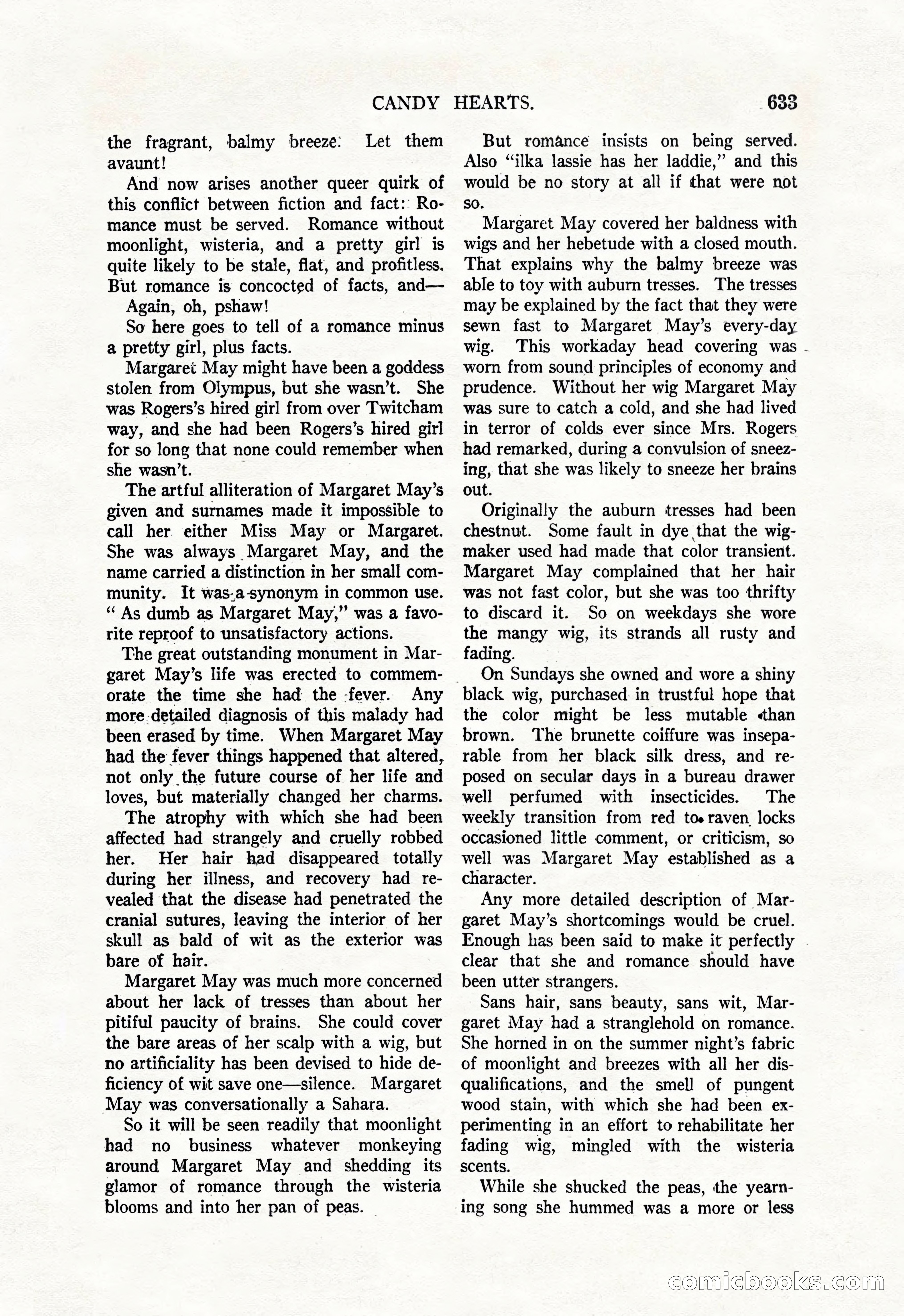
A restored page from Pulp Fiction, 1920. Page through the whole issue in the reader above.
📄 Transcribed text from this page (OCR, searchable)
Machine-transcribed from the original scan — historical spelling and the odd misread are preserved.
CANDY HEARTS. 635 the fragrant, balmy breeze: Let them avaunt! And now arises another queer quirk of this conflict between fiction and fact: Ro- mance must be served. Romance without moonlight, wisteria, and a pretty girl is quite likely to be stale, flat, and profitless. But romance is concocted of facts, and— Again, oh, pshaw! — So here goes to tell of a romance minus a pretty girl, plus facts. Margaret May might have been a goddess stolen from Olympus, but she wasn’t. She was Rogers’s hired girl from over Twitcham way, and she had been Rogers’s hired girl for so long that none could remember when she wasn’t. Z : The artful alliteration of Margaret May’s given and surnames made it impossible to call her either Miss May or Margaret. She was always Margaret May, and the name carried a distinction in her small com- munity. It was-a-synonym in common use. ‘‘ As dumb as Margaret May,” was a favo- rite reproof to unsatisfactory actions. The great outstanding monument in Mar- garet May’s life was erected to commem- _ orate the time she had the -fever. Any more detailed diagnosis of this malady had been erased by time. When Margaret May had the fever things happened that altered, not only the future course of her life and loves, but materially changed her charms. The atrophy with which she had been affected had strangely and cruelly robbed her. Her hair had disappeared totally during her illness, and recovery had re- vealed that the disease had penetrated the cranial sutures, leaving the interior of her skull as bald of wit as the exterior was bare of hair. Margaret May was much more concerned about her lack of tresses than about her pitiful paucity of brains. She could cover the bare areas of her scalp with a wig, but no artificiality has been devised to hide de- ficiency of wit save one—silence. Margaret ‘May was conversationally a Sahara. So it will be seen readily that moonlight had no _ business whatever monkeying around Margaret May and shedding its glamor of romance through the wisteria blooms and into her pan of peas. — But romance insists on being served. Also “ilka lassie has her laddie,” and this would be no story at all if that were not SO. Margaret May covered her baldness with wigs and her hebetude with a closed mouth. That explains why the balmy breeze was able to toy with auburn tresses. The tresses may be explained by the fact that they were sewn fast to Margaret May’s every-day wig. This workaday head covering was - worn from sound principles of economy and prudence. Without her wig Margaret May was sure to catch a cold, and she had lived in terror of colds ever since Mrs. Rogers had remarked, during a convulsion of sneez- ing, that she was likely to sneeze her brains out. Originally the auburn tresses had been chestnut. Some fault in dye that the wig- maker used had made that color transient. Margaret May complained that her hair was not fast color, but she was too thrifty to discard it. So on weekdays she wore the mangy wig, its strands all rusty and fading. On Sundays she owned and wore a shiny black wig, purchased: in trustful hope that the color might be less mutable «than brown. ‘The brunette coiffure was insepa- rable from her black silk dress, and re- posed on secular days in a bureau drawer well perfumed with insecticides. The weekly transition from red toe raven. locks occasioned little comment, or criticism, so well was Margaret May established as a character. Any more detailed description of Mar- garet May’s shortcomings would be cruel. Enough has been said to make it perfectly . clear that she and romance should have been utter strangers. Sans hair, sans beauty, sans wit, Mar- garet May had a stranglehold on romance. She horned in on the summer night’s fabric of moonlight and breezes with all her dis- qualifications, and the smell of pungent wood stain, with which she had been ex- perimenting in an effort to rehabilitate her fading wig, mingled with the wisteria scents. While she shucked the peas, the yearn- ing song she hummed was a more or less nn (C(O) NOOK