
Pulp Fiction, 1920 · page 160 of 180
Argosy, Vol. 118, No. 4 — page 160: what you’re looking at
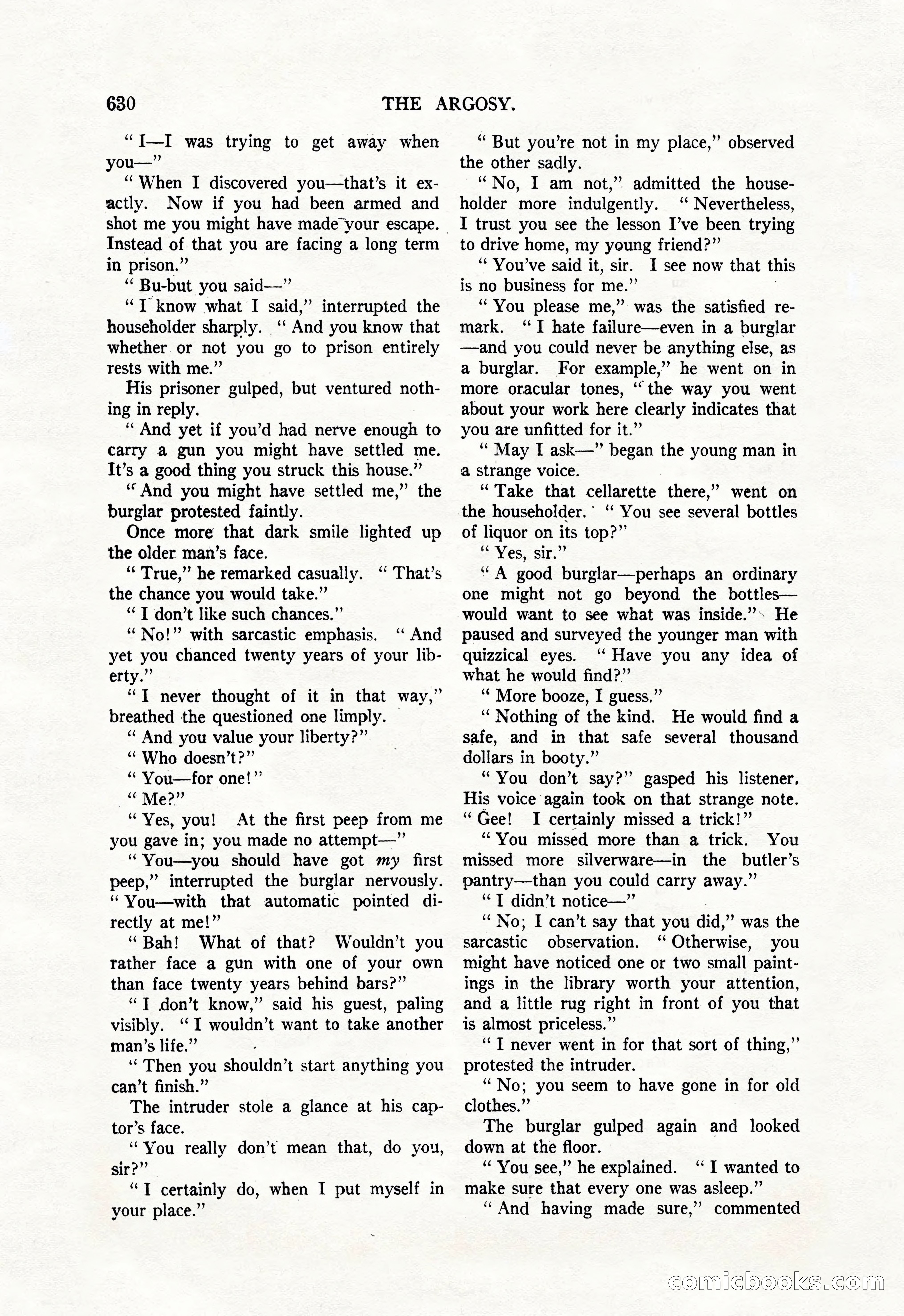
A restored page from Pulp Fiction, 1920. Page through the whole issue in the reader above.
📄 Transcribed text from this page (OCR, searchable)
Machine-transcribed from the original scan — historical spelling and the odd misread are preserved.
630 ‘““I—I was trying to get away when you—” “When I discovered you—that’s it ex- actly. Now if you had been armed and shot me you might have made your escape. Instead of that you are facing a long term in prison.” ‘“ Bu-but you said—” “IT know what I said,” interrupted the householder sharply. _‘‘ And you know that whether or not you go to prison entirely rests with me.” His prisoner gulped, but ventured noth- ing in reply. ‘And yet if you’d had nerve tnt to carry a gun you might have settled me. It’s a good thing you struck this house.” ‘““And you might have settled me,” the burglar protested faintly. Once more that dark smile lighted up the older man’s face. ‘“* True,” he remarked casually. ‘“ That’s the chance you would take.” “ T don’t like such chances.”’ “No!” with sarcastic emphasis. ‘‘ And yet you chanced twenty years of your lib- erty.” “T never thought of it in that way,” breathed the questioned one limply. | “ And you value your liberty?” ‘Who doesn’t?” “ You—for one!”’ &é¢ Me?” “Yes, you! At the first peep from me you gave in; you made no attempt—”’ ‘‘’‘You—you should have got my first peep,” interrupted the burglar nervously. “ You—with that automatic pointed di- rectly at me!” “Bah! What of that? Wouldn’t you rather face a gun with one of your own than face twenty years behind bars?” “T don’t know,” said his guest, paling visibly. ‘‘ I wouldn’t want to take another man’s life.” ‘Then you shouldn’t start anything you can’t finish.” The intruder stole a glance at his cap- tor’s face. “You really don’t mean that, do you, sir?” “T certainly do, when I put myself in your place.” THE ARGOSY. “ But youre not in my place,” observed the other sadly. “No, I am not,” admitted the house- holder more indulgently. ‘‘ Nevertheless, _ I trust you see the lesson I’ve been trying to drive home, my young friend?” ‘““'You’ve said it, sir. I see now that this is no business for me.”’ : ‘You please me,” was the satisfied re- mark. ‘I hate failure—even in a burglar —and you could never be anything else, as a burglar. For example,’ he went on in more oracular tones, “ the way you went about your work here clearly indicates that you are unfitted for it.” ‘“ May I ask—” began the young man in a strange voice. “Take that cellarette there,” went on the householder. “‘ You see several bottles of liquor on its top?”’ Ves. Six. ‘“A good burglar—perhaps an ordinary one might not go beyond the bottles— would want to see what was inside.” . He paused and surveyed the younger man with quizzical eyes. ‘“‘ Have you any idea of what he would find?” ‘* More booze, I guess,” ‘“‘ Nothing of the kind. He would find a safe, and in that safe several thousand dollars in booty.” “You don’t say?” gasped his listener. His voice again took on that strange note. “Gee! I certainly missed a trick!” “You missed more than a trick. You missed more silverware—in the butler’s pantry—than you could carry away.” ‘“T didn’t notice—”’ “No; I can’t say that you did, ”” was the sarcastic observation. “ Otherwise, you might have noticed one or two small paint- ings in the library worth your attention, and a little rug right in front of you that is almost priceless.”’ ‘‘T never went in for that sort of thing,”’ protested the intruder. “No; you seem to have gone in for old clothes.”’ The burglar gulped again and looked down at the floor. “You see,” he explained. ‘‘ I wanted to make sure that every one was asleep.” ‘“And having made sure,’’ commented (Cl Q) mM cloookk