
Pulp Fiction, 1920 · page 14 of 180
Argosy, Vol. 118, No. 4 — page 14: what you’re looking at
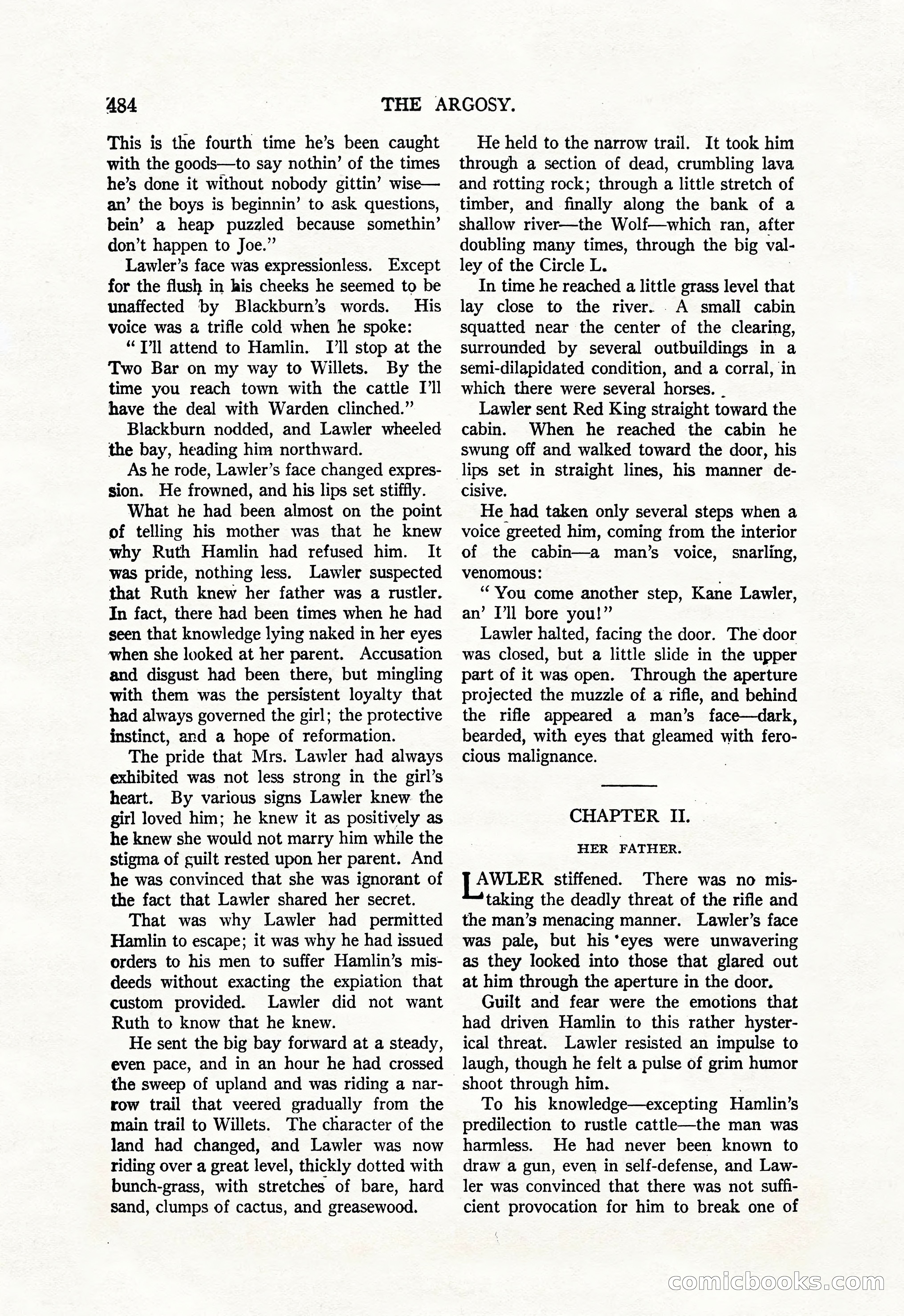
A restored page from Pulp Fiction, 1920. Page through the whole issue in the reader above.
📄 Transcribed text from this page (OCR, searchable)
Machine-transcribed from the original scan — historical spelling and the odd misread are preserved.
A84 This is the fourth time he’s been caught with the goods—to say nothin’ of the times he’s done it without nobody gittin’ wise— an’ the boys is beginnin’ to ask questions, bein’ a heap puzzled because somethin’ don’t happen to Joe.” Lawler’s face was expressionless. Except for the flush in his cheeks he seemed to be unaffected by Blackburn’s words. His voice was a trifle cold when he spoke: “Tl attend to Hamlin. I'll stop at the Two Bar on my way to Willets. By the time you reach town with the cattle I'll have the deal with Warden clinched.” Blackburn nodded, and Lawler wheeled the bay, heading him northward. As he rode, Lawler’s face changed expres- sion. He frowned, and his lips set stiffly. What he had been almost on the point of telling his mother was that he knew why Ruth Hamlin had refused him. It was pride, nothing less. Lawler suspected that Ruth knew her father was a rustler. In fact, there had been times when he had seen that knowledge lying naked in her eyes when she looked at her parent. Accusation and disgust had been there, but mingling with them was the persistent loyalty that had always governed the girl; the protective instinct, and a hope of reformation. The pride that Mrs. Lawler had always exhibited was not less strong in the girl’s heart. By various signs Lawler knew. the girl loved him; he knew it as positively as he knew she would not marry him while the stigma of guilt rested upon her parent. And he was convinced that she was ignorant of the fact that Lawler shared her secret. That was why Lawler had permitted Hamlin to escape; it was why he had issued orders to his men to suffer Hamlin’s mis- deeds without exacting the expiation that custom provided. Lawler did not want Ruth to know that he knew. He sent the big bay forward at a steady, even pace, and in an hour he had crossed the sweep of upland and was riding a nar- row trail that veered gradually from the main trail to Willets. The character of the land had changed, and Lawler was now riding over a great level, thickly dotted with bunch-grass, with stretches of bare, hard sand, clumps of cactus, and greasewood. THE ARGOSY. He held to the narrow trail. It took him through a section of dead, crumbling lava and rotting rock; through a little stretch of timber, and finally along the bank of a shallow river—the Wolf—which ran, after doubling many times, through the big val- ley of the Circle L. In time he reached a little grass level that lay close to the river. . A small cabin squatted near the center of the clearing, surrounded by several outbuildings in a semi-dilapidated condition, and a corral, in which there were several horses. _ Lawler sent Red King straight toward the cabin. When he reached the cabin he swung off and walked toward the door, his lips set in straight lines, his manner de- cisive. He had taken only several steps when a voice greeted him, coming from the interior of the cabin—a man’s voice, snarling, venomous: ‘You come another step, Kane SELLE: an’ I'll bore you!” Lawler halted, facing the door. The EeOE was closed, but a little slide in the upper part of it was open. Through the aperture projected the muzzle of a rifle, and behind the rifle appeared a man’s face—dark, bearded, with eyes that gleamed with fero- cious malignance. CHAPTER II. HER FATHER. AWLER stiffened. There was no mis- taking the deadly threat of the rifle and the man’s menacing manner. Lawler’s face was pale, but his ‘eyes were unwavering as they looked into those that glared out at him through the aperture in the door. Guilt and fear were the emotions that had driven Hamlin to this rather hyster- ical threat. Lawler resisted an impulse to laugh, though he felt a pulse of grim humor shoot through him. To his mide ecepune Hamlin’s predilection to rustle cattle—the man was harmless. He had never been known to draw a gun, even in self-defense, and Law- ler was convinced that there was not suffi- cient provocation for him to break one of DOOLK