
Pulp Fiction, 1920 · page 126 of 180
Argosy, Vol. 118, No. 4 — page 126: what you’re looking at
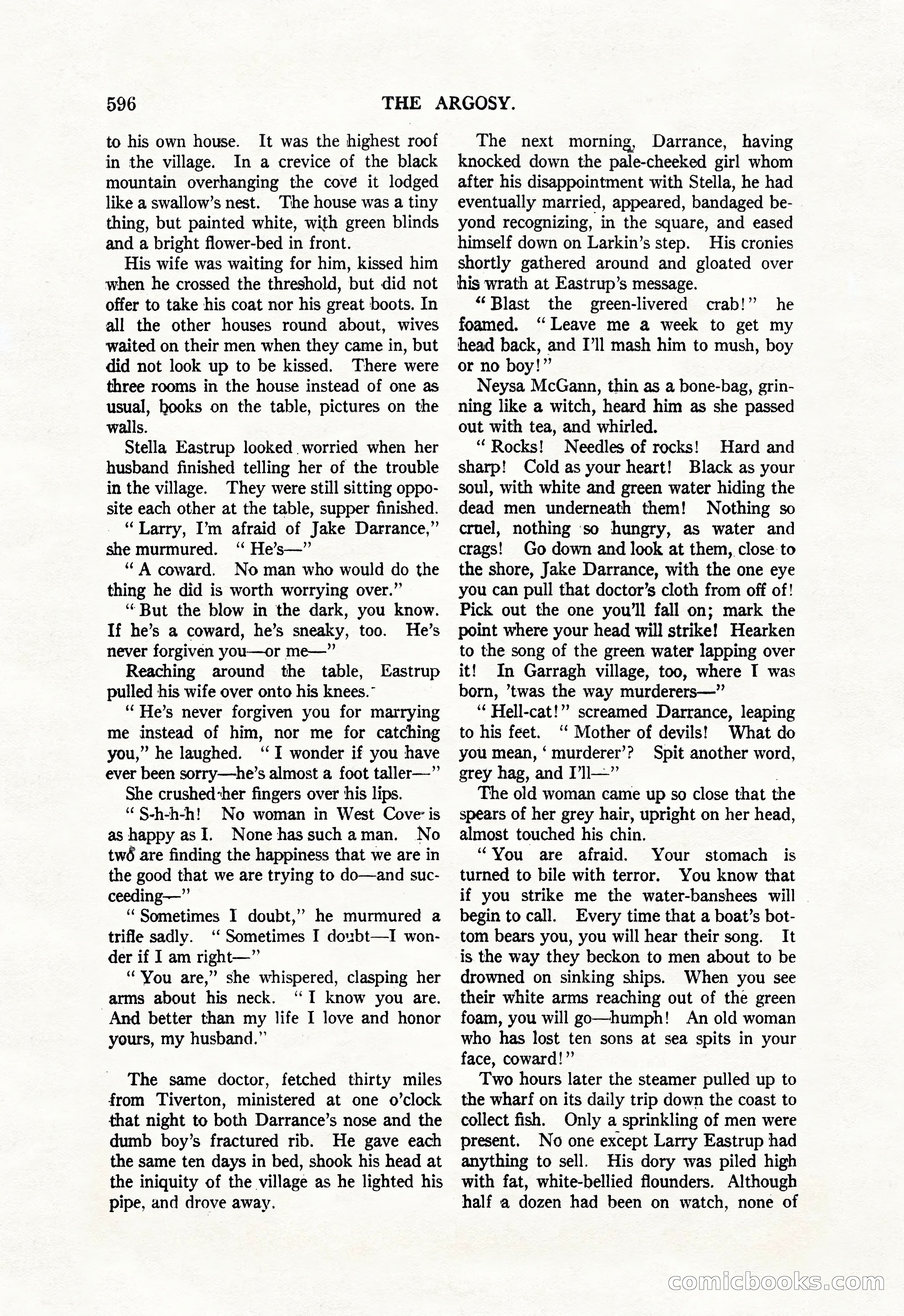
A restored page from Pulp Fiction, 1920. Page through the whole issue in the reader above.
📄 Transcribed text from this page (OCR, searchable)
Machine-transcribed from the original scan — historical spelling and the odd misread are preserved.
596 to his own house. It was the highest roof in the village. In a crevice of the black mountain overhanging the cove it lodged like a swallow’s nest. The house was a tiny thing, but painted white, with green blinds and a bright flower-bed in front. His wife was waiting for him, kissed him when he crossed the threshold, but did not offer to take his coat nor his great boots. In all the other houses round about, wives waited on their men when they came in, but did not look up to be kissed. There were three rooms in the house instead of one as usual, hooks on the table, pictures on the walls. Stella Eastrup looked worried when her husband finished telling her of the trouble in the village. They were still sitting oppo- site each other at the table, supper finished. “ Larry, I’m afraid of Jake Darrance,” she murmured. ‘ He’s—” ‘*A coward. No man who would do the thing he did is worth worrying over.”’ ‘But the blow in the dark, you know. If he’s a coward, he’s sneaky, too. He’s never forgiven you—or me—” Reaching around the table, pulled his wife over onto his knees.~ ‘“He’s never forgiven you for marrying me instead of him, nor me for catching you,” he laughed. ‘I wonder if you have ever been sorry—he’s almost a foot taller—”’ She crushed-her fingers over his lips. ‘“‘ S-h-h-h! No woman in West Cove: is as happy asI. None hassuchaman. No tw6 are finding the happiness that we are in the good that we are trying to do—and suc- ceeding—’’ ‘Sometimes I doubt,” he murmured a trifle sadly. ‘‘ Sometimes I doubt—I won- der if I am right—”’ ‘You are,” she whispered, clasping her arms about his neck. “I know you are. And better than my life I love and honor yours, my husband.” Eastrup The same doctor, fetched thirty miles from Tiverton, ministered at one o’clock that night to both Darrance’s nose and the dumb boy’s fractured rib. He gave each the same ten days in bed, shook his head at the iniquity of the village as he lighted his pipe, and drove away. THE ARGOSY. The next morning, Darrance, having knocked down the pale-cheeked girl whom after his disappointment with Stella, he had eventually married, appeared, bandaged be- yond recognizing, in the square, and eased himself down on Larkin’s step. His cronies shortly gathered around and gloated over his wrath at Eastrup’s message. “Blast the green-livered crab!” he foamed. “Leave me a week to get my head back, and I’ll mash him to mush, boy or no boy!” Neysa McGann, thin as a bone-bag, grin- ning like a witch, heard him as she passed out with tea, and whirled. “Rocks! Needles of rocks! Hard and sharp! Cold as your heart! Black as your soul, with white and green water hiding the dead men underneath them! Nothing so cruel, nothing so hungry, as water and crags! Go down and look at them, close to the shore, Jake Darrance, with the one eye you can pull that doctor’s cloth from off of! Pick out the one you'll fall on; mark the point where your head will strike! Hearken to the song of the green water lapping over it! In Garragh village, too, where I was born, ’twas the way murderers—” ‘* Hell-cat!”’ screamed Darrance, leaping to his feet. ‘‘ Mother of devils! What do you mean, ‘murderer’? Spit another word, grey hag, and I’Jl—” The old woman came up so close that the spears of her grey hair, upright on her head, almost touched his chin. “You are afraid. Your stomach turned to bile with terror. is You know that if you strike me the water-banshees will | begin to call. Every time that a boat’s bot- tom bears you, you will hear their song. It is the way they beckon to men about to be drowned on sinking ships. When you see their white arms reaching out of the green foam, you will go—humph! An old woman who has lost ten sons at sea spits in your face, coward!” Two hours later the steamer pulled up to the wharf on its daily trip down the coast to collect fish. Only a sprinkling of men were present. No one except Larry Eastrup had anything to sell. His dory was piled high with fat, white-bellied flounders. Although half a dozen had been on watch, none of DOOK