
Pulp Fiction, 1920 · page 117 of 180
Argosy, Vol. 118, No. 4 — page 117: what you’re looking at
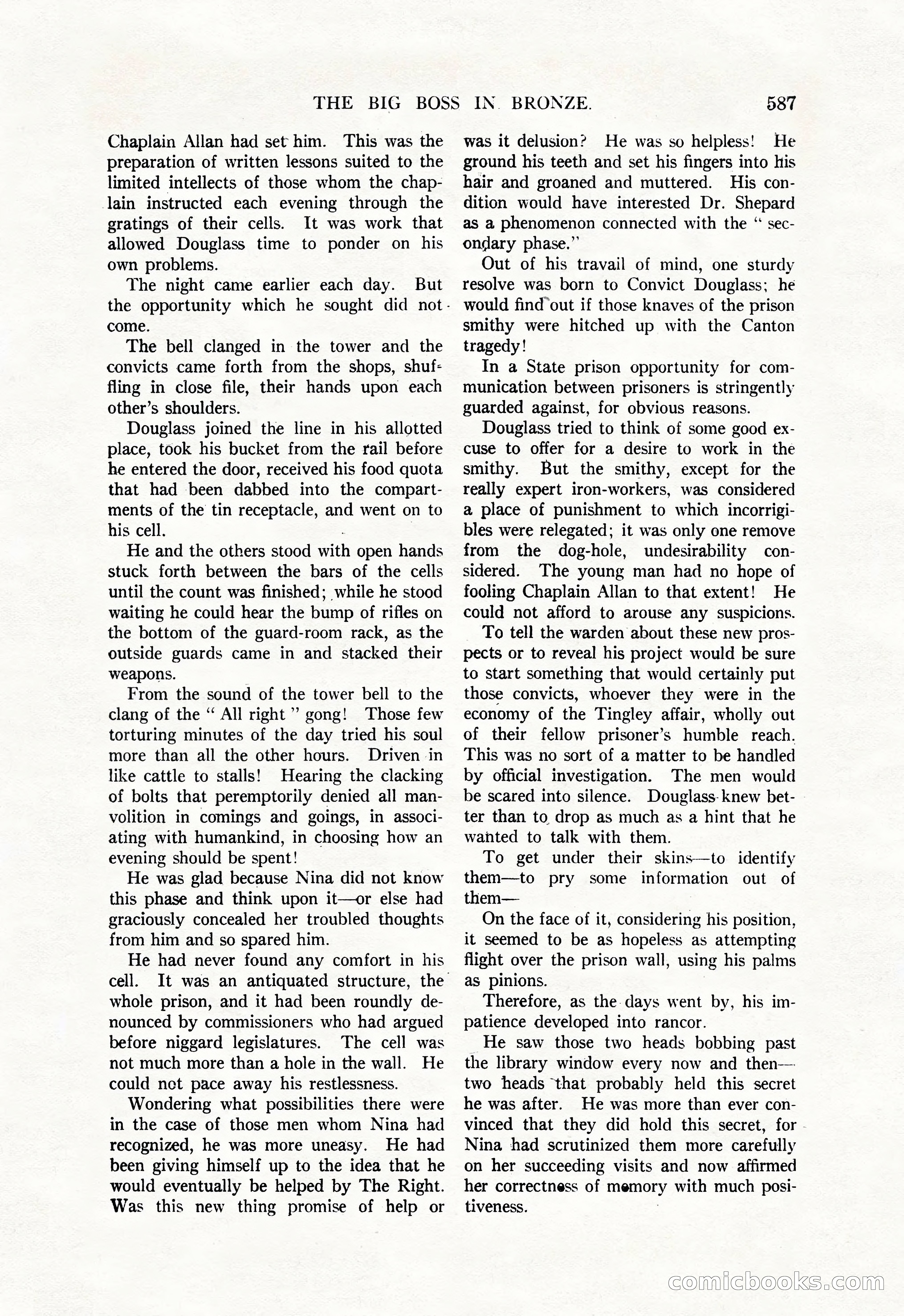
A restored page from Pulp Fiction, 1920. Page through the whole issue in the reader above.
📄 Transcribed text from this page (OCR, searchable)
Machine-transcribed from the original scan — historical spelling and the odd misread are preserved.
THE BIG BOSS IN. BRONZE. Chaplain Allan had set him. This was the preparation of written lessons suited to the limited intellects of those whom the chap- lain instructed each evening through the gratings of their cells. It was work that allowed Douglass time to ponder on his own problems. The night came earlier each day. But the opportunity which he sought did not- come. The bell clanged in the tower and the convicts came forth from the shops, shuf- fling in close file, their hands upon each other’s shoulders. Douglass joined the line in his allotted place, took his bucket from the rail before he entered the door, received his food quota that had been dabbed into the compart- ments of the tin receptacle, and went on to his cell. | He and the others stood with open hands stuck forth between the bars of the cells until the count was finished; while he stood waiting he could hear the bump of rifles on the bottom of the guard-room rack, as the outside guards came in and stacked their weapons. | From the sound of the tower bell to the clang of the “ All right” gong! Those few torturing minutes of the day tried his soul more than all the other hours. Driven in like cattle to stalls!) Hearing the clacking of bolts that peremptorily denied all man- volition in comings and goings, in associ- ating with humankind, in choosing how an evening should be spent! He was glad because Nina did not know this phase and think upon it—or else had graciously concealed her troubled thoughts from him and so spared him. He had never found any comfort in his cell. whole prison, and it had been roundly de- nounced by commissioners who had argued before niggard legislatures. The cell was not much more than a hole in the wall. He could net pace away his restlessness. Wondering what possibilities there were in the case of those men whom Nina had recognized, he was more uneasy. He had been giving himself up to the idea that he would eventually be helped by The Right. Was this new thing promise of help or It was an antiquated structure, the 587 was it delusion? He was so helpless! He ground his teeth and set his fingers into his hair and groaned and muttered. His con- dition would have interested Dr. Shepard as a phenomenon connected with the “ sec- ondary phase.’”’ Out of his travail of mind, one sturdy resolve was born to Convict Douglass; he would find out if those knaves of the prison smithy were hitched up with the Canton tragedy! In a State prison opportunity for com- munication between prisoners is stringently guarded against, for obvious reasons. Douglass tried to think of some good ex- cuse to offer for a desire to work in the smithy. But the smithy, except for the really expert iron-workers, was considered a place of punishment to which incorrigi- bles were relegated; it was only one remove from the dog-hole, undesirability con- sidered. The young man had no hope of fooling Chaplain Allan to that extent! He could not afford to arouse any suspicions. To tell the warden about these new pros- pects or to reveal his project would be sure to start something that would certainly put those convicts, whoever they were in the economy of the Tingley affair, wholly out of their fellow prisoner’s humble reach. This was no sort of a matter to be handled by official investigation. The men would be scared into silence. Douglass- knew bet- ter than to drop as much as a hint that he wanted to talk with them. To get under their skins—to identify them—to pry some information out of them— On the face of it, considering his position, it seemed to be as hopeless as attempting flight over the prison wall, using his palms as pinions. | Therefore, as the days went by, his im- patience developed into rancor. _ He saw those two heads bobbing past the library window every now and then— two heads that probably held this secret he was after. He was more than ever con- vinced that they did hold this secret, for - Nina had scrutinized them more carefully on her succeeding visits and now affirmed her correctness of memory with much posi- tiveness. : mM (C(O) clo@olkx