
Pulp Fiction, 1920 · page 110 of 180
Argosy, Vol. 118, No. 4 — page 110: what you’re looking at
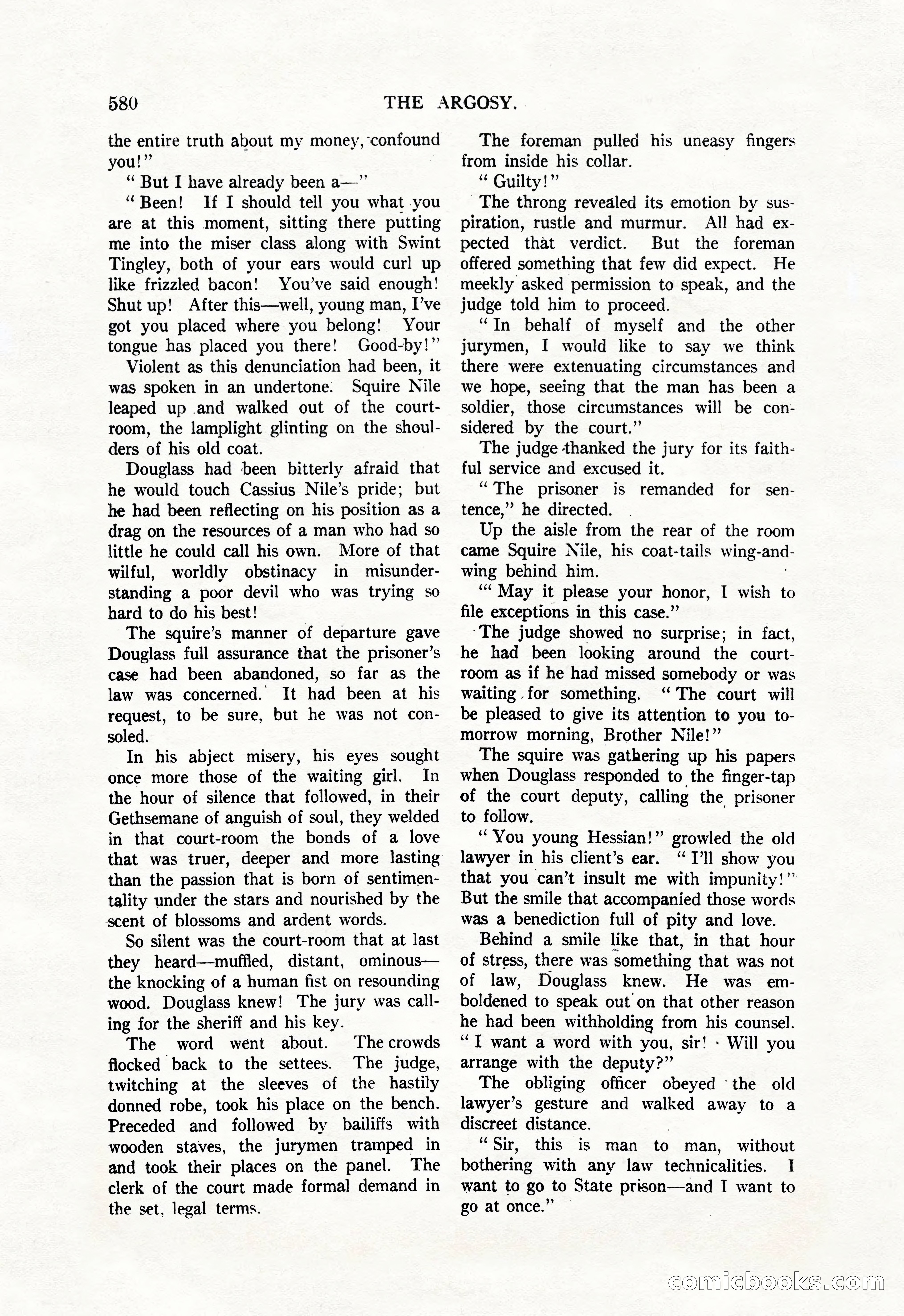
A restored page from Pulp Fiction, 1920. Page through the whole issue in the reader above.
📄 Transcribed text from this page (OCR, searchable)
Machine-transcribed from the original scan — historical spelling and the odd misread are preserved.
580 the entire truth about my money, ‘confound you!” ‘“‘ But I have already been a—”’ “Been! If I should tell you what you are at this moment, sitting there putting me into the miser class along with Swint Tingley, both of your ears would curl up like frizzled bacon! You’ve said enough! Shut up! After this—well, young man, I’ve got you placed where you belong! Your tongue has placed you there! Good-by!”’ Violent as this denunciation had been, it was spoken in an undertone. Squire Nile leaped up and walked out of the court- room, the lamplight glinting on the shoul- ders of his old coat. Douglass had been bitterly afraid that he would touch Cassius Nile’s pride; but he had been reflecting on his position as a drag on the resources of a man who had so little he could call his own. More of that wilful, worldly obstinacy in misunder- standing a poor devil who was trying so hard to do his best! The squire’s manner of departure gave Douglass full assurance that the prisoner’s case had been abandoned, so far as the law was concerned. It had been at his request, to be sure, but he was not con- soled. In his abject misery, his eyes sought once more those of the waiting girl. In the hour of silence that followed, in their Gethsemane of anguish of soul, they welded in that court-room the bonds of a love that was truer, deeper and more lasting than the passion that is born of sentimen- tality under the stars and nourished by the scent of blossoms and ardent words. So silent was the court-room that at last they heard—muffled, distant, ominous— the knocking of a human fist on resounding wood. Douglass knew! The jury was call- ing for the sheriff and his key. The word went about. The crowds flocked back to the settees. The judge, twitching at the sleeves of the hastily donned robe, took his place on the bench. Preceded and followed by bailiffs with wooden staves, the jurymen tramped in and took their places on the panel. The clerk of the court made formal demand in the set, legal terms. THE ARGOSY. The foreman pulled his uneasy fingers from inside his collar. Guilty!” The throng revedled its emotion by sus- piration, rustle and murmur. All had ex- pected that verdict. But the foreman offered something that few did expect. He meekly asked permission to speak, and the judge told him to proceed. “In behalf of myself and the other jurymen, I would like to say we think there were extenuating circumstances and we hope, seeing that the man has been a soldier, those circumstances will be con- sidered by the court.” The judge thanked the jury for its faith- ful service and excused it. “The prisoner is remanded for sen- tence,” he directed. Up the aisle from the rear of the room came Squire Nile, his coat-tails wing- -and- wing behind him. ‘“ May it please your honor, I wish to file exceptions in this case.” ‘The judge showed no surprise; in fact, he had been looking around the court- room as if he had missed somebody or was waiting for something. ‘“ The court will be pleased to give its attention to you to- morrow morning, Brother Nile!” The squire was gathering up his papers when Douglass responded to the finger-tap of the court deputy, calling the prisoner to follow. ‘You young Hessian!” growled the old lawyer in his client’s ear. “I'll show you that you can’t insult me with impunity!” But the smile that accompanied those words was a benediction full of pity and love. Behind a smile like that, in that hour of stress, there was something that was not of law, Douglass knew. He was em- boldened to speak out on that other reason he had been withholding from his counsel. ‘““T want a word with you, sir! + Will you arrange with the deputy?” The obliging officer obeyed -the old lawyer’s gesture and walked away to a discreet distance. , “Sir, this is man to man, without bothering with any law technicalities. I want to go to State prison—and I want to go at once.” (C(O) mM DOOK