
Pulp Fiction, 1917 · page 99 of 200
The Argosy, Vol. 90 No. 1 — page 99: what you’re looking at
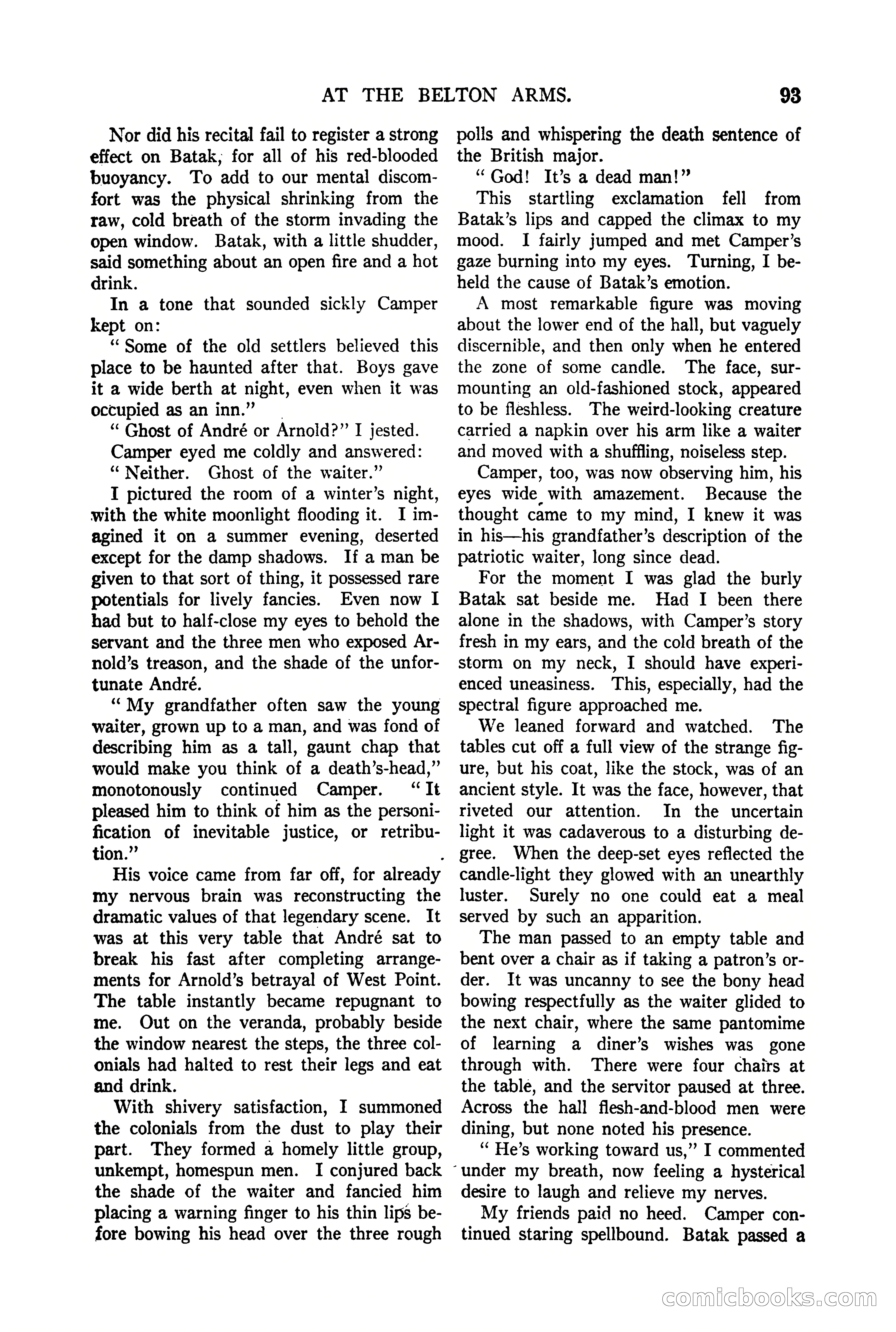
A restored page from Pulp Fiction, 1917. Page through the whole issue in the reader above.
📄 Transcribed text from this page (OCR, searchable)
Machine-transcribed from the original scan — historical spelling and the odd misread are preserved.
AT THE BELTON ARMS. Nor did his recital fail to register a strong effect on Batak, for all of his red-blooded buoyancy. To add to our mental discom- fort was the physical shrinking from the raw, cold breath of the storm invading the open window. Batak, with a little shudder, said something about an open fire and a hot drink. In a tone that sounded sickly Camper kept on: “Some of the old settlers believed this place to be haunted after that. Boys gave it a wide berth at night, even when it was occupied as an inn.” “Ghost of André or Arnold?” I jested. Camper eyed me coldly and answered: “Neither. Ghost of the waiter.” I pictured the room of a winter’s night, with the white moonlight flooding it. I im- agined it on a summer evening, deserted except for the damp shadows. If a man be given to that sort of thing, it possessed rare potentials for lively fancies. Even now I had but to half-close my eyes to behold the servant and the three men who exposed Ar- nold’s treason, and the shade of the unfor- tunate André. “My grandfather often saw the young waiter, grown up to a man, and was fond of describing him as a tall, gaunt chap that would make you think of a death’s-head,” monotonously continued Camper. “It pleased him to think of him as the personi- fication of inevitable justice, or retribu- tion.” His voice came from far off, for already my nervous brain was reconstructing the dramatic values of that legendary scene. It was at this very table that André sat to break his fast after completing arrange- ments for Arnold’s betrayal of West Point. The table instantly became repugnant to me. Out on the veranda, probably beside the window nearest the steps, the three col- onials had halted to rest their legs and eat and drink. With shivery satisfaction, I summoned the colonials from the dust to play their part. They formed a homely little group, unkempt, homespun men. I conjured back the shade of the waiter and fancied him placing a warning finger to his thin lips be- fore bowing his head over the three rough 93 polls and whispering the death sentence of the British major. “God! It’s a dead man!” This startling exclamation fell from Batak’s lips and capped the climax to my mood. I fairly jumped and met Camper’s gaze burning into my eyes. Turning, I be- held the cause of Batak’s emotion. A most remarkable figure was moving about the lower end of the hall, but vaguely discernible, and then only when he entered the zone of some candle. The face, sur- mounting an old-fashioned stock, appeared to be fleshless. The weird-looking creature carried a napkin over his arm like a waiter and moved with a shuffling, noiseless step. Camper, too, was now observing him, his eyes wide with amazement. Because the thought came to my mind, I knew it was in his—his grandfather’s description of the patriotic waiter, long since dead. For the moment I was glad the burly Batak sat beside me. Had I been there alone in the shadows, with Camper’s story fresh in my ears, and the cold breath of the storm on my neck, I should have experi- enced uneasiness. This, especially, had the spectral figure approached me. We leaned forward and watched. The tables cut off a full view of the strange fig- ure, but his coat, like the stock, was of an ancient style. It was the face, however, that riveted our attention. In the uncertain light it was cadaverous to a disturbing de- . gree. When the deep-set eyes reflected the candle-light they glowed with an unearthly luster. Surely no one could eat a meal served by such an apparition. The man passed to an empty table and bent over a chair as if taking a patron’s or- der. It was uncanny to see the bony head bowing respectfully as the waiter glided to the next chair, where the same pantomime of learning a diner’s wishes was gone through with. There were four chairs at the table, and the servitor paused at three. Across the hall flesh-and-blood men were dining, but none noted his presence. ‘““ He’s working toward us,” I commented “under my breath, now feeling a hysterical desire to laugh and relieve my nerves. My friends paid no heed. Camper con- tinued staring spellbound. Batak passed a oO Comiclbooe S CO