
Pulp Fiction, 1917 · page 65 of 200
The Argosy, Vol. 90 No. 1 — page 65: what you’re looking at
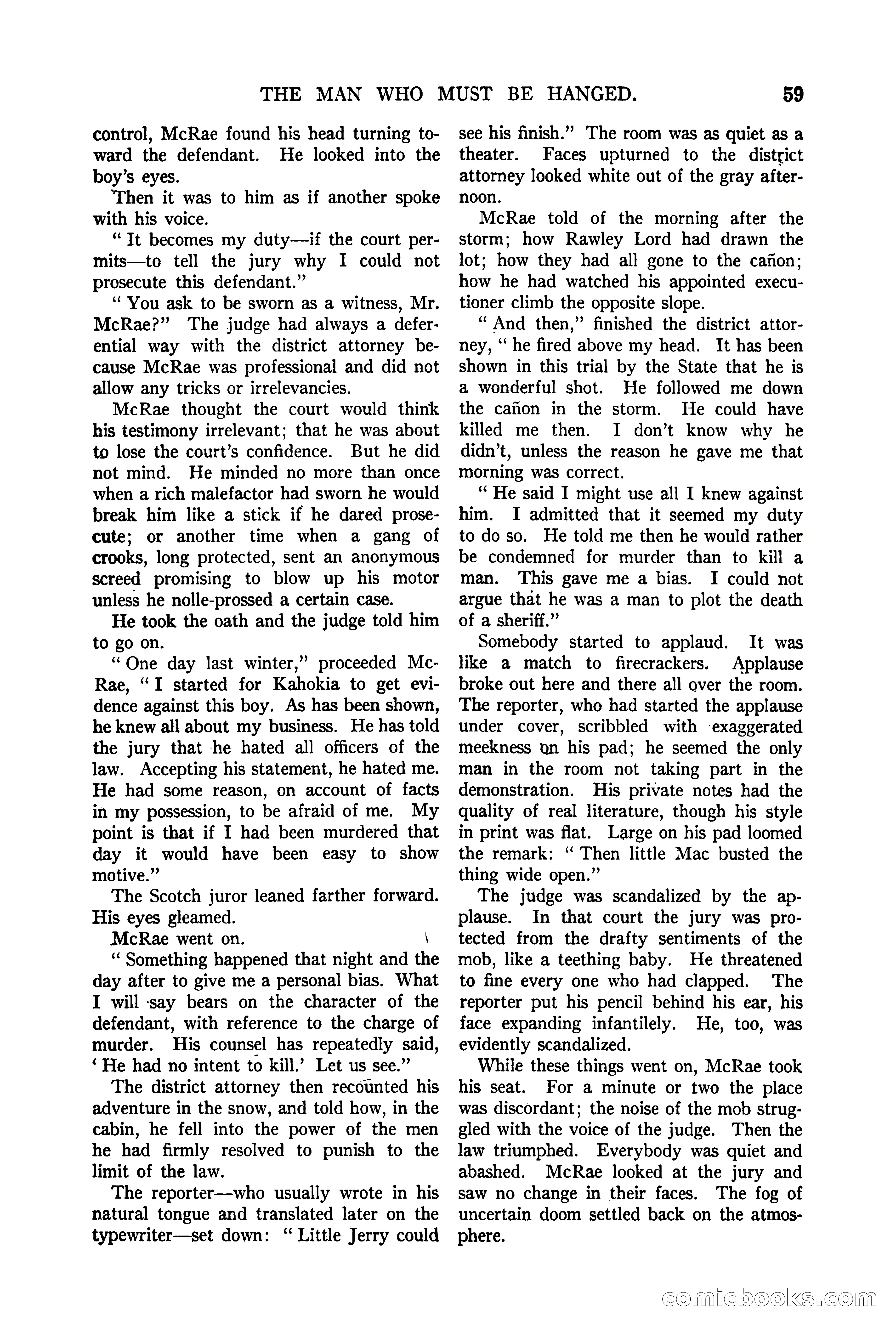
A restored page from Pulp Fiction, 1917. Page through the whole issue in the reader above.
📄 Transcribed text from this page (OCR, searchable)
Machine-transcribed from the original scan — historical spelling and the odd misread are preserved.
THE MAN WHO MUST BE HANGED. control, McRae found his head turning to- ward the defendant. He looked into the boy’s eyes. Then it was to him as if another spoke with his voice. “It becomes my duty—if the court per- mits—to tell the jury why I could not prosecute this defendant.” “You ask to be sworn as a witness, Mr. McRae?” The judge had always a defer- ential way with the district attorney be- cause McRae was professional and did not allow any tricks or irrelevancies. McRae thought the court would think his testimony irrelevant; that he was about to lose the court’s confidence. But he did not mind. He minded no more than once when a rich malefactor had sworn he would break him like a stick if he dared prose- cute; or another time when a gang of crooks, long protected, sent an anonymous screed promising to blow up his motor unless he nolle-prossed a certain case. He took the oath and the judge told him to go on. “One day last winter,” proceeded Mc- Rae, “I started for Kahokia to get evi- dence against this boy. As has been shown, he knew all about my business. He has told the jury that he hated all officers of the law. Accepting his statement, he hated me. He had some reason, on account of facts in my possession, to be afraid of me. My point is that if I had been murdered that day it would have been easy to show motive.” The Scotch juror leaned farther forward. His eyes gleamed. McRae went on. \ ‘‘ Something happened that night and the day after to give me a personal bias. What I will -say bears on the character of the defendant, with reference to the charge of murder. His counsel has repeatedly said, ‘He had no intent to kill.’ Let us see.” The district attorney then recounted his adventure in the snow, and told how, in the cabin, he fell into the power of the men he had firmly resolved to punish to the limit of the law. The reporter—who usually wrote in his natural tongue and translated later on the typewriter—set down: “ Little Jerry could 59 see his finish.”” The room was as quiet as a theater. Faces upturned to the district attorney looked white out of the gray after- noon. McRae told of the morning after the storm; how Rawley Lord had drawn the lot; how they had all gone to the cafon; how he had watched his appointed execu- tioner climb the opposite slope. “And then,” finished the district attor- ney, “‘ he fired above my head. It has been shown in this trial by the State that he is a wonderful shot. He followed me down the cafon in the storm. He could have killed me then. JI don’t know why he didn’t, unless the reason he gave me that morning was correct. “He said I might use all I knew against him. I admitted that it seemed my duty to do so. He told me then he would rather be condemned for murder than to kill a man. This gave me a bias. I could not argue that he was a man to plot the death of a sheriff.” Somebody started to applaud. It was like a match to firecrackers. Applause broke out here and there all over the room. The reporter, who had started the applause under cover, scribbled with exaggerated meekness on his pad; he seemed the only man in the room not taking part in the demonstration. His private notes had the quality of real literature, though his style in print was flat. Large on his pad loomed the remark: ‘“‘ Then little Mac busted the thing wide open.” The judge was scandalized by the ap- plause. In that court the jury was pro- tected from the drafty sentiments of the mob, like a teething baby. He threatened to fine every one who had clapped. The reporter put his pencil behind his ear, his face expanding infantilely. He, too, was evidently scandalized. While these things went on, McRae took his seat. For a minute or two the place was discordant; the noise of the mob strug- gled with the voice of the judge. Then the law triumphed. Everybody was quiet and abashed. McRae looked at the jury and saw no change in their faces. The fog of uncertain doom settled back on the atmos- phere. comicbooks CO