
Pulp Fiction, 1917 · page 43 of 200
The Argosy, Vol. 90 No. 1 — page 43: what you’re looking at
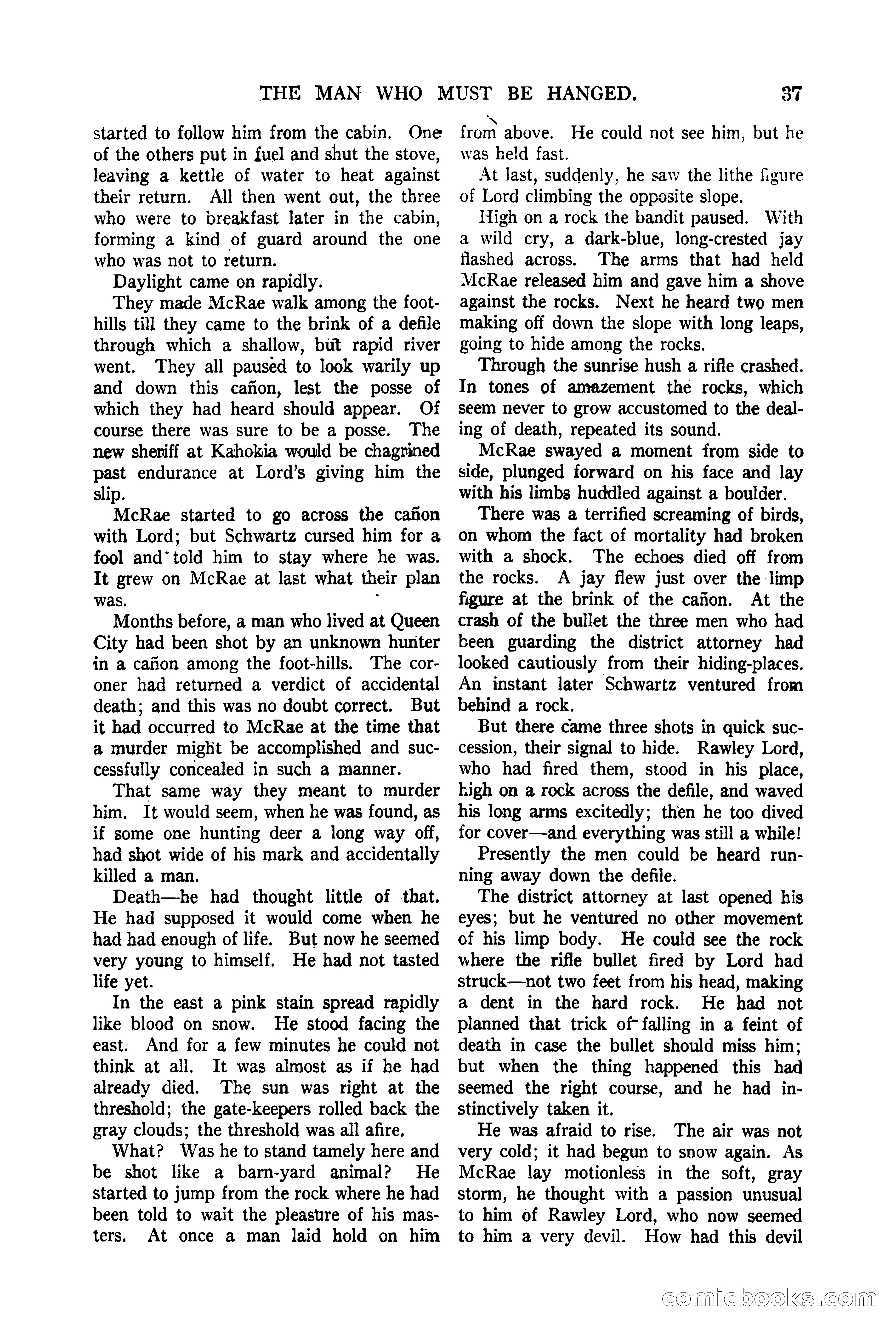
A restored page from Pulp Fiction, 1917. Page through the whole issue in the reader above.
📄 Transcribed text from this page (OCR, searchable)
Machine-transcribed from the original scan — historical spelling and the odd misread are preserved.
THE MAN WHO MUST BE HANGED, oF started to follow him from the cabin. One of the others put in fuel and shut the stove, leaving a kettle of water to heat against their return. All then went out, the three who were to breakfast later in the cabin, forming a kind of guard around the one who was not to return. Daylight came on rapidly. They made McRae walk among the foot- hills till they came to the brink of a defile through which a shallow, btt rapid river went. They all paused to look warily up and down this cafion, lest the posse of which they had heard should appear. Of course there was sure to be a posse. The new sheriff at Kahokia would be chagrined past endurance at Lord’s giving him the slip. McRae started to go across the cafon with Lord; but Schwartz cursed him for a fool and“told him to stay where he was. It grew on McRae at last what their plan was. Months before, a man who lived at Queen City had been shot by an unknown hunter in a cahon among the foot-hills. The cor- oner had returned a verdict of accidental death; and this was no doubt correct. But it had occurred to McRae at the time that a murder might be accomplished and suc- cessfully concealed in such a manner. That same way they meant to murder him. It would seem, when he was found, as if some one hunting deer a long way off, had shot wide of his mark and accidentally killed a man. Death—he had thought little of that. He had supposed it would come when he had had enough of life. But now he seemed very young to himself. He had not tasted life yet. In the east a pink stain spread rapidly like blood on snow. He stood facing the east. And for a few minutes he could not think at all. It was almost as if he had already died. The sun was right at the threshold; the gate-keepers rolled back the gray clouds; the threshold was all afire. What? Was he to stand tamely here and be shot like a barn-yard animal? He started to jump from the rock where he had been told to wait the pleastire of his mas- ters. At once a man laid hold on him from above. He could not see him, but he was held fast. At last, suddenly, he saw the lithe figure of Lord climbing the opposite slope. High on a rock the bandit paused. With a wild cry, a dark-blue, long-crested jay flashed across. The arms that had held McRae released him and gave him a shove against the rocks. Next he heard two men making off down the slope with long leaps, going to hide among the rocks. Through the sunrise hush a rifle crashed. In tones of amazement the rocks, which seem never to grow accustomed to the deal- ing of death, repeated its sound. McRae swayed a moment from side to side, plunged forward on his face and lay with his limbs huddled against a boulder. There was a terrified screaming of birds, on whom the fact of mortality had broken with a shock. The echoes died off from the rocks. A jay flew just over the limp figure at the brink of the cafion. At the crash of the bullet the three men who had been guarding the district attorney had looked cautiously from their hiding-places. An instant later Schwartz ventured from behind a rock. But there came three shots in quick suc- cession, their signal to hide. Rawley Lord, who had fired them, stood in his place, kigh on a rock across the defile, and waved his long arms excitedly; then he too dived for cover—and everything was still a while! Presently the men could be heard run- ning away down the defile. The district attorney at last opened his eyes; but he ventured no other movement of his limp body. He could see the rock where the rifle bullet fired by Lord had struck—not two feet from his head, making a dent in the hard rock. He had not planned that trick of* falling in a feint of death in case the bullet should miss him; but when the thing happened this had seemed the right course, and he had in- stinctively taken it. He was afraid to rise. The air was not very cold; it had begun to snow again. As McRae lay motionless in the soft, gray storm, he thought with a passion unusual to him of Rawley Lord, who now seemed to him a very devil. How had this devil oO Comicbooe S CO