
Pulp Fiction, 1917 · page 39 of 200
The Argosy, Vol. 90 No. 1 — page 39: what you’re looking at
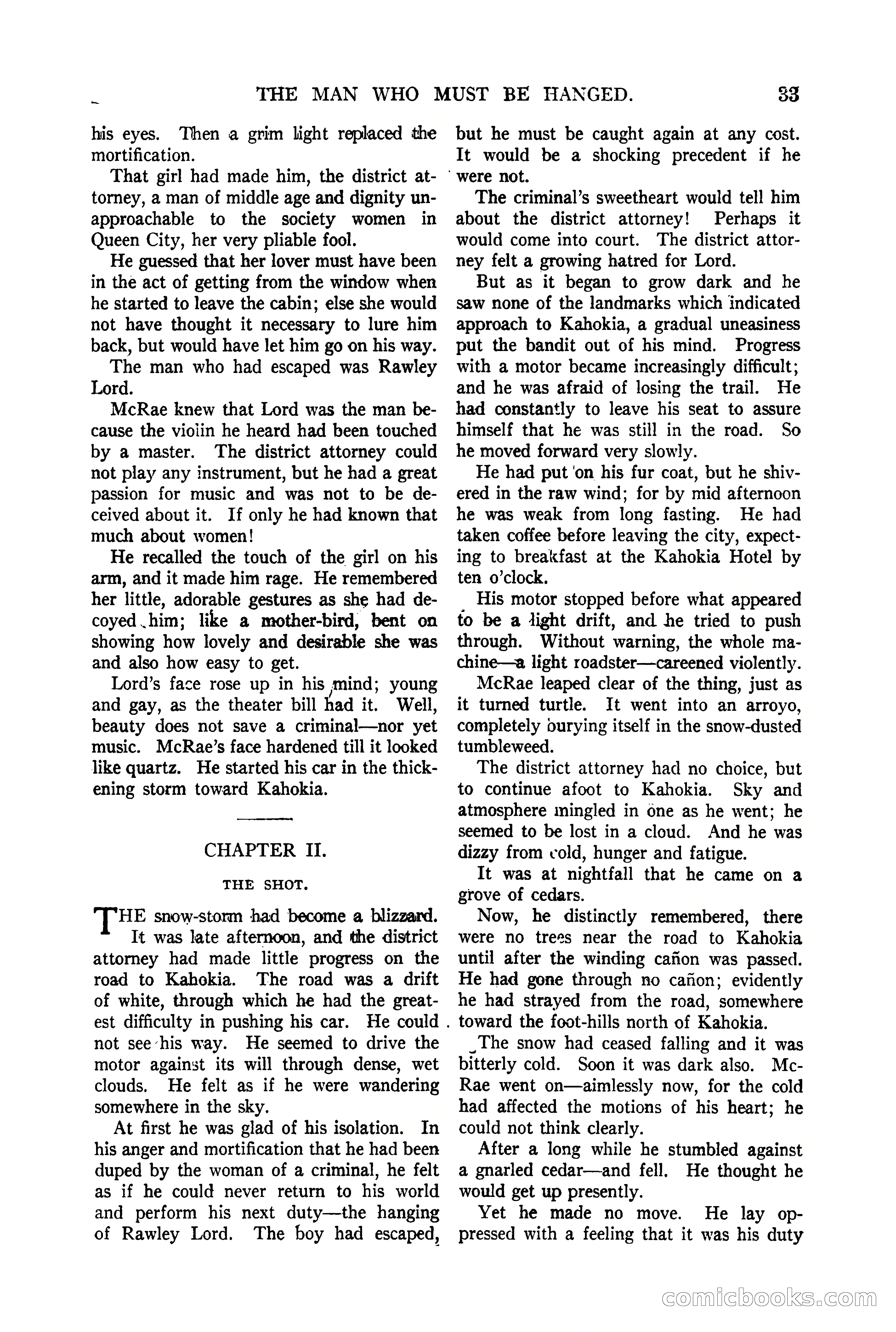
A restored page from Pulp Fiction, 1917. Page through the whole issue in the reader above.
📄 Transcribed text from this page (OCR, searchable)
Machine-transcribed from the original scan — historical spelling and the odd misread are preserved.
_ THE MAN WHO MUST BE HANGED. his eyes. Then a grim light replaced the mortification. That girl had made him, the district at- torney, a man of middle age and dignity un- approachable to the society women in Queen City, her very pliable fool. He guessed that her lover must have been in the act of getting from the window when he started to leave the cabin; else she would not have thought it necessary to lure him back, but would have let him go on his way. The man who had escaped was Rawley Lord. McRae knew that Lord was the man be- cause the vioiin he heard had been touched by a master. The district attorney could not play any instrument, but he had a great passion for music and was not to be de- ceived about it. If only he had known that much about women! He recalled the touch of the girl on his arm, and it made him rage. He remembered her little, adorable gestures as she had de- coyed.him; like a mother-bird, bent on showing how lovely and desirable she was and also how easy to get. Lord’s face rose up in his mind; young and gay, as the theater bill had it. Well, beauty does not save a criminal—nor yet music. McRae’s face hardened till it looked like quartz. He started his car in the thick- ening storm toward Kahokia. CHAPTER II. THE SHOT. HE snow-storm had become a blizzard. It was late afternoon, and the district attorney had made little progress on the road to Kahokia. The road was a drift of white, through which he had the great- est difficulty in pushing his car. He could . not see-his way. He seemed to drive the motor against its will through dense, wet clouds. He felt as if he were wandering somewhere in the sky. At first he was glad of his isolation. In his anger and mortification that he had been duped by the woman of a criminal, he felt as if he could never return to his world and perform his next duty—the hanging of Rawley Lord. The boy had escaped, oo but he must be caught again at any cost. It would be a shocking precedent if he ’ were not. The criminal’s sweetheart would tel! him about the district attorney! Perhaps it would come into court. The district attor- ney felt a growing hatred for Lord. But as it began to grow dark and he saw none of the landmarks which indicated approach to Kahokia, a gradual uneasiness put the bandit out of his mind. Progress with a motor became increasingly difficult; and he was afraid of losing the trail. He had constantly to leave his seat to assure himself that he was still in the road. So he moved forward very slowly. He had put ‘on his fur coat, but he shiv- ered in the raw wind; for by mid afternoon he was weak from long fasting. He had taken coffee before leaving the city, expect- ing to breakfast at the Kahokia Hotel by ten o’clock. _ His motor stopped before what appeared to be a light drift, and he tried to push through. Without warning, the whole ma- chine—a light roadster—careened violently. McRae leaped clear of the thing, just as it turned turtle. It went into an arroyo, completely ourying itself in the snow-dusted tumbleweed. The district attorney had no choice, but to continue afoot to Kahokia. Sky and atmosphere mingled in one as he went; he seemed to be lost in a cloud. And he was dizzy from cold, hunger and fatigue. It was at nightfall that he came on a grove of cedars. Now, he distinctly remembered, there were no trees near the road to Kahokia until after the winding cafion was passed. He had gone through no cajion; evidently he had strayed from the road, somewhere toward the foot-hills north of Kahokia. _The snow had ceased falling and it was bitterly cold. Soon it was dark also. Mc- Rae went on—aimlessly now, for the cold had affected the motions of his heart; he could not think clearly. After a long while he stumbled against a gnarled cedar—and fell. He thought he would get up presently. Yet he made no move. He lay op- pressed with a feeling that it was his duty oO Comicbooe S CO