
Pulp Fiction, 1917 · page 35 of 200
The Argosy, Vol. 90 No. 1 — page 35: what you’re looking at
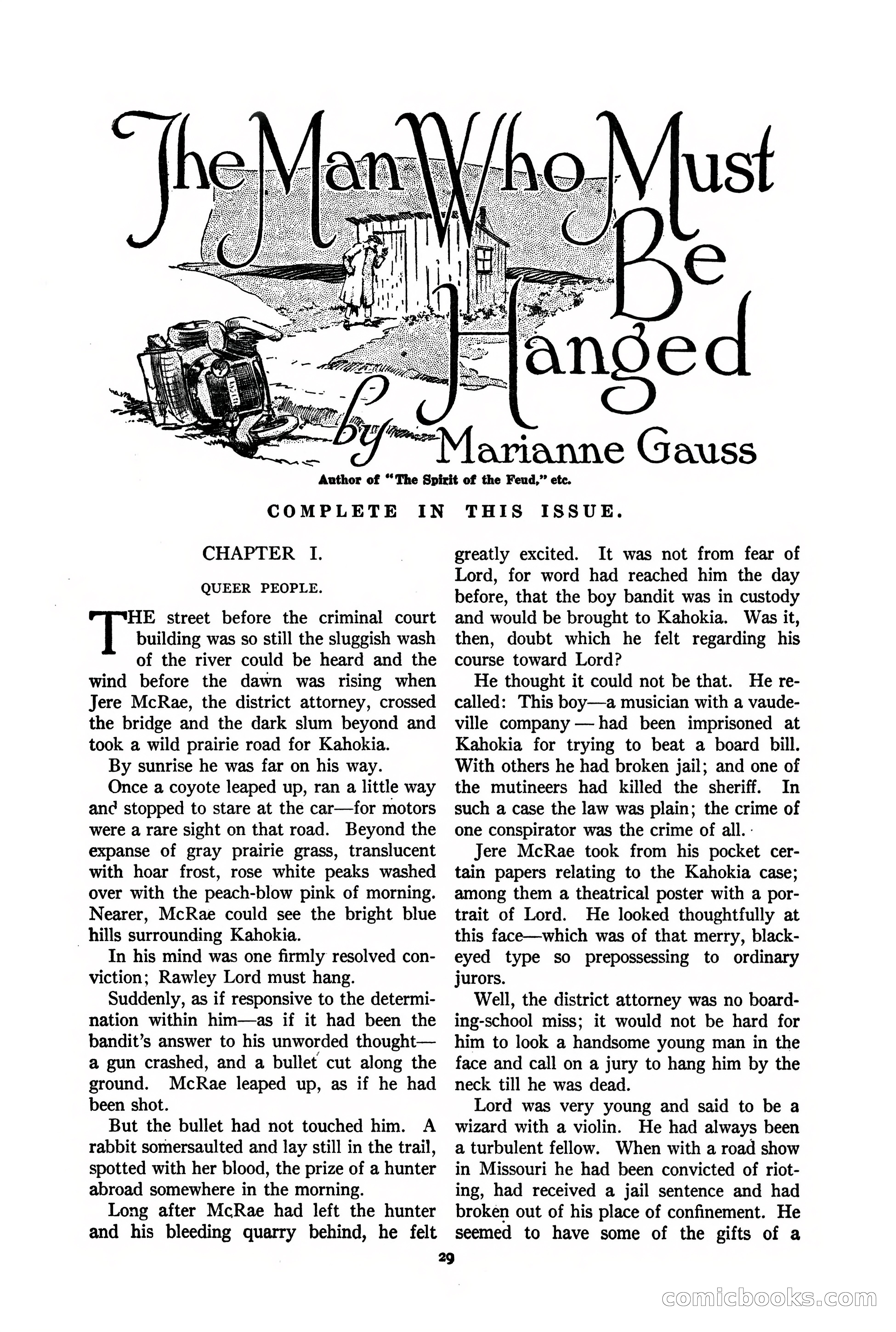
A restored page from Pulp Fiction, 1917. Page through the whole issue in the reader above.
📄 Transcribed text from this page (OCR, searchable)
Machine-transcribed from the original scan — historical spelling and the odd misread are preserved.
Author of “The Spirit of the Feud,” etc. COMPLETE IN THIS ISSUE. CHAPTER I. QUEER PEOPLE. HE street before the criminal court building was so still the sluggish wash of the river could be heard and the wind before the dawn was rising when Jere McRae, the district attorney, crossed the bridge and the dark slum beyond and took a wild prairie road for Kahokia. By sunrise he was far on his way. Once a coyote leaped up, ran a little way and stopped to stare at the car—for motors were a rare sight on that road. Beyond the expanse of gray prairie grass, translucent with hoar frost, rose white peaks washed over with the peach-blow pink of morning. Nearer, McRae could see the bright blue hills surrounding Kahokia. In his mind was one firmly resolved con- viction; Rawley Lord must hang. Suddenly, as if responsive to the determi- nation within him—as if it had been the bandit’s answer to his unworded thought— a gun crashed, and a bullet cut along the ground. McRae leaped up, as if he had been shot. But the bullet had not touched him. A rabbit somersaulted and lay still in the trail, spotted with her blood, the prize of a hunter abroad somewhere in the morning. Long after McRae had left the hunter and his bleeding quarry behind, he felt 29 greatly excited. It was not from fear of Lord, for word had reached him the day before, that the boy bandit was in custody and would be brought to Kahokia. Was it, then, doubt which he felt regarding his course toward Lord? He thought it could not be that. He re- called: This boy—a musician with a vaude- ville company — had been imprisoned at Kahokia for trying to beat a board bill. With others he had broken jail; and one of the mutineers had killed the sheriff. In such a case the law was plain; the crime of one conspirator was the crime of all. - Jere McRae took from his pocket cer- tain papers relating to the Kahokia case; among them a theatrical poster with a por- trait of Lord. He looked thoughtfully at this face—which was of that merry, black- eyed type so prepossessing to ordinary jurors. Well, the district attorney was no board- ing-school miss; it would not be hard for him to look a handsome young man in the face and call on a jury to hang him by the neck till he was dead. Lord was very young and said to be a wizard with a violin. He had always been a turbulent fellow. When with a road show in Missouri he had been convicted of riot- ing, had received a jail sentence and had broken out of his place of confinement. He seemed to have some of the gifts of a Comicbooe S CO