
Pulp Fiction, 1917 · page 24 of 200
The Argosy, Vol. 90 No. 1 — page 24: what you’re looking at
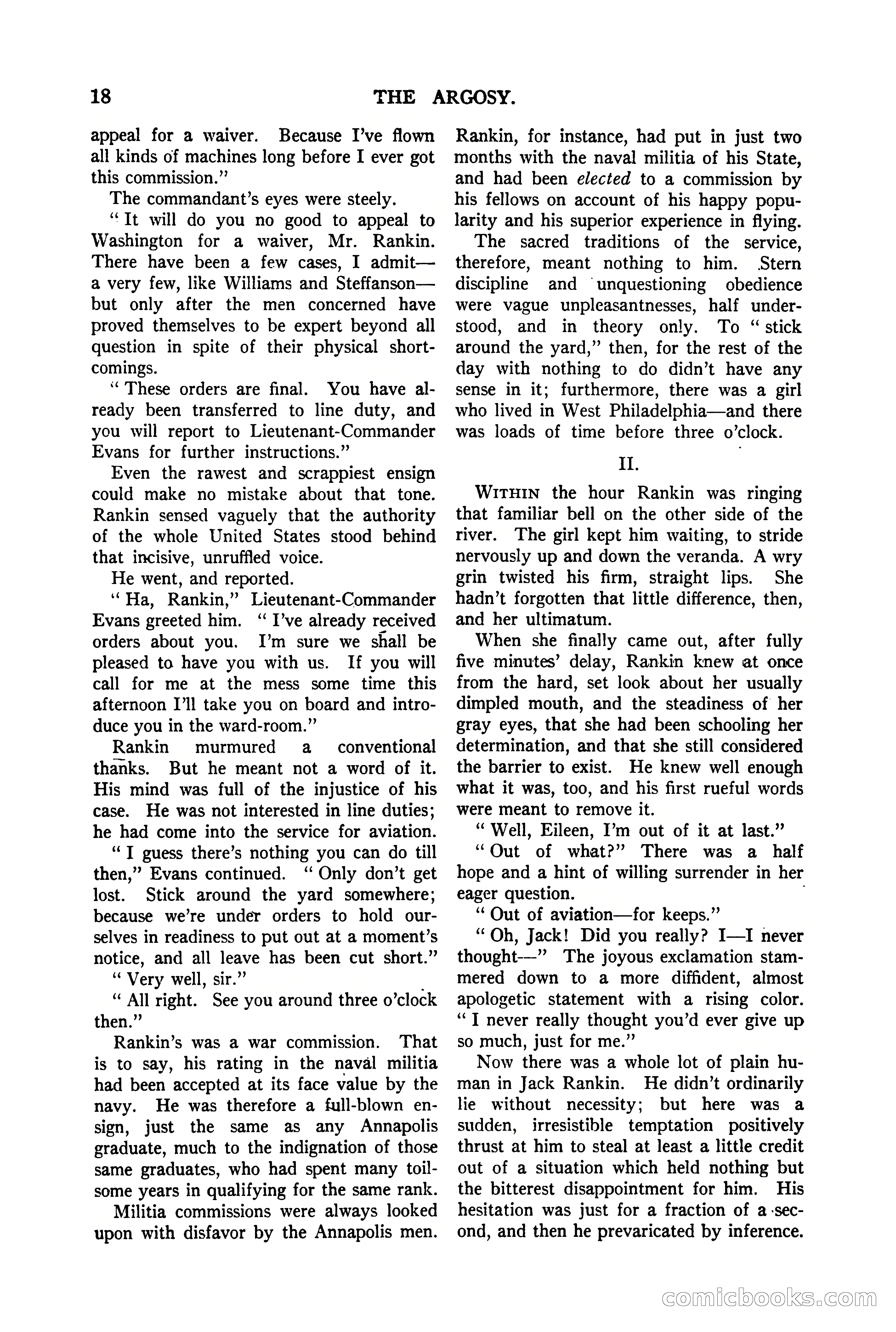
A restored page from Pulp Fiction, 1917. Page through the whole issue in the reader above.
📄 Transcribed text from this page (OCR, searchable)
Machine-transcribed from the original scan — historical spelling and the odd misread are preserved.
18 appeal for a waiver. Because I’ve flown all kinds of machines long before I ever got this commission.” The commandant’s eyes were steely. “It will do you no good to appeal to Washington for a waiver, Mr. Rankin. There have been a few cases, I admit— a very few, like Williams and Steffanson— but only after the men concerned have proved themselves to be expert beyond all question in spite of their physical short- comings. “These orders are final. You have al- ready been transferred to line duty, and you will report to Lieutenant-Commander Evans for further instructions.” Even the rawest and scrappiest ensign could make no mistake about that tone. Rankin sensed vaguely that the authority of the whole United States stood behind that incisive, unruffled voice. He went, and reported. ‘“Ha, Rankin,” Lieutenant-Commander Evans greeted him. ‘I’ve already received orders about you. I’m sure we shall be pleased to have you with us. If you will call for me at the mess some time this afternoon I'll take you on board and intro- duce you in the ward-room.”’ Rankin murmured a_ conventional thanks. But he meant not a word of it. His mind was full of the injustice of his case. He was not interested in line duties; he had come into the service for aviation. ‘“‘T guess there’s nothing you can do till then,” Evans continued. ‘ Only don’t get lost. Stick around the yard somewhere; because we’re under orders to hold our- selves in readiness to put out at a moment’s notice, and all leave has been cut short.” ‘Very well, sir.” “ All right. See you around three o’clock then.” Rankin’s was a war commission. That is to say, his rating in the naval militia had been accepted at its face value by the navy. He was therefore a full-blown en- sign, just the same as any Annapolis graduate, much to the indignation of those same graduates, who had spent many toil- some years in qualifying for the same rank. Militia commissions were always looked upon with disfavor by the Annapolis men. THE ARGOSY. Rankin, for instance, had put in just two months with the naval militia of his State, and had been elected to a commission by his fellows on account of his happy popu- larity and his superior experience in flying. The sacred traditions of the service, therefore, meant nothing to him. Stern discipline and ‘unquestioning obedience were vague unpleasantnesses, half under- stood, and in theory only. To “ stick around the yard,” then, for the rest of the day with nothing to do didn’t have any sense in it; furthermore, there was a girl who lived in West Philadelphia—and there was loads of time before three o’clock. II. WITHIN the hour Rankin was ringing that familiar bell on the other side of the river. The girl kept him waiting, to stride nervously up and down the veranda. A wry grin twisted his firm, straight lips. She hadn’t forgotten that little difference, then, and her ultimatum. When she finally came out, after fully five minutes’ delay, Rankin knew at once from the hard, set look about her usually dimpled mouth, and the steadiness of her gray eyes, that she had been schooling her determination, and that she still considered the barrier to exist. He knew well enough what it was, too, and his first rueful words were meant to remove it. “Well, Eileen, I’m out of it at last.” “Out of what?” There was a_ half hope and a hint of willing surrender in her eager question. . ‘“‘ Out of aviation—for keeps.”’ “Oh, Jack! Did you really? I—I never thought-—” The joyous exclamation stam- mered down to a more diffident, almost apologetic statement with a rising color. ‘“‘T never really thought you’d ever give up so much, just for me.” Now there was a whole lot of plain hu- man in Jack Rankin. He didn’t ordinarily lie without necessity; but here was a sudden, irresistible temptation positively thrust at him to steal at least a little credit out of a situation which held nothing but the bitterest disappointment for him. His hesitation was just for a fraction of a-sec- ond, and then he prevaricated by inference. oO Comicbooe S CO