
Pulp Fiction, 1917 · page 184 of 200
The Argosy, Vol. 90 No. 1 — page 184: what you’re looking at
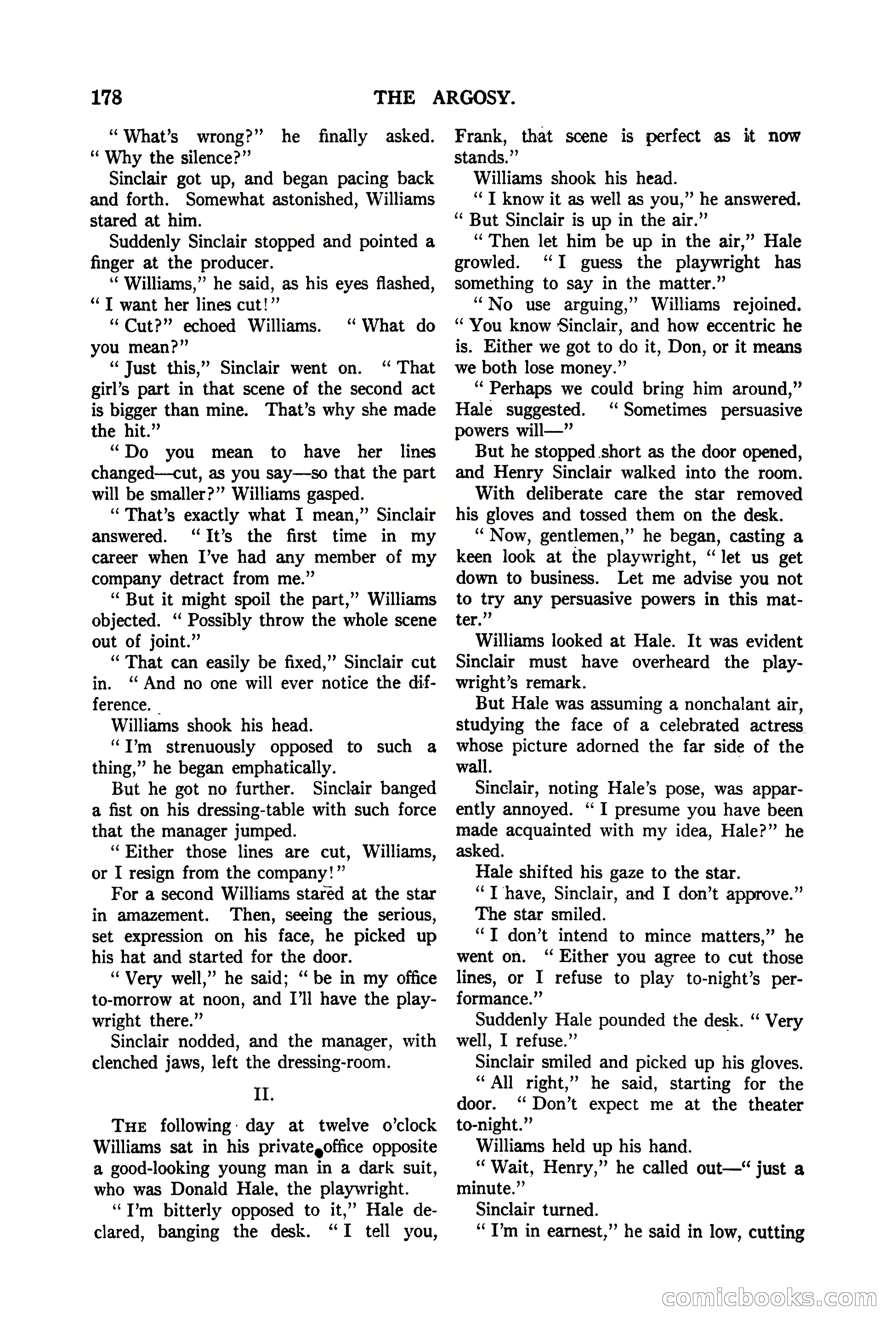
A restored page from Pulp Fiction, 1917. Page through the whole issue in the reader above.
📄 Transcribed text from this page (OCR, searchable)
Machine-transcribed from the original scan — historical spelling and the odd misread are preserved.
178 “‘What’s wrong?” he “Why the silence?” Sinclair got up, and began pacing back and forth. Somewhat astonished, Williams stared at him. Suddenly Sinclair stopped and pointed a finger at the producer. “ Williams,” he said, as his eyes flashed, ‘“‘T want her lines cut!”’ “Cut?” echoed Williams. you mean?” “‘ Just this,” Sinclair went on. ‘“ That girl’s part in that scene of the second act is bigger than mine. That’s why she made the hit.” “Do you mean to have her lines changed—cut, as you say—so that the part will be smaller?” Williams gasped. “That’s exactly what I mean,” Sinclair answered. “It’s the first time in my career when I’ve had any member of my company detract from me.” ‘“‘ But it might spoil the part,” Williams objected. ‘‘ Possibly throw the whole scene out of joint.” ‘“‘ That can easily be fixed,” Sinclair cut in. ‘“ And no one will ever notice the dif- ference. | Williams shook his head. “Tm strenuously opposed to such a thing,” he began emphatically. But he got no further. Sinclair banged a fist on his dressing-table with such force that the manager jumped. ‘“‘ Either those lines are cut, Williams, or I resign from the company!” For a second Williams stared at the star in amazement. Then, seeing the serious, set expression on his face, he picked up his hat and started for the door. “Very well,” he said; ‘ be in my office to-morrow at noon, and I’ll have the play- wright there.” Sinclair nodded, and the manager, with clenched jaws, left the dressing-room. II. THE following: day at twelve o’clock Williams sat in his privategoffice opposite a good-looking young man in a dark suit, who was Donald Hale, the playwright. ‘I’m bitterly opposed to it,” Hale de- clared, banging the desk. “I tell you, finally asked. “What do THE ARGOSY. Frank, that scene is perfect as it now stands.” Williams shook his head. ‘“‘T know it as well as you,” he answered. ‘* But Sinclair is up in the air.” ‘Then let him be up in the air,” Hale growled. ‘I guess the playwright has something to say in the matter.” ‘““No use arguing,” Williams rejoined. “You know Sinclair, and how eccentric he is. Either we got to do it, Don, or it means we both lose money.” “Perhaps we could bring him around,” Hale suggested. ‘“ Sometimes persuasive powers will—”’ But he stopped short as the door opened, and Henry Sinclair walked into the room. With deliberate care the star removed his gloves and tossed them on the desk. “Now, gentlemen,” he began, casting a keen look at the playwright, “let us get down to business. Let me advise you not to try any persuasive powers in this mat- ter.”’ Williams looked at Hale. It was evident Sinclair must have overheard the play- wright’s remark. But Hale was assuming a nonchalant air, studying the face of a celebrated actress whose picture adorned the far side of the wall. Sinclair, noting Hale’s pose, was appar- ently annoyed. ‘I presume you have been made acquainted with my idea, Hale?” he asked. Hale shifted his gaze to the star. “T have, Sinclair, and I don’t approve.” The star smiled. ‘““T don’t intend to mince matters,” he went on. “ Either you agree to cut those lines, or I refuse to play to-night’s per- formance.” Suddenly Hale pounded the desk. “ Very well, I refuse.” Sinclair smiled and picked up his gloves. “All right,” he said, starting for the door. ‘ Don’t expect me at the theater to-night.” Williams held up his hand. “Wait, Henry,” he called out—“ just a minute.” Sinclair turned. ‘Tm in earnest,” he said in low, cutting oO Comicbooe S CO