
Pulp Fiction, 1917 · page 120 of 200
The Argosy, Vol. 90 No. 1 — page 120: what you’re looking at
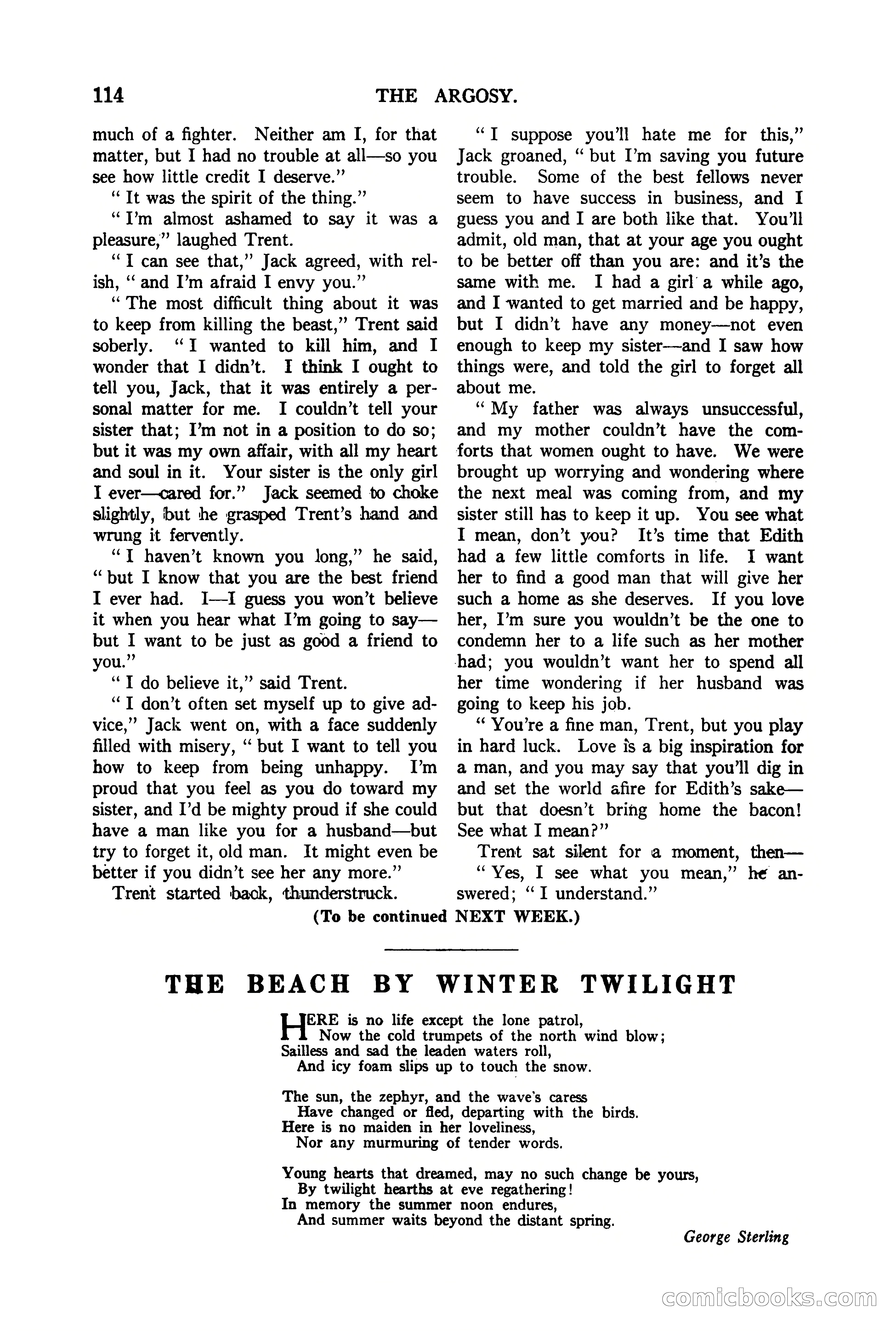
A restored page from Pulp Fiction, 1917. Page through the whole issue in the reader above.
📄 Transcribed text from this page (OCR, searchable)
Machine-transcribed from the original scan — historical spelling and the odd misread are preserved.
114 much of a fighter. Neither am I, for that matter, but I had no trouble at all—so you see how little credit I deserve.” ‘‘ It was the spirit of the thing.” ‘I’m almost ashamed to say it was a pleasure,” laughed Trent. “I can see that,” Jack agreed, with rel- ish, ‘“‘ and I’m afraid I envy you.” “The most difficult thing about it was to keep from killing the beast,” Trent said soberly. ‘I wanted to kill him, and I wonder that I didn’t. I think I ought to tell you, Jack, that it was entirely a per- sonal matter for me. I couldn’t tell your sister that; I’m not in a position to do so; but it was my own affair, with all my heart and soul in it. Your sister is the only girl I ever—cared for.” Jack seemed to choke slightly, but he grasped Trent’s hand and wrung it fervently. “I haven’t known you long,” he said, “but I know that you are the best friend I ever had. I-—I guess you won’t believe it when you hear what I’m going to say— but I want to be just as good a friend to you.” ‘I do believe it,” said Trent. “TI don’t often set myself up to give ad- vice,” Jack went on, with a face suddenly filled with misery, ‘“ but I want to tell you how to keep from being unhappy. I’m proud that you feel as you do toward my sister, and I’d be mighty proud if she could have a man like you for a husband—but try to forget it, old man. It might even be better if you didn’t see her any more.” Trent started back, thunderstruck. THE ARGOSY. ‘“T suppose you'll hate me for this,” Jack groaned, “ but I’m saving you future trouble. Some of the best fellows never seem to have success in business, and I guess you and I are both like that. You’ll admit, old man, that at your age you ought to be better off than you are: and it’s the same with me. I had a girl'a while ago, and I wanted to get married and be happy, but I didn’t have any money—not even enough to keep my sister—and I saw how things were, and told the girl to forget all about me. ‘“My father was always unsuccessful, and my mother couldn’t have the com- forts that women ought to have. We were brought up worrying and wondering where the next meal was coming from, and my sister still has to keep it up. You see what I mean, don’t you? It’s time that Edith had a few little comforts in life. I want her to find a good man that will give her such a home as she deserves. If you love her, I’m sure you wouldn’t be the one to condemn her to a life such as her mother had; you wouldn’t want her to spend all her time wondering if her husband was going to keep his job. “You're a fine man, Trent, but you play in hard luck. Love is a big inspiration for aman, and you may say that you'll dig in and set the world afire for Edith’s sake— but that doesn’t bring home the bacon! See what I mean?” Trent sat silent for a moment, then— “Yes, I see what you mean,” he an- swered; “I understand.” (To be continued NEXT WEEK.) THE BEACH BY WINTER TWILIGHT ERE is no life except the lone patrol, Now the cold trumpets of the north wind blow; Sailless and sad the leaden waters roll, And icy foam slips up to touch the snow. The sun, the zephyr, and the wave's caress Have changed or fied, departing with the birds. Here is no maiden in her loveliness, Nor any murmuring of tender words. Young hearts that dreamed, may no such change be yours, By twilight hearths at eve regathering! In memory the summer noon endures, And summer waits beyond the distant spring. George Sterling oO comicbool< CO