
Pulp Fiction, 1917 · page 84 of 192
Argosy, Vol. 85, No. 3 — page 84: what you’re looking at
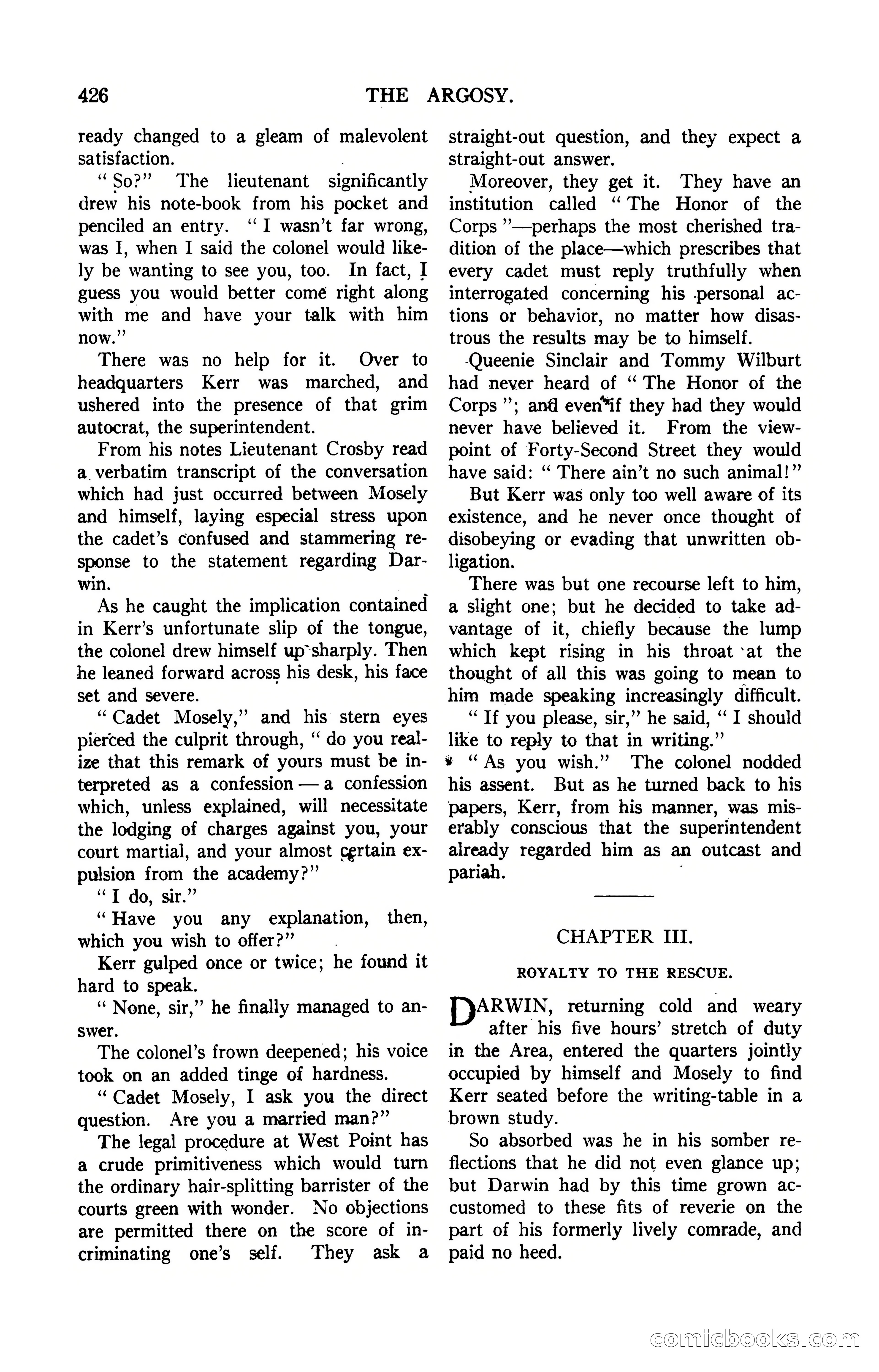
A restored page from Pulp Fiction, 1917. Page through the whole issue in the reader above.
📄 Transcribed text from this page (OCR, searchable)
Machine-transcribed from the original scan — historical spelling and the odd misread are preserved.
426 ready changed to a gleam of malevolent satisfaction. . “So?” The lieutenant significantly drew his note-book from his pocket and penciled an entry. ‘‘ I wasn’t far wrong, was I, when I said the colonel would like- ly be wanting to see you, too. In fact, I guess you would better comé right along with me and have your talk with him now.” There was no help for it. Over to headquarters Kerr was marched, and ushered into the presence of that grim autocrat, the superintendent. From his notes Lieutenant Crosby read a verbatim transcript of the conversation which had just occurred between Mosely and himself, laying especial stress upon the cadet’s confused and stammering re- sponse to the statement regarding Dar- win. a As he caught the implication contained in Kerr’s unfortunate slip of the tongue, the colonel drew himself up*sharply. Then he leaned forward across his desk, his face set and severe. “Cadet Mosely,” and his stern eyes pierced the culprit through, ‘“‘ do you real- ize that this remark of yours must be in- terpreted as a confession — a confession which, unless explained, will necessitate the lodging of charges against you, your court martial, and your almost certain ex- pulsion from the academy?”’ ‘“T do, sir.” “Have you any explanation, then, which you wish to offer?” Kerr gulped once or twice; he found it hard to speak. ‘None, sir,”’ he finally managed to an- swer. The colonel’s frown deepened; his voice took on an added tinge of hardness. “Cadet Mosely, I ask you the direct question. Are you a married man?” The legal procedure at West Point has a crude primitiveness which would turn the ordinary hair-splitting barrister of the courts green with wonder. No objections are permitted there on the score of in- criminating one’s self. They ask a THE ARGOSY. Straight-out question, and they expect a Straight-out answer. Moreover, they get it. They have an institution called ‘The Honor of the Corps ”—perhaps the most cherished tra- dition of the place—which prescribes that every cadet must reply truthfully when interrogated concerning his personal ac- tions or behavior, no matter how disas- trous the results may be to himself. Queenie Sinclair and Tommy Wilburt had never heard of ‘ The Honor of the Corps ”; and even*if they had they would never have believed it. From the view- point of Forty-Second Street they would have said: ‘‘ There ain’t no such animal!” But Kerr was only too well aware of its existence, and he never once thought of disobeying or evading that unwritten ob- ligation. There was but one recourse left to him, a slight one; but he decided to take ad- vantage of it, chiefly because the lump which kept rising in his throat ‘at the thought of all this was going to mean to him made speaking increasingly difficult. ‘“‘ If you please, sir,’’ he said, ‘‘ I should like to reply to that in writing.” ¥ “ As you wish.” The colonel nodded his assent. But as he turned back to his papers, Kerr, from his manner, was mis- erably conscious that the superintendent already regarded him as an outcast and pariah. CHAPTER III. ROYALTY TO THE RESCUE. ARWIN, returning cold and weary after his five hours’ stretch of duty in the Area, entered the quarters jointly occupied by himself and Mosely to find Kerr seated before the writing-table in a brown study. So absorbed was he in his somber re- flections that he did not even glance up; but Darwin had by this time grown ac- customed to these fits of reverie on the part of his formerly lively comrade, and paid no heed. comicloool C©