
Pulp Fiction, 1917 · page 70 of 192
Argosy, Vol. 85, No. 3 — page 70: what you’re looking at
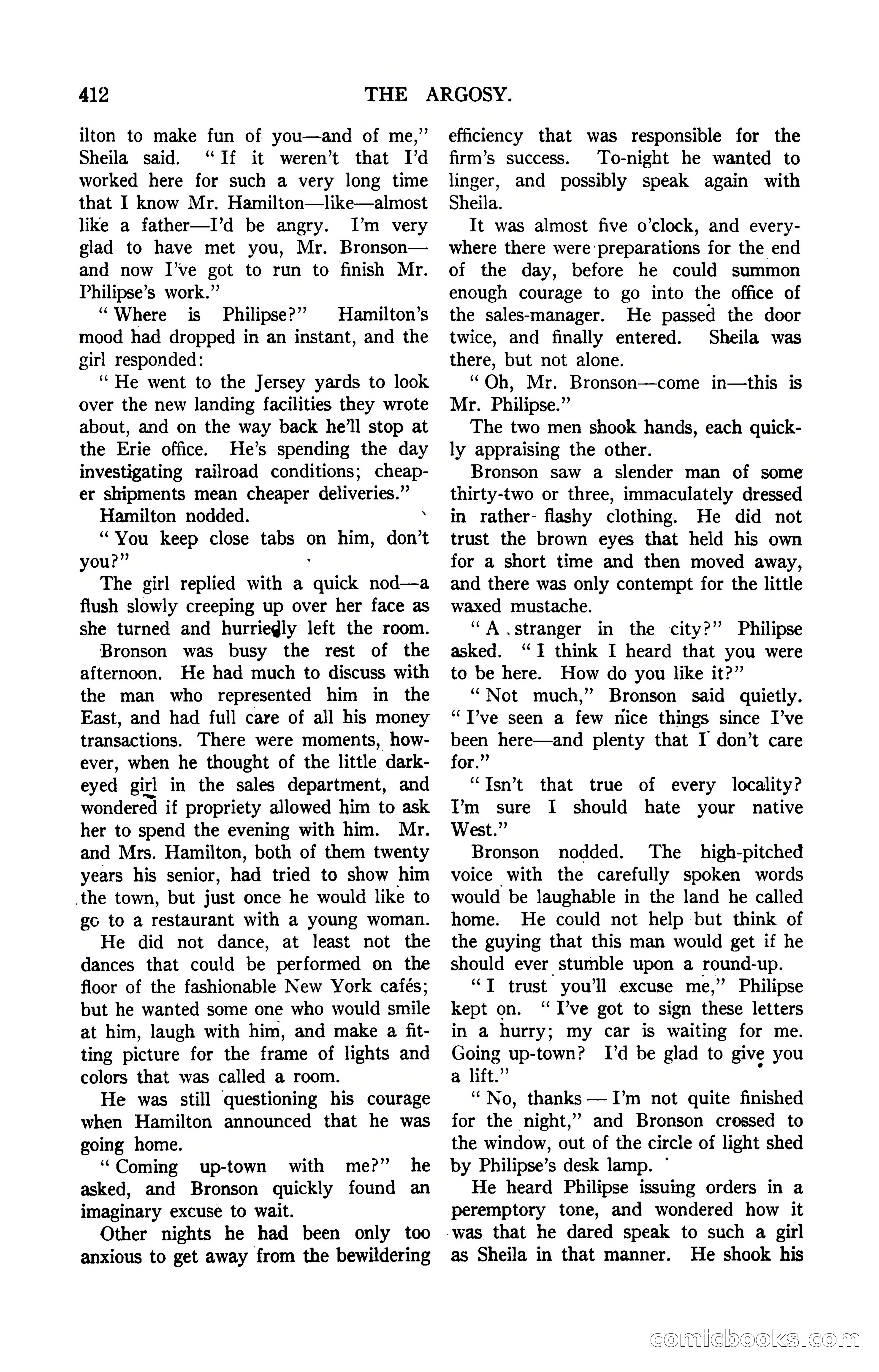
A restored page from Pulp Fiction, 1917. Page through the whole issue in the reader above.
📄 Transcribed text from this page (OCR, searchable)
Machine-transcribed from the original scan — historical spelling and the odd misread are preserved.
412 ilton to make fun of you—and of me,” Sheila said. “If it weren’t that Id worked here for such a very long time that I know Mr. Hamilton—like—almost like a father—I’d be angry. I’m very glad to have met you, Mr. Bronson— and now I’ve got to run to finish Mr. Philipse’s work.” ‘Where is Philipse?”’ |Hamilton’s mood had dropped in an instant, and the girl responded: ‘He went to the Jersey yards to look over the new landing facilities they wrote about, and on the way back he'll stop at the Erie office. He’s spending the day investigating railroad conditions; cheap- er shipments mean cheaper deliveries.” Hamilton nodded. . “You keep close tabs on him, don’t you?” The girl replied with a quick nod—a flush slowly creeping up over her face as she turned and hurrie@ly left the room. Bronson was busy the rest of the afternoon. He had much to discuss with the man who represented him in the East, and had full care of all his money transactions. There were moments, how- ever, when he thought of the little dark- eyed girl in the sales department, and wondered if propriety allowed him to ask her to spend the evening with him. Mr. and Mrs. Hamilton, both of them twenty years his senior, had tried to show him the town, but just once he would like to go to a restaurant with a young woman. He did not dance, at least not the dances that could be performed on the floor of the fashionable New York cafés; but he wanted some one who would smile at him, laugh with him, and make a fit- ting picture for the frame of lights and colors that was called a room. He was still questioning his courage when Hamilton announced that he was going home. “Coming up-town with me?” he asked, and Bronson quickly found an imaginary excuse to wait. Other nights he had been only too anxious to get away from the bewildering THE ARGOSY. efficiency that was responsible for the firm’s success. To-night he wanted to linger, and possibly speak again with Sheila. It was almost five o’clock, and every- where there were preparations for the end of the day, before he could summon enough courage to go into the office of the sales-manager. He passed the door twice, and finally entered. Sheila was there, but not alone. “Oh, Mr. Bronson—come in—this is Mr. Philipse.”’ The two men shook hands, each quick- ly appraising the other. Bronson saw a slender man of some thirty-two or three, immaculately dressed in rather- flashy clothing. He did not trust the brown eyes that held his own for a short time and then moved away, and there was only contempt for the little waxed mustache. ‘“A .stranger in the city?” Philipse asked. “I think I heard that you were to be here. How do you like it?” ‘Not much,” Bronson said quietly. “T’ve seen a few nice things since I’ve been here—and plenty that I don’t care for.” “TIsn’t that true of every locality? I’m sure I should hate your native West.” Bronson nodded. The _ high-pitched voice with the carefully spoken words would be laughable in the land he called home. He could not help but think of the guying that this man would get if he should ever stumble upon a round-up. “T trust youll excuse me,” Philipse kept on. “ I’ve got to sign these letters in a hurry; my car is waiting for me. Going up-town? Id be glad to give you a lift.” ‘“ No, thanks — I’m not quite finished for the night,’”’ and Bronson crossed to the window, out of the circle of light shed by Philipse’s desk lamp. He heard Philipse issuing orders in a peremptory tone, and wondered how it -was that he dared speak to such a girl as Sheila in that manner. He shook his comicloool C©