
Pulp Fiction, 1917 · page 18 of 192
Argosy, Vol. 85, No. 3 — page 18: what you’re looking at
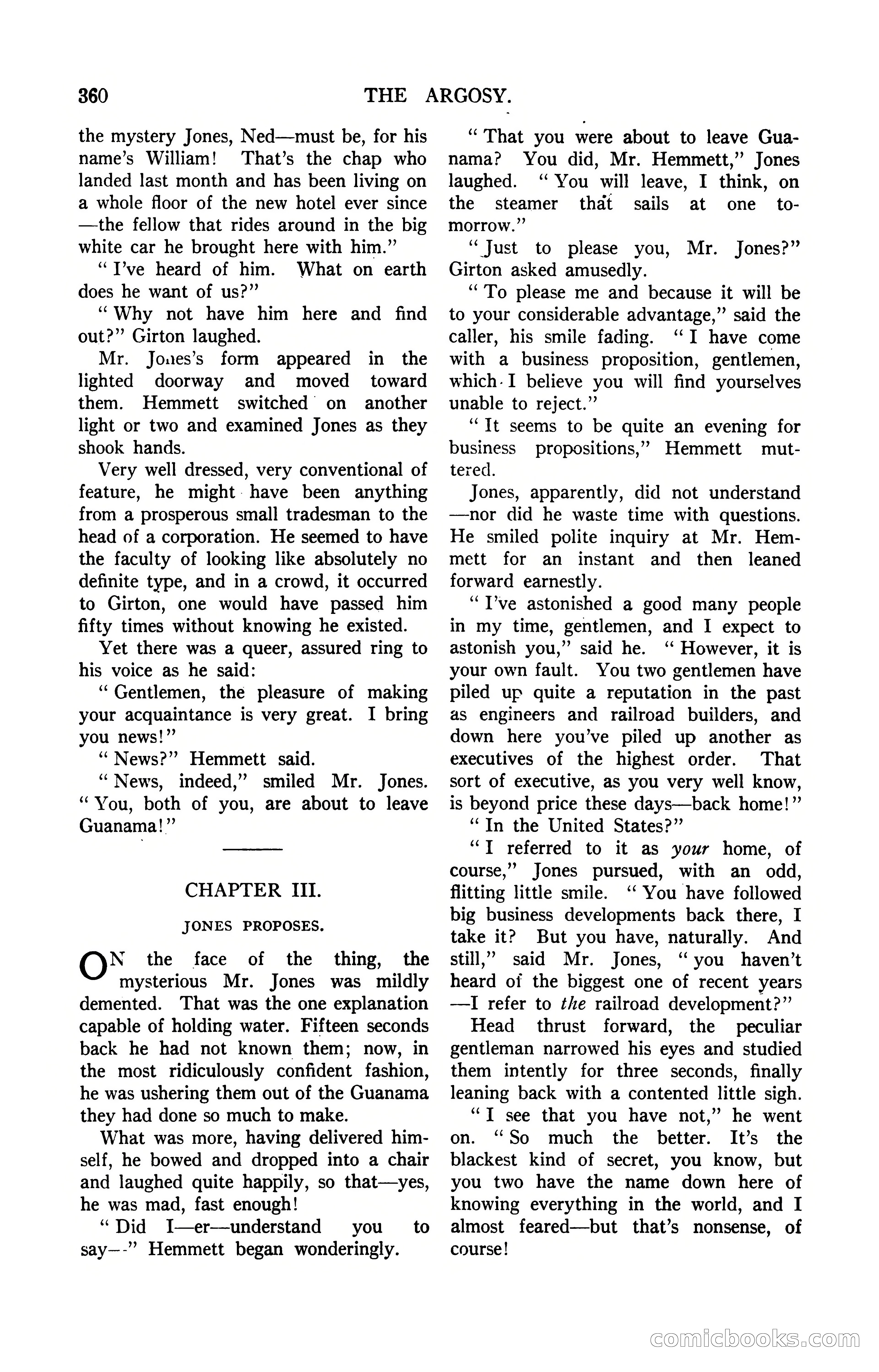
A restored page from Pulp Fiction, 1917. Page through the whole issue in the reader above.
📄 Transcribed text from this page (OCR, searchable)
Machine-transcribed from the original scan — historical spelling and the odd misread are preserved.
360 the mystery Jones, Ned—must be, for his name’s William! That’s the chap who landed last month and has been living on a whole floor of the new hotel ever since —the fellow that rides around in the big white car he brought here with him.” “T’ve heard of him. What on earth does he want of us?” ‘““Why not have him here and find out?” Girton laughed. Mr. Jones’s form appeared in the lighted doorway and moved _ toward them. Hemmett switched on another light or two and examined Jones as they shook hands. Very well dressed, very conventional of feature, he might: have been anything from a prosperous small tradesman to the head of a corporation. He seemed to have the faculty of looking like absolutely no definite type, and in a crowd, it occurred to Girton, one would have passed him fifty times without knowing he existed. Yet there was a queer, assured ring to his voice as he said: ‘“‘ Gentlemen, the pleasure of making your acquaintance is very great. I bring you news!”’ ‘““ News?” Hemmett said. ‘News, indeed,” smiled Mr. Jones. ‘You, both of you, are about to leave Guanama!”’ CHAPTER III. JONES PROPOSES. OX the face of the thing, the mysterious Mr. Jones was mildly demented. That was the one explanation capable of holding water. Fifteen seconds back he had not known them; now, in the most ridiculously confident fashion, he was ushering them out of the Guanama they had done so much to make. What was more, having delivered him- self, he bowed and dropped into a chair and laughed quite happily, so that—yes, he was mad, fast enough! “Did I—er—understand you say—-” Hemmett began wonderingly. to THE ARGOSY. “That you were about to leave Gua- nama? You did, Mr. Hemmett,”’ Jones laughed. ‘ You will leave, I think, on the steamer that sails at one to- morrow.”’ ‘Just to please you, Mr. Jones?” Girton asked amusedly. ‘To please me and because it will be to your considerable advantage,” said the caller, his smile fading. ‘‘I have come with a business proposition, gentlemen, which-I believe you will find yourselves unable to reject.” “It seems to be quite an evening for business propositions,” Hemmett mut- tered. Jones, apparently, did not understand —nor did he waste time with questions. He smiled polite inquiry at Mr. Hem- mett for an instant and then leaned forward earnestly. ‘““T’ve astonished a good many people in my time, gentlemen, and I expect to astonish you,” said he. ‘‘ However, it is your own fault. You two gentlemen have piled up quite a reputation in the past as engineers and railroad builders, and down here you’ve piled up another as executives of the highest order. That sort of executive, as you very well know, is beyond price these days—back home!” ‘“In the United States?” ‘““T referred to it as your home, of course,” Jones pursued, with an odd, flitting little smile. ‘‘ You have followed big business developments back there, I take it? But you have, naturally. And still,” said Mr. Jones, ‘‘ you haven’t heard of the biggest one of recent years —I refer to the railroad development?” Head thrust forward, the peculiar gentleman narrowed his eyes and studied them intently for three seconds, finally leaning back with a contented little sigh. “I see that you have not,” he went on. “So much the better. It’s the blackest kind of secret, you know, but you two have the name down here of knowing everything in the world, and I almost feared—but that’s nonsense, of course! MICLOOOK C©