
Pulp Fiction, 1917 · page 148 of 192
Argosy, Vol. 85, No. 3 — page 148: what you’re looking at
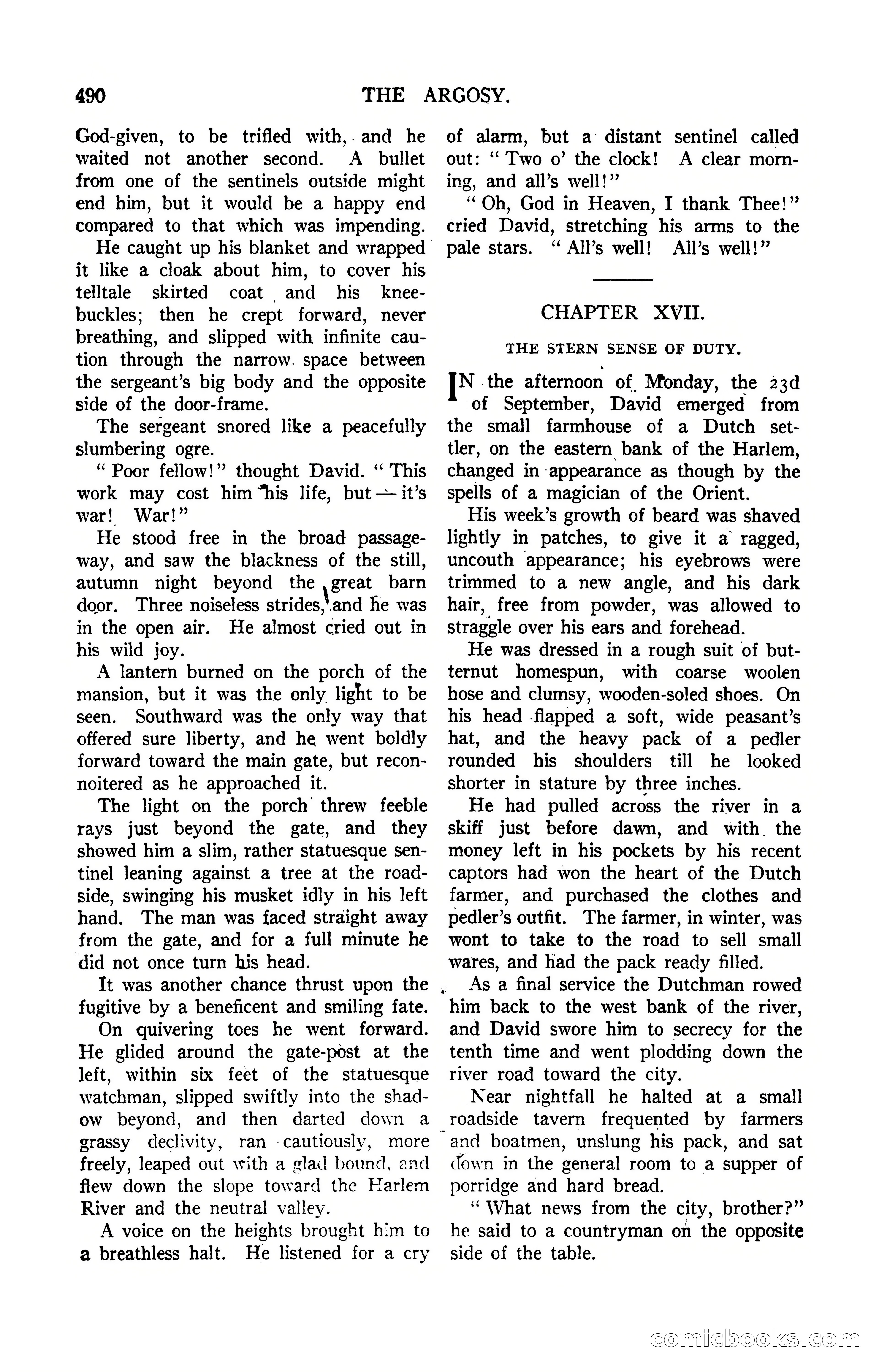
A restored page from Pulp Fiction, 1917. Page through the whole issue in the reader above.
📄 Transcribed text from this page (OCR, searchable)
Machine-transcribed from the original scan — historical spelling and the odd misread are preserved.
430 God-given, to be trifled with,. and he waited not another second. A _ bullet from one of the sentinels outside might end him, but it would be a happy end compared to that which was impending. He caught up his blanket and wrapped it like a cloak about him, to cover his telltale skirted coat and his’ knee- buckles; then he crept forward, never breathing, and slipped with infinite cau- tion through the narrow. space between the sergeant’s big body and the opposite side of the door-frame. The sergeant snored like a peacefully slumbering ogre. “Poor fellow!” thought David. ‘“ This work may cost him “his life, but — it’s war! War!” He stood free in the broad passage- way, and saw the blackness of the still, autumn night beyond the ,great barn door. Three noiseless strides ‘and he was in the open air. He almost cried out in his wild joy. A lantern burned on the porch of the mansion, but it was the only light to be seen. Southward was the only way that offered sure liberty, and he went boldly forward toward the main gate, but recon- noitered as he approached it. The light on the porch threw feeble rays just beyond the gate, and they showed him a slim, rather statuesque sen- tinel leaning against a tree at the road- side, swinging his musket idly in his left hand. The man was faced straight away from the gate, and for a full minute he did not once turn his head. It was another chance thrust upon the fugitive by a beneficent and smiling fate. On quivering toes he went forward. He glided around the gate-post at the left, within six feet of the statuesque watchman, slipped swiftly into the shad- ow beyond, and then darted down a erassy declivity, ran -cautiously, more freely, leaped out with a glad bound, and flew down the slope toward the Harlem River and the neutral valley. A voice on the heights brought him to a breathless halt. He listened for a cry rs THE ARGOSY. of alarm, but a distant sentinel called out: “Two o’ the clock! A clear morn- ing, and all’s well!” ‘“Oh, God in Heaven, I thank Thee!” cried David, stretching his arms to the pale stars. “ All’s well! All’s well!” CHAPTER XVII. THE STERN SENSE OF DUTY. [N the afternoon of. Monday, the 23d of September, David emerged from the small farmhouse of a Dutch set- tler, on the eastern bank of the Harlem, changed in appearance as though by the spells of a magician of the Orient. His week’s growth of beard was shaved lightly in patches, to give it a ragged, uncouth appearance; his eyebrows were trimmed to a new angle, and his dark hair, free from powder, was allowed to straggle over his ears and forehead. He was dressed in a rough suit of but- ternut homespun, with coarse woolen hose and clumsy, wooden-soled shoes. On his head -flapped a soft, wide peasant’s hat, and the heavy pack of a pedler rounded his shoulders till he looked shorter in stature by three inches. He had pulled across the river in a skiff just before dawn, and with. the money left in his pockets by his recent captors had won the heart of the Dutch farmer, and purchased the clothes and pedler’s outfit. The farmer, in winter, was wont to take to the road to sell small wares, and had the pack ready filled. As a final service the Dutchman rowed him back to the west bank of the river, and David swore him to secrecy for the tenth time and went plodding down the river road toward the city. Near nightfall he halted at a small roadside tavern frequented by farmers -and boatmen, unslung his pack, and sat down in the general room to a supper of porridge and hard bread. ‘What news from the city, brother?” he said to a countryman on the opposite side of the table. CO 1OOOLK nn C©