
Pulp Fiction, 1917 · page 111 of 192
Argosy, Vol. 85, No. 3 — page 111: what you’re looking at
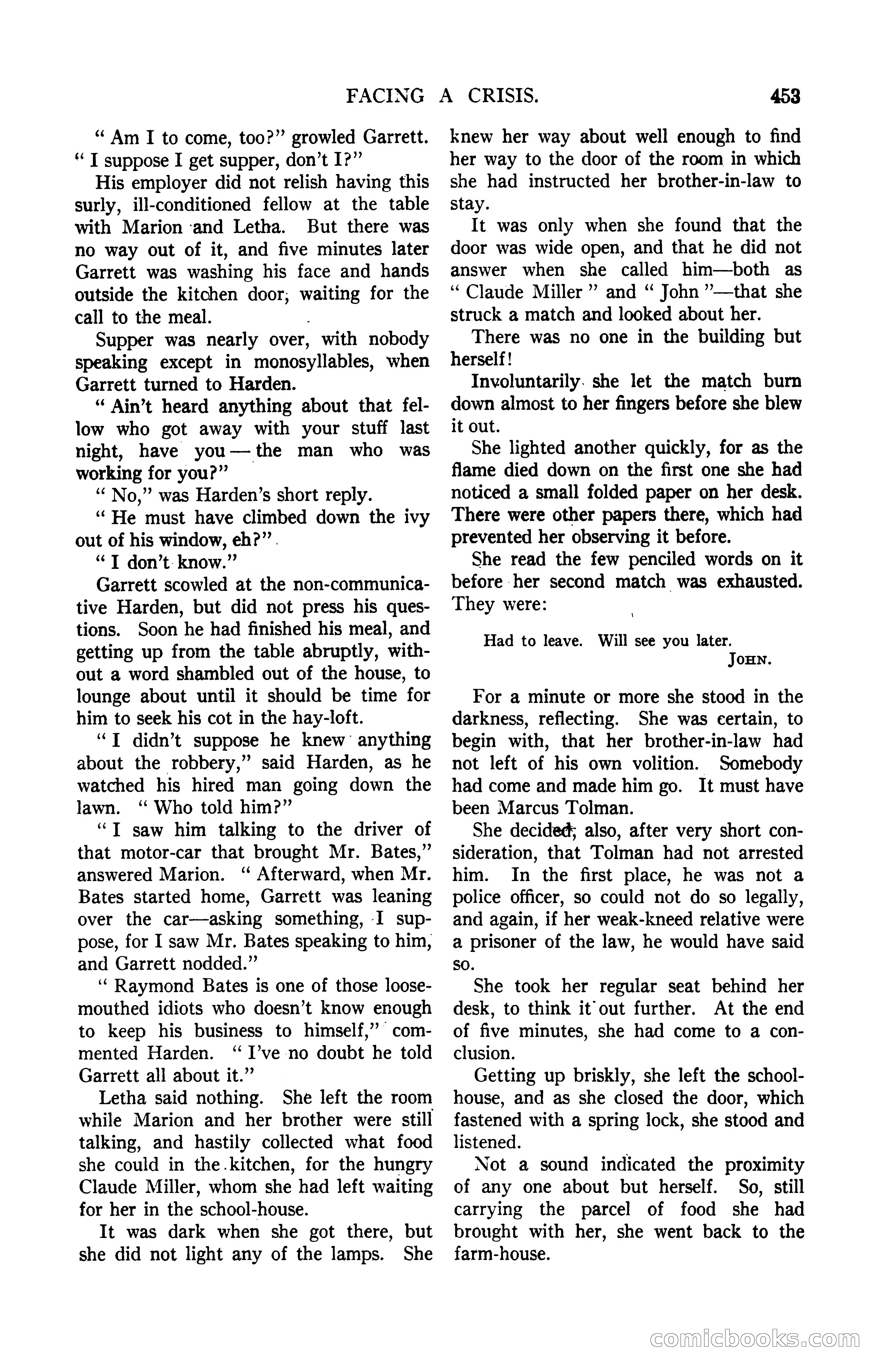
A restored page from Pulp Fiction, 1917. Page through the whole issue in the reader above.
📄 Transcribed text from this page (OCR, searchable)
Machine-transcribed from the original scan — historical spelling and the odd misread are preserved.
FACING “Am I to come, too?” growled Garrett. ‘‘ T suppose I get supper, don’t I?” His employer did not relish having this surly, ill-conditioned fellow at the table with Marion ‘and Letha. But there was no way out of it, and five minutes later Garrett was washing his face and hands outside the kitchen door, waiting for the call to the meal. . Supper was nearly over, with nobody speaking except in monosyllables, when Garrett turned to Harden. “ Ain’t heard anything about that fel- low who got away with your stuff last night, have you— the man who was working for your” ‘“‘ No,” was Harden’s short reply. ‘“He must have climbed down the ivy out of his window, eh?’’. “T don’t: know.” Garrett scowled at the non-communica- tive Harden, but did not press his ques- tions. Soon he had finished his meal, and getting up from the table abruptly, with- out a word shambled out of the house, to lounge about until it should be time for him to seek his cot in the hay-loft. “TI didn’t suppose he knew anything about the robbery,” said Harden, as he watched his hired man going down the lawn. ‘“ Who told him?” “T saw him talking to the driver of that motor-car that brought Mr. Bates,” answered Marion. ‘‘ Afterward, when Mr. Bates started home, Garrett was leaning over the car—asking something, I sup- pose, for I saw Mr. Bates speaking to him, and Garrett nodded.” ‘““Raymond Bates is one of those loose- mouthed idiots who doesn’t know enough to keep his business to himself,” com- mented Harden. ‘I’ve no doubt he told Garrett all about it.” Letha said nothing. She left the room while Marion and her brother were still talking, and hastily collected what food she could in the.kitchen, for the hungry Claude Miller, whom she had left waiting for her in the school-house. It was dark when she got there, but she did not light any of the lamps. She A CRISIS. 453 knew her way about well enough to find her way to the door of the room in which she had instructed her brother-in-law to stay. It was only when she found that the door was wide open, and that he did not answer when she called him—both as ‘Claude Miller” and “ John ”—that she struck a match and looked about her. There was no one in the building but herself! Involuntarily. she let the match bum down almost to her fingers before she blew it out. She lighted another quickly, for as the flame died down on the first one she had noticed a small folded paper on her desk. There were other papers there, which had prevented her observing it before. She read the few penciled words on it before -her second match was exhausted. They were: Had to leave. Will see you later. JouHNn. For a minute or more she stood in the darkness, reflecting. She was certain, to begin with, that her brother-in-law had not left of his own volition. Somebody had come and made him go. It must have been Marcus Tolman. She decided also, after very short con- sideration, that Tolman had not arrested him. In the first place, he was not a police officer, so could not do so legally, and again, if her weak-kneed relative were a prisoner of the law, he would have said SO. She took her regular seat behind her desk, to think it out further. At the end of five minutes, she had come to a con- clusion. Getting up briskly, she left the school- house, and as she closed the door, which fastened with a spring lock, she stood and listened. Not a sound indicated the proximity of any one about but herself. So, still carrying the parcel of food she had brought with her, she went back to the farm-house. comicloool C©