
Pulp Fiction, 1916 · page 99 of 220
The Argosy, April 1916 — page 99: what you’re looking at
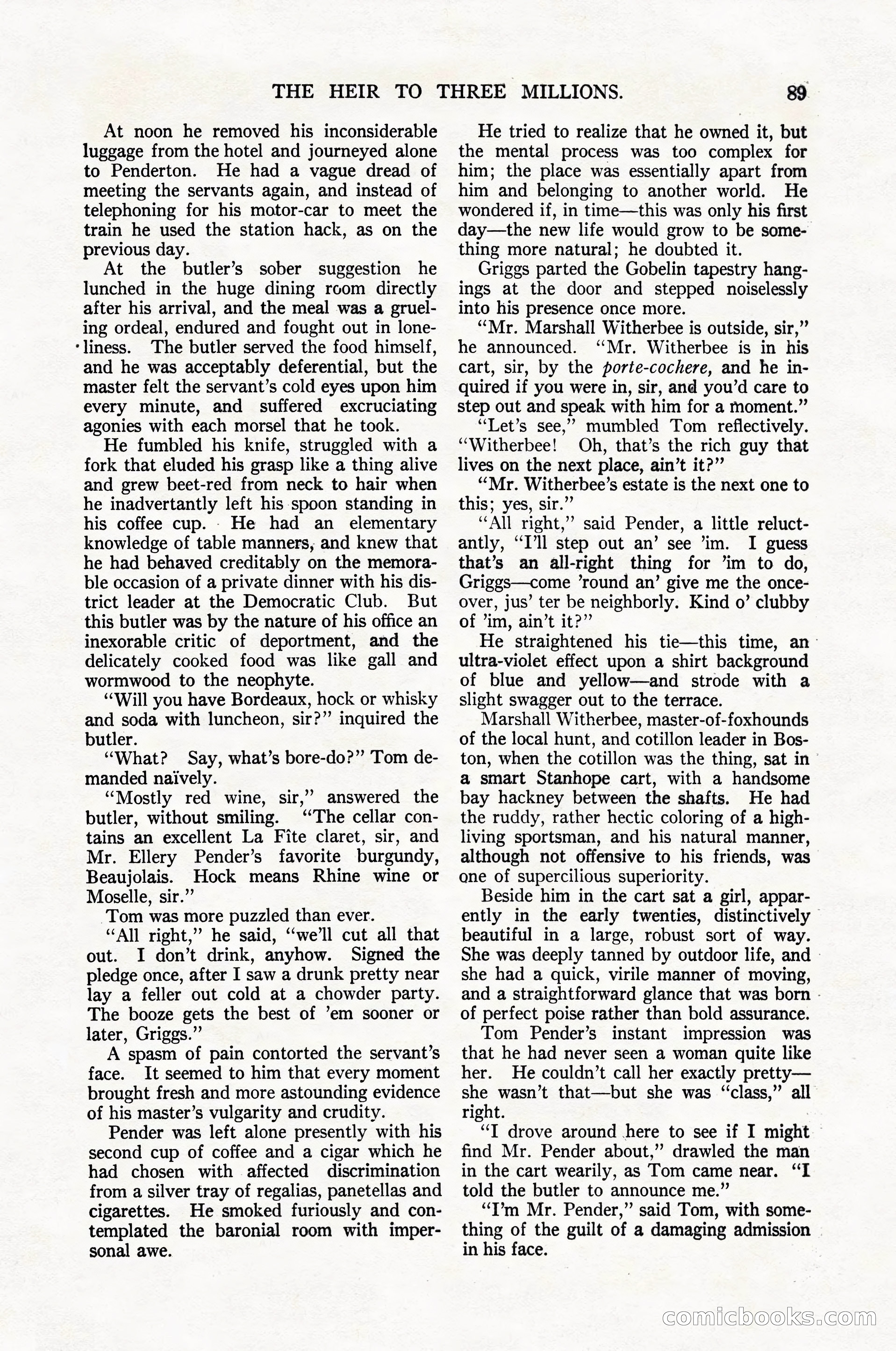
A restored page from Pulp Fiction, 1916. Page through the whole issue in the reader above.
📄 Transcribed text from this page (OCR, searchable)
Machine-transcribed from the original scan — historical spelling and the odd misread are preserved.
THE HEIR TO THREE MILLIONS. At noon he removed his inconsiderable luggage from the hotel and journeyed alone to Penderton. He had a vague dread of meeting the servants again, and instead of telephoning for his motor-car to meet the train he used the station hack, as on the previous day. At the butler’s sober suggestion he lunched in the huge dining room directly after his arrival, and the meal was a gruel- ing ordeal, endured and fought out in lone- ‘liness. The butler served the food himself, and he was acceptably deferential, but the master felt the servant’s cold eyes upon him every minute, and suffered excruciating agonies with each morsel that he took. He fumbled his knife, struggled with a fork that eluded his grasp like a thing alive and grew beet-red from neck to hair when he inadvertantly left his spoon standing in his coffee cup. - He had an elementary knowledge of table manners, and knew that he had behaved creditably on the memora- ble occasion of a private dinner with his dis- trict leader at the Democratic Club. But this butler was by the nature of his office an inexorable critic of deportment, and the delicately cooked food was like gall and wormwood to the neophyte. ‘Will you have Bordeaux, hock or whisky and soda with luncheon, sir?” inquired the butler. “What? Say, what’s bore-do?” Tom de- manded naively. “Mostly red wine, sir,” answered the butler, without smiling. “The cellar con- tains an excellent La Fite claret, sir, and Mr. Ellery Pender’s favorite burgundy, Beaujolais. Hock means Rhine wine or Moselle, sir.” Tom was more puzzled than ever. ‘All right,” he said, ‘we'll cut all that out. I don’t drink, anyhow. Signed the pledge once, after I saw a drunk pretty near lay a feller out cold at a chowder party. The booze gets the best of ’em sooner or later, Griggs.” A spasm of pain contorted the servant’s face. It seemed to him that every moment brought fresh and more astounding evidence of his master’s vulgarity and crudity. Pender was left alone presently with his second cup of coffee and a cigar which he had chosen with affected discrimination from a silver tray of regalias, panetellas and cigarettes. He smoked furiously and con- templated the baronial room with imper- sonal awe. 89 He tried to realize that he owned it, but the mental process was too complex for him; the place was essentially apart from him and belonging to another world. He wondered if, in time—this was only his first day—the new life would grow to be some- thing more natural; he doubted it. Griggs parted the Gobelin tapestry hang- ings at the door and stepped noiselessly into his presence once more. “Mr. Marshall Witherbee is outside, sir,” he announced. ‘‘Mr. Witherbee is in his cart, sir, by the porte-cochere, and he in- quired if you were in, sir, and you’d care to step out and speak with him for a moment.” ‘““Let’s see,” mumbled Tom reflectively. ‘“Witherbee! Oh, that’s the rich guy that lives on the next place, ain’t it?”’ “Mr. Witherbee’s estate is the next one to this; yes, sir.” ‘All right,” said Pender, a little reluct- antly, “I’ll step out an’ see ’im. I guess that’s an all-right thing for ’im to do, Griggs—come ’round an’ give me the once- over, jus’ ter be neighborly. Kind o’ clubby of ’im, ain’t it?” He straightened his tie—this time, an ultra-violet effect upon a shirt background of blue and yellow—and strode with a slight swagger out to the terrace. Marshall Witherbee, master-of-foxhounds of the local hunt, and cotillon leader in Bos- ton, when the cotillon was the thing, sat in a smart Stanhope cart, with a handsome bay hackney between the shafts. He had the ruddy, rather hectic coloring of a high- living sportsman, and his natural manner, although not offensive to his friends, was one of supercilious superiority. Beside him in the cart sat a girl, appar- ently in the early twenties, distinctively beautiful in a large, robust sort of way. She was deeply tanned by outdoor life, and - she had a quick, virile manner of moving, and a straightforward glance that was born - of perfect poise rather than bold assurance. Tom Pender’s instant impression was that he had never seen a woman quite like her. He couldn’t call her exactly pretty— she wasn’t that—but she was ‘‘class,”’ all right. “YT drove around here to see if I might find Mr. Pender about,” drawled the man in the cart wearily, as Tom came near. “I told the butler to announce me.” “I’m Mr. Pender,” said Tom, with some- thing of the guilt of a damaging admission in his face. MICLOOOK C@