
Pulp Fiction, 1916 · page 92 of 220
The Argosy, April 1916 — page 92: what you’re looking at
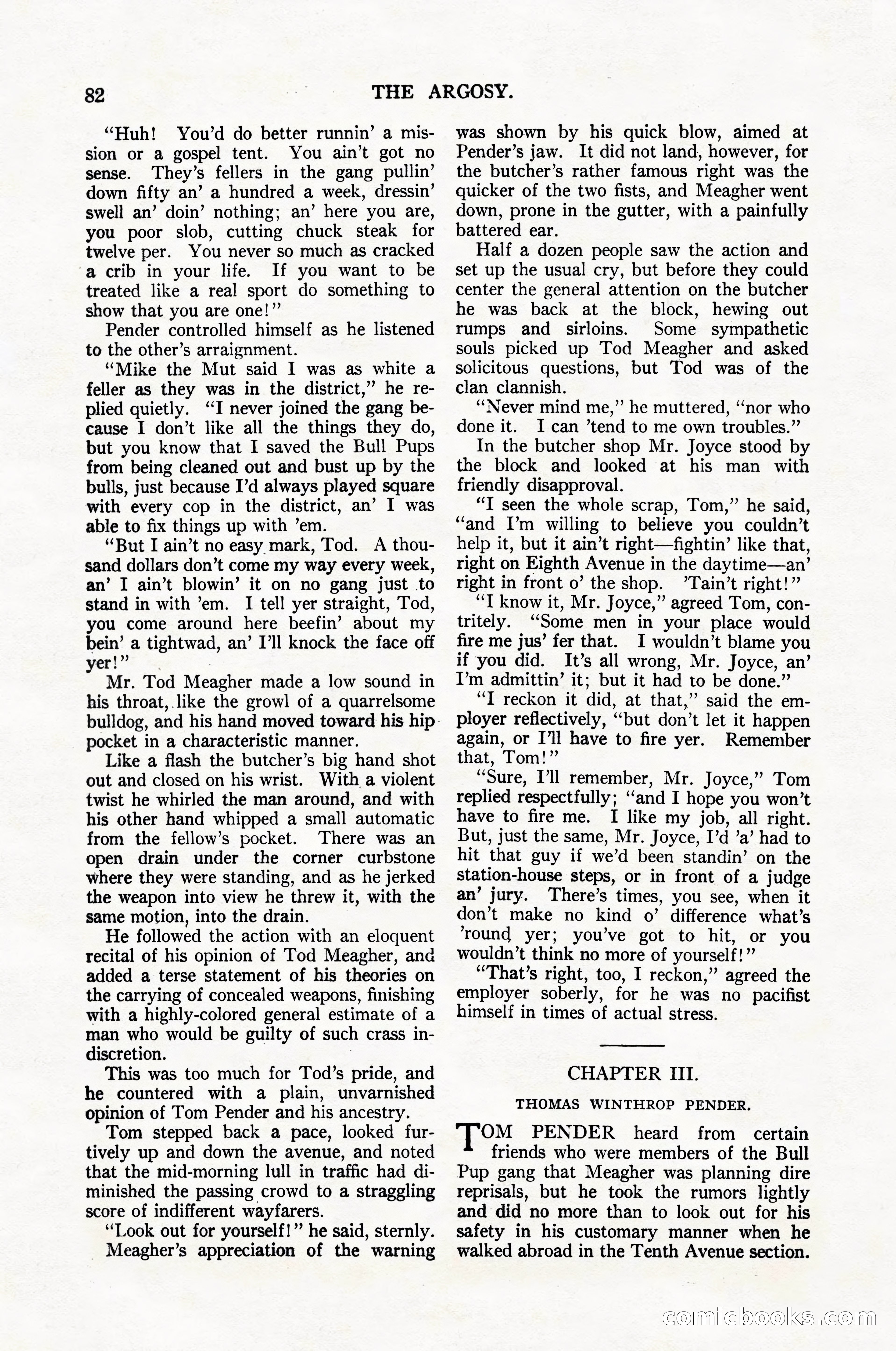
A restored page from Pulp Fiction, 1916. Page through the whole issue in the reader above.
📄 Transcribed text from this page (OCR, searchable)
Machine-transcribed from the original scan — historical spelling and the odd misread are preserved.
82 “Huh! You’d do better runnin’ a mis- sion or a gospel tent. You ain’t got no sense. They’s fellers in the gang pullin’ down fifty an’ a hundred a week, dressin’ swell an’ doin’ nothing; an’ here you are, you poor slob, cutting chuck steak for twelve per. You never so much as cracked ‘a crib in your life. If you want to be treated like a real sport do something to show that you are one!”’ Pender controlled himself as he listened to the other’s arraignment. “Mike the Mut said I was as white a feller as they was in the district,” he re- plied quietly. “I never joined the gang be- cause I don’t like all the things they do, but you know that I saved the Bull Pups from being cleaned out and bust up by the bulls, just because I’d always played square with every cop in the district, an’ I was able to fix things up with ’em. “But I ain’t no easy mark, Tod. A thou- sand dollars don’t come my way every week, an’ I ain’t blowin’ it on no gang just to stand in with ’em. I tell yer straight, Tod, you come around here beefin’ about my bein’ a tightwad, an’ I’ll knock the face off =. & ) . Mr. Tod Meagher made a low sound in his throat, like the growl of a quarrelsome bulldog, and his hand moved toward his hip. pocket in a characteristic manner. Like a flash the butcher’s big hand shot out and closed on his wrist. With a violent twist he whirled the man around, and with his other hand whipped a small automatic from the fellow’s pocket. There was an open drain under the corner curbstone where they were standing, and as he jerked the weapon into view he threw it, with the same motion, into the drain. He followed the action with an eloquent recital of his opinion of Tod Meagher, and added a terse statement of his theories on the carrying of concealed weapons, finishing with a highly-colored general estimate of a man who would be guilty of such crass in- discretion. , This was too much for Tod’s pride, and he countered with a plain, unvarnished opinion of Tom Pender and his ancestry. Tom stepped back a pace, looked fur- tively up and down the avenue, and noted that the mid-morning lull in traffic had di- minished the passing crowd to a straggling score of indifferent wayfarers. ‘Look out for yourself!” he said, sternly. Meagher’s appreciation of the warning THE ARGOSY. was shown by his quick blow, aimed at Pender’s jaw. It did not land, however, for the butcher’s rather famous right was the quicker of the two fists, and Meagher went down, prone in the gutter, with a painfully battered ear. Half a dozen people saw the action and set up the usual cry, but before they could center the general attention on the butcher he was back at the block, hewing out rumps and sirloins. Some sympathetic souls picked up Tod Meagher and asked solicitous questions, but Tod was of the clan clannish. “Never mind me,” he muttered, ‘‘nor who done it. I can ’tend to me own troubles.”’ In the butcher shop Mr. Joyce stood by the block and looked at his man with friendly disapproval. “I seen the whole scrap, Tom,” he said, “and I’m willing to believe you couldn’t help it, but it ain’t right—fightin’ like that, right on Eighth Avenue in the daytime—an’ right in front o’ the shop. ’Tain’t right!” “T know it, Mr. Joyce,” agreed Tom, con- tritely. ‘Some men in your place would fire me jus’ fer that. I wouldn’t blame you if you did. It’s all wrong, Mr. Joyce, an’ I’m admittin’ it; but it had to be done.” “T reckon it did, at that,” said the em- ployer reflectively, ‘“‘but don’t let it happen again, or I’ll have to fire yer. Remember that, Tom!” “Sure, I'll remember, Mr. Joyce,” Tom replied respectfully; “and I hope you won’t have to fire me. I like my job, all right. But, just the same, Mr. Joyce, I’d ’a’ had to hit that guy if we’d been standin’ on the Station-house steps, or in front of a judge an’ jury. There’s times, you see, when it don’t make no kind o’ difference what’s ‘round yer; you’ve got to hit, or you wouldn’t think no more of yourself!” “That’s right, too, I reckon,” agreed the employer soberly, for he was no pacifist himself in times of actual stress. CHAPTER III. THOMAS WINTHROP PENDER. ‘TOM PENDER heard from certain friends who were members of the Bull Pup gang that Meagher was planning dire reprisals, but he took the rumors lightly and did no more than to look out for his safety in his customary manner when he walked abroad in the Tenth Avenue section. COmiclboo SS C@