
Pulp Fiction, 1916 · page 89 of 220
The Argosy, April 1916 — page 89: what you’re looking at
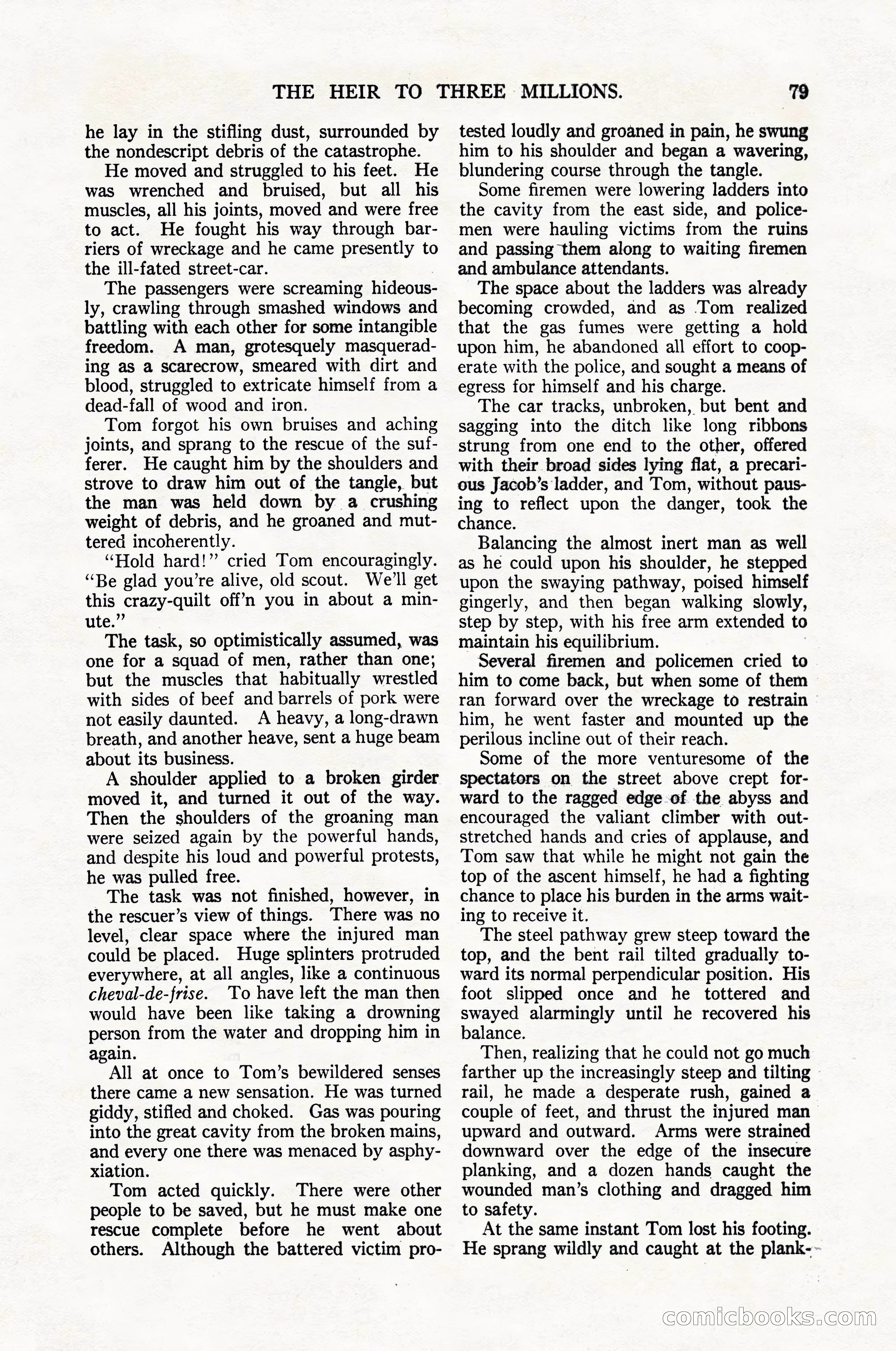
A restored page from Pulp Fiction, 1916. Page through the whole issue in the reader above.
📄 Transcribed text from this page (OCR, searchable)
Machine-transcribed from the original scan — historical spelling and the odd misread are preserved.
THE HEIR TO THREE MILLIONS. he lay in the stifling dust, surrounded by the nondescript debris of the catastrophe. He moved and struggled to his feet. He was wrenched and bruised, but all his muscles, all his joints, moved and were free to act. He fought his way through bar- riers of wreckage and he came presently to the ill-fated street-car. The passengers were screaming hideous- ly, crawling through smashed windows and battling with each other for some intangible freedom. A man, grotesquely masquerad- ing as a scarecrow, smeared with dirt and blood, struggled to extricate himself from a dead-fall of wood and iron. Tom forgot his own bruises and aching joints, and sprang to the rescue of the suf- ferer. He caught him by the shoulders and strove to draw him out of the tangle, but the man was held down by a crushing weight of debris, and he groaned and mut- tered incoherently. “Hold hard!” cried Tom encouragingly. “Be glad youre alive, old scout. We'll get this crazy-quilt off’n you in about a min- ute.” The task, so optimistically assumed, was one for a squad of men, rather than one; but the muscles that habitually wrestled with sides of beef and barrels of pork were not easily daunted. A heavy, a long-drawn breath, and another heave, sent a huge beam about its business. A shoulder applied to a broken girder moved it, and turned it out of the way. Then the shoulders of the groaning man were seized again by the powerful hands, and despite his loud and powerful protests, he was pulled free. The task was not finished, however, in the rescuer’s view of things. There was no level, clear space where the injured man could be placed. Huge splinters protruded everywhere, at all angles, like a continuous cheval-de-frise. To have left the man then would have been like taking a drowning person from the water and dropping him in again. All at once to Tom’s bewildered senses there came a new sensation. He was turned giddy, stifled and choked. Gas was pouring into the great cavity from the broken mains, and every one there was menaced by asphy- xiation. Tom acted quickly. There were other people to be saved, but he must make one rescue complete before he went about others. Although the battered victim pro- at tested loudly and groaned in pain, he swung him to his shoulder and began a wavering, blundering course through the tangle. Some firemen were lowering ladders into the cavity from the east side, and police- men were hauling victims from the ruins and passing them along to waiting firemen and ambulance attendants. The space about the ladders was already becoming crowded, and as Tom realized that the gas fumes were getting a hold upon him, he abandoned all effort to coop- erate with the police, and sought a means of egress for himself and his charge. The car tracks, unbroken, but bent and sagging into the ditch like long ribbons strung from one end to the other, offered with their broad sides lying flat, a precari- ous Jacob’s ladder, and Tom, without paus- ing to reflect upon the danger, took the chance. Balancing the almost inert man as well as he could upon his shoulder, he stepped upon the swaying pathway, poised himself gingerly, and then began walking slowly, step by step, with his free arm extended to maintain his equilibrium. Several firemen and policemen cried to him to come back, but when some of them ran forward over the wreckage to restrain him, he went faster and mounted up the perilous incline out of their reach. Some of the more venturesome of the spectators on the street above crept for- ward to the ragged edge of the abyss and encouraged the valiant climber with out- stretched hands and cries of applause, and Tom saw that while he might not gain the top of the ascent himself, he had a fighting chance to place his burden in the arms wait- ing to receive it. The steel pathway grew steep toward the top, and the bent rail tilted gradually to- ward its normal perpendicular position. His foot slipped once and he tottered and swayed alarmingly until he recovered his balance. Then, realizing that he could not go much farther up the increasingly steep and tilting rail, he made a desperate rush, gained a couple of feet, and thrust the injured man upward and outward. Arms were strained downward over the edge of the insecure planking, and a dozen hands caught the wounded man’s clothing and dragged him to safety. At the same instant Tom lost his footing. He sprang wildly and caught at the plank- COmiclboo® cS C@